
The Storyline
Real families. Real discoveries. Real stories.
Three Generations of Shrinking and Expanding
Kate Hamall bore six children in Chicago and buried four of them across 1892 and 1893. Two generations later her great-grandson Thomas Kenny was the only person alive carrying that line forward — one boy of six, in a household that had just come apart. His cousins Edward and Emmett Holland both lived to eighty-nine and had no children, so that branch ended quietly in the 1990s with nobody left to tell. Then in 1957 Thomas Kenny married Barbara Ann O'Brien, and they had six children: the number Kate started with, eighty years on.
Part of the Storyline Genealogy Series: From Research to Story
The Father Who Tried
His bank closed fifteen weeks after the wedding and took his career with it; he was forty-nine before he found the work he would be known for. Three contacts with his son are documented across twenty years — a trip to Washington in 1947, a letter to a young woman he had never met, and a thousand-mile journey to be in the wedding photographs on his own birthday. His son said in later life that he felt estranged from him, and kept his watch, and wore it to all five of his daughters' weddings. This page sets those beside each other without deciding between them.
Part of the Storyline Genealogy Case Studies Series: From Research to Story
Mothers and Sons: A Working-Class Family Pattern
Kate kept house with Thomas Henry from 1911 until she died in 1919. Emma was with Thomas Eugene, on and off, for the best part of twenty years. Margaret joined Thomas Kenny's household for the last stretch of her life. Read through a modern lens the repetition looks like a family trait; read through the household accounts it looks like arithmetic — no pensions, no Social Security until 1935, and women earning half a man's wage for the same work. Margaret is the proof of it: she followed the family north, took an apartment of her own in New Jersey, and was still keeping books at sixty. She moved in only when she could no longer pay for a front door of her own.
Part of the Storyline Genealogy Case Studies Series: From Research to Story
The Mystery Man: Photo Analysis
In a 1947 photograph, two men sit together at the US Capitol—one is Thomas Eugene Hamall, age 42. The other remained unidentified for 75 years. Through forensic photo analysis, family tree reconstruction, and a 1968 high school yearbook, we found the man the evidence points to—and uncovered a poignant story about family connections maintained across three fractured generations.
Part of the Storyline Genealogy series: From Research to Story
They Were Never Photographed Together
Three sets of photographs, three claims to test, and three different answers. Two men in formal dress at the same Riverside bridge in the year one of them married there. A dog on a lawn chair at a cottage, in two frames taken the same season. A father and a son at the same Capitol balustrade in 1947. One case holds, one fails at the last step, and one is settled as to the event but open as to the journey — and saying which is which is the whole method. A shared element can put two photographs in one place. It cannot put a person there.
Part of the Storyline Genealogy Series: From Research to Story

The Property War
Four years of litigation, two courts and an appeal to the Supreme Court of Illinois — over a cottage measuring twenty-four feet by twenty-four. Read from the decision itself rather than from family memory, the case turns out to run the other way round: Thomas Hamall was the one who sued, his former wife was the one who appealed, and the court expressly declined to decide the point of law the family has long believed it settled.
Part of the Storyline Genealogy series: Uncovering the human stories behind legal history, one family at a time.

The Missing Brother Mystery
Sometimes the most puzzling genealogical mysteries hide in plain sight. One census entry proved particularly haunting: 'Thornton Hammil' listed as Owen Hamall's brother in 1880 Chicago—but no such person seemed to exist anywhere else in the historical record. The breakthrough came where it often does in immigrant family research: in the margins of church records, where community relationships revealed themselves through acts of faith and mutual support.
Part of the Storyline Genealogy series: When mysterious census entries unlock complex family stories that span continents and generations
The Fire in Your Blood
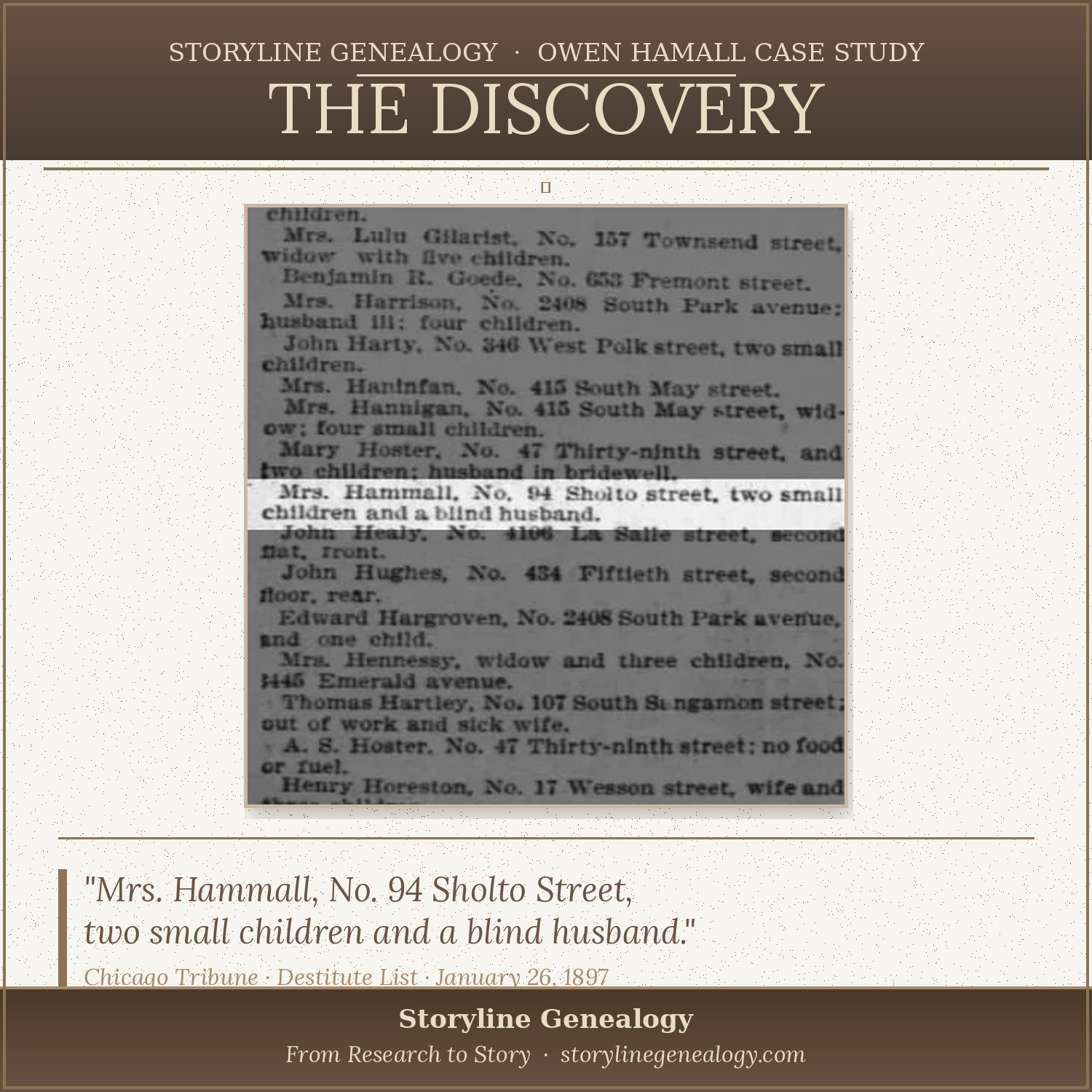
When Owen Hamall died of meningitis in 1898, he left behind more than just a grieving family—he left behind a story of resilience that would echo through generations. This story was discovered not through grand family legends, but through a single newspaper clipping that reduced his family's struggle to twenty-three stark words: "Mrs. Hammall, 94 Sholto Street, two small children and a blind husband."
This entry in the Chicago Tribune's "Destitute List" from January 26, 1897, could have been just another piece of historical data. Instead, it became the foundation for understanding what it truly meant to be a Hamall descendant—and why some family stories deserve to be told as letters of strength to future generations.
Part of the Storyline Genealogy series: When family tragedies become letters of strength to future generations.