
520 Livres for a Murdered Husband
One month after a Marine officer ran her husband through with a sword and fled, Marie Lorgueil signed away the family's right to sue him — for 520 livres, cash in hand. Read correctly, the deed that looks like surrender is the clearest surviving evidence of a colonial widow’s legal standing.

The Challenge
On 13 September 1690, Dumont de Blaignac, a lieutenant in the colonial Marine forces, killed Toussaint Hunault with a sword in the Montréal area and fled. Marie Lorgueil was left a widow near sixty, responsible for the couple’s minor children, and already carrying debt. The question the record forces is not whether justice was done — it plainly was not — but what legal moves were actually open to a woman in her position.
The pillar this case study anchors — women and legal agency in New France — turns on a hard question: did a widow’s legal capacity mean anything when the odds were this lopsided? Marie’s deed is where that question meets a document, not a generality.

The Breakthrough
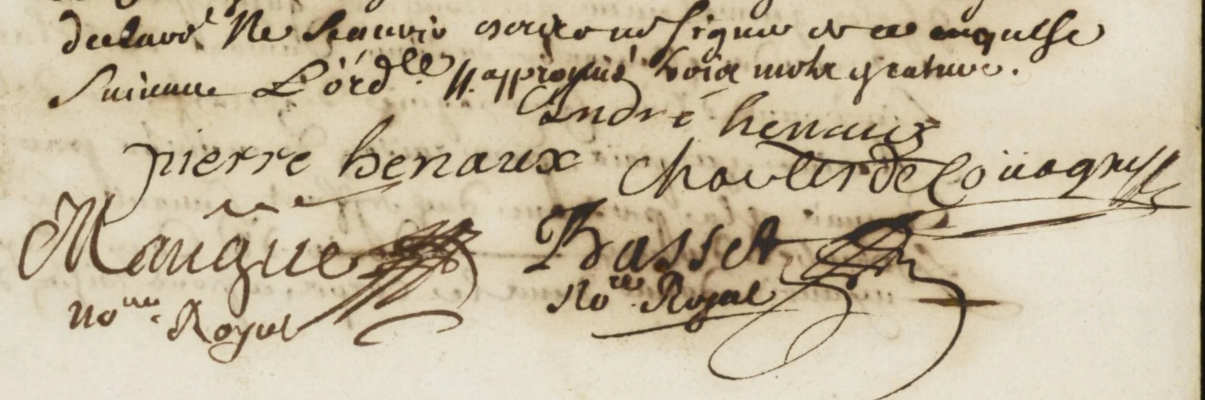
The central document is a cession et transport de droits drawn by notary Bénigne Basset. In it, Marie Lorgueil — answering in her own name (se faisant fort) for her minor children — together with her adult sons André and Pierre Hunault, transfers to the merchant Charles de Couagne every right and action the family could raise against the officer, in return for 520 livres paid on the spot.
“…pour raison du meurtre par luy commis en la personne dudit défunt Hunault… de coups d’espée qu’il luy auroit donné dans le corps…”
…by reason of the murder he committed on the person of the late Hunault… by sword-blows he had given him in the body…
Cession, Act 2064 · Greffe Basset · 10 October 1690 Confirmed
What the transfer proves is subtle but decisive. The notary records Marie ceding, transporting, and quitting the claim — the legal verbs of an owner disposing of property. To sell the right to sue, she had first to hold that right and be recognized as competent to alienate it. The deed names her cedent alongside her son, not represented by him.
“…se faisant fort pour les enfants mineurs dudit défunt et d’elle… cède, transporte et quitte audit sieur de Couagne…”
…as guardian for the minor children of the said deceased and of herself… cedes, transfers and quits to the said sieur de Couagne…
Cession, Act 2064 · fol. [img 253] Proven
An earlier version of this research placed this 'widow's settlement' in 1691 , after a suit was filed. The act itself, its dorse (“du 10 octobre 1690”), and the archival foliation all read October 1690 — under a month after the murder. And it is not a settlement of a pending suit but a cession of the right to sue, coupled with a power of attorney to Couagne to pursue it. Marie did not litigate and then sell; she sold the litigation. Couagne re-conveyed the concession to Jacques Talebot, former Marine soldier, the same day, for 720 livres.
reconstructed / inferred · stated in a dated record
The Result
The deed yields a three-part arc — a loss, a transfer, and a life that continued — each fixed to a dated document rather than to the drama of a courtroom that never convened.
A sword, and a claim
- Toussaint killed 13 Sep 1690; the officer flees
- Marie answers (se fait fort) for the minor children
- A right to damages arises — valuable only if enforceable
Selling the right to sue
- 10 Oct 1690: cession to Couagne for 520 livres, cash
- Couagne granted power of attorney to pursue Blaignac
- Couagne had been the family's creditor since 1688
Survival, on the record
- Marie lives with son André at Varennes
- Dies 29 Nov 1700, near age 66, among family
- The 307-livre debt to son André no longer pressed on her; the Couagne debt was settled separately, in 1691, with the land
The transaction is easy to read as defeat — and as justice, it was. But as evidence of agency, it proves the opposite of helplessness. Under the Custom of Paris a widow could act in her own name, serve as guardian, and alienate property. Marie does all three in one instrument: she is named, she answers (se fait fort) for her minor children, and she disposes of a legal asset for a negotiated price.
A woman without legal standing has nothing to sell — her claim would pass through a male representative. Marie’s name on a cession of the very right to sue a nobleman is not a footnote to her powerlessness; it is the documentary proof that colonial law recognized her capacity, even as colonial power ensured she could not use it to win.
The document that looks like a widow giving up is the one place the law wrote down that she had something to give. Read with discipline, a deed of surrender becomes a deed of standing.
Go Deeper
This case study extracts one focused proof-argument — a widow’s legal standing, read from a single deed — from a much larger life. The full narrative, with the murder, the mourning, and the decade that followed, lives in the documentary biography series.
Marie’s deed proves her own standing. The next chapter shows what that standing became: two generations of one family turning to the colonial courts again and again — her sons Pierre and Toussaint, her daughters Jeanne and Françoise, and the cases that followed.
A Family in Court →