
Resolving Conflicting Age Evidence
A ten-year discrepancy in the birth year of a seventeenth-century Fille à marier — one age makes her a child bride at thirteen, the other a young woman of twenty-three — resolved through systematic comparison of primary sources and application of hierarchical source evaluation principles.
The Challenge
Gillette Banne appears in genealogical databases with a birth year of "c. 1636" or "Around 1636." This date, accepted by PRDH-IGD (#7116) and Genealogy Quebec, yields a dramatic biographical narrative: a girl of thirteen shipped across the Atlantic, married immediately upon arrival, widowed at fifteen with an infant daughter, and executed at thirty-six for killing the man who beat her daughter bloody.
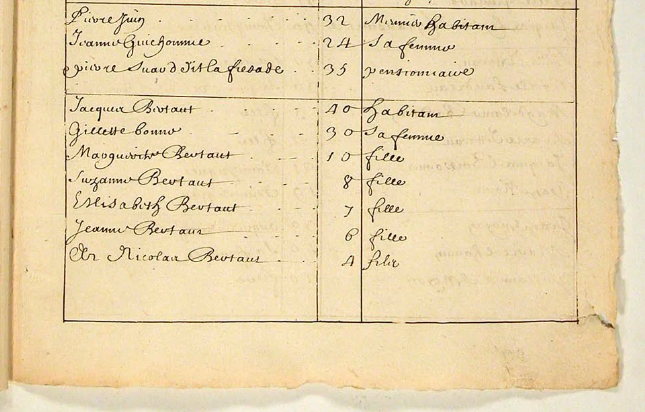
But a single source underlies this chronology: the 1666 census of New France, which records her age as 30 in the household of Jacques Bertault at Trois-Rivières.
The Conflicting Sources
Three primary contemporaneous sources record Gillette Banne's age. They do not agree.
| Source | Date | Age | Birth |
|---|---|---|---|
| 1664 Confirmation | 22 May 1664 | 38 | c. 1626 |
| 1666 Census | 1666 | 30 | c. 1636 |
| 1672 Trial | June 1672 | ~45 | c. 1627 |
The discrepancy is not subtle. The 1666 census gives an age incompatible with both the 1664 confirmation and the 1672 trial record. She cannot have been 38 in May 1664 and 30 two years later in 1666.
The Database Propagation
Text: "Gillette Banne was born about 1636 in Argences..." The authoritative published monograph on the Filles à marier follows the census-based date without noting the conflicting confirmation evidence.
Birth: "Around 1636, Argences, diocese of Bayeux, Normandy." Source basis not stated in public-facing record. Follows the 1666 census.
Birth date: "1636" without qualification. Father: Marin Banne. Mother: Isabelle Boyre. Follows the 1666 census.
Birth: "born about 1626 (conf. 1664)." Explicitly cites the confirmation register as the source basis. This is the only major database to use the confirmation evidence.
The challenge is clear: three major sources — a published monograph and two genealogical databases — have propagated a birth year derived from a single census record, without cross-referencing against the confirmation register or trial record that contradict it. The narrative of a thirteen-year-old child bride rests on uncritical acceptance of the census age.
The Breakthrough
The resolution turns on a principle fundamental to the Genealogical Proof Standard: not all primary sources are created equal. When primary sources conflict, the researcher must evaluate each source's proximity to the event, the circumstances of its creation, and the likelihood of error in each recording context.
Source Analysis: The 1664 Confirmation
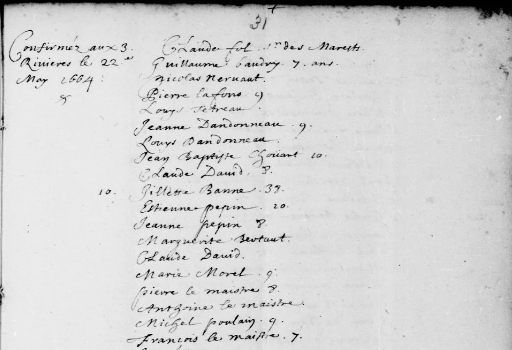
Primary The confirmation register of Trois-Rivières, dated 22 May 1664, records: "Gillette Banne . 38"
Recording Context
- Sacramental record created by the parish priest
- Age typically stated by the confirmand herself
- Recorded in conjunction with a religious rite requiring the individual's presence
- Part of a numbered list with sequential entries
The confirmation register is a first-person attestation in a sacramental context. Gillette stated her own age to the priest. The age recorded (38) implies birth c. 1626.
Source Analysis: The 1672 Trial
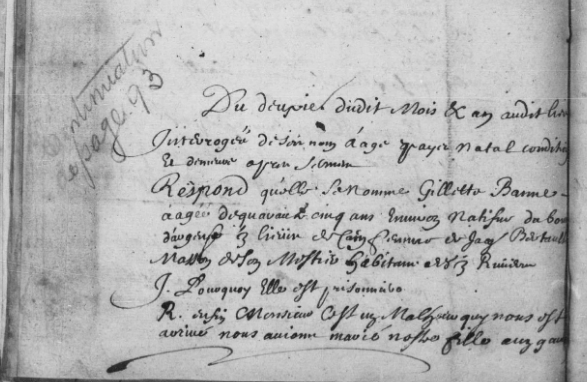
Primary The criminal trial record (BAnQ ID 398771, verso of fol. 100) contains the opening of the first interrogation of Gillette Banne, dated June 2, 1672. The leaf is an unstamped verso of fol. 100; its marginal note, "continuation page 93," carries the interrogation forward to fol. 93. Under oath, she states:
"Respond qu'elle se nomme Gillette Banne aagée de quarante cinq ans Environ, Natifve du bourg d'Argences à 3 lieües de la Ville de Caën femme de Jacques Bertault Masson de son Mestier Habitant a Troÿ Rivieres"
[Responds that she is named Gillette Banne, aged approximately forty-five years, native of the town of Argences, three leagues from the city of Caen, wife of Jacques Bertault, mason by his trade, inhabitant of Trois-Rivières]
Recording Context
- Legal proceeding before the Prévôté de Québec
- Age stated by Gillette herself under judicial examination
- Recorded by the court scribe as part of formal interrogation
- Includes birthplace identification consistent with other records
- Standard formulaic opening: name, age, birthplace, condition, residence
The trial record is a sworn legal attestation. Gillette stated her own age (~45) under judicial examination on June 2, 1672. The age recorded implies birth c. 1627, aligning closely with the 1664 confirmation.
Source Analysis: The 1666 Census
Secondary The 1666 census of New France records Gillette as age 30 in the household of Jacques Bertault.
Recording Context
- Crown administrative enumeration
- Ages frequently estimated by enumerator, not stated by subject
- Household head often provided ages for all members
- Known for systematic age-rounding and estimation errors
- Internal inconsistency: incompatible with 1664 record two years prior
Colonial census records are notoriously unreliable for precise ages. Enumerators routinely estimated ages by appearance, rounded to convenient numbers, or accepted the household head's approximations. The 1666 census age of 30 is internally inconsistent with the 1664 confirmation age of 38 — a logical impossibility that flags the census as the erroneous source.
The Convergence
Two independent primary sources — the 1664 confirmation and the 1672 trial — converge on a birth year of c. 1626–1627. Both record ages stated by Gillette herself in formal contexts (sacramental and judicial). The 1666 census stands alone with an age that creates an internal contradiction with the confirmation record just two years prior.
The Result
Confirmed Gillette Banne was born c. 1626 in Argences, Normandy — not c. 1636. The corrected birth year is established by convergence of the 1664 confirmation register and the 1672 trial record, both containing ages stated by Gillette herself, against an internally inconsistent census enumeration.
The Corrected Chronology
| Event | Date | Corrected Age |
|---|---|---|
| Birth | c. 1626 | — |
| Emigration to New France | c. 1649 | ~23 |
| Marriage to Marin Chauvin | Before 1650 | ~23–24 |
| Birth of Marie Chauvin | 8 Sept 1650 | ~24 |
| Widowhood | 7 June 1651 | ~25 |
| Marriage to Jacques Bertault | 27 July 1653 | ~27 |
| Confirmation | 22 May 1664 | 38 (stated) |
| Execution | 9 June 1672 | ~46 |
The Revised Narrative
The corrected chronology fundamentally changes the biographical narrative. Gillette Banne was not a child of thirteen shipped across the Atlantic and married immediately upon arrival. She was a young woman in her early twenties who emigrated as a fille à marier, married a man close to her own age (Marin Chauvin was ~24), and was widowed at twenty-five — not fifteen.
The correction reaches her second marriage as well. Jacques Bertault gave his own age under oath in 1672 as about fifty, implying a birth year near 1622. On the corrected reading he was roughly four years Gillette's senior, not the decade older that the c. 1636 birth year had implied.
The story remains remarkable and tragic. But it is now grounded in evidence rather than perpetuated error.
Database and Publication Implications
- Gagne (2002): Birth year "about 1636" requires correction to c. 1626
- PRDH-IGD: Birth year "Around 1636" requires correction to c. 1626
- Genealogy Quebec: Birth year "1636" requires correction to c. 1626
- Denis Beauregard: Correctly uses "born about 1626 (conf. 1664)"
- Trudel Catalogue: Age 18 at arrival (based on 1636 birth) requires recalculation to ~23
Methodological Takeaway
This case demonstrates a broader principle: when databases propagate a date without citing the underlying source, the researcher must trace back to the primary record and evaluate it against all available evidence. The "c. 1636" birth year was accepted because it appeared in authoritative databases — but those databases had accepted an uncritical reading of a single census enumeration without cross-referencing the confirmation register or trial record.
Denis Beauregard's database stands as the exception: by explicitly citing "(conf. 1664)" as the source basis, it preserved the evidentiary trail and arrived at the correct reading.
Principles of Age-Evidence Evaluation
I. Source Hierarchy for Age Evidence
When multiple sources record an individual's age, not all sources carry equal evidentiary weight. The hierarchy applied in this case:
- Self-stated ages in sacramental records: Confirmation registers, marriage records where age is stated, burial records with age — these typically record ages stated by the individual or close family. High reliability for relative accuracy.
- Self-stated ages in legal proceedings: Trial records, notarial contracts with age statements, sworn depositions — these record ages stated under formal or oath circumstances. High reliability.
- Third-party estimated ages in census records: Colonial census enumerations, tax rolls, military musters — these frequently record ages estimated by the enumerator or provided by a household head. Known for systematic errors including age-rounding, estimation by appearance, and transcription mistakes. Lower reliability for precise ages.
- Derivative ages in genealogical databases: PRDH, Genealogy Quebec, Ancestry trees — these compile ages from underlying primary sources. Reliability depends entirely on which primary source was privileged and whether conflicting sources were reconciled.
II. Internal Consistency Testing
Before accepting any age statement, the researcher should test it against other dated records for the same individual. In Gillette Banne's case:
- 1664 Confirmation (age 38) + 1666 Census (age 30) = Impossible. An individual cannot age backwards. One source must be wrong.
- 1664 Confirmation (age 38) + 1672 Trial (age ~45) = Consistent. Eight years between records, seven-year age increase (within normal rounding tolerance).
- 1666 Census (age 30) + 1672 Trial (age ~45) = Inconsistent. Six years between records, fifteen-year age increase is implausible.
The internal consistency test identifies the 1666 census as the outlier. The confirmation and trial records form a consistent chronological arc; the census does not fit.
III. The GPS Five Criteria Applied
Criterion 1 — Reasonably Exhaustive Search
All available primary sources recording Gillette Banne's age were identified and examined: the 1664 confirmation register, the 1666 census, and the 1672 trial record. Database records (PRDH, Genealogy Quebec, Denis Beauregard) were traced to their underlying primary sources.
Criterion 2 — Complete and Accurate Source Citations
Each source is cited by archival reference: Confirmation Register, Trois-Rivières, 22 May 1664, page 31, entry #10; Census of New France, 1666, Trois-Rivières, Bertault household; BAnQ Criminal Trial, Cote TP1,S777,D110, ID 398771, verso of fol. 100 (margin, "continuation page 93").
Criterion 3 — Skillful Analysis and Correlation
The three age statements were correlated chronologically and tested for internal consistency. The recording context of each source was analyzed to assess reliability. The convergence of the confirmation and trial records against the census outlier was identified.
Criterion 4 — Resolution of Conflicting Evidence
The conflict was resolved by application of source hierarchy (self-stated ages over third-party estimates), internal consistency testing (the census creates an impossibility), and convergence analysis (two sources agree against one). The resolution is explicit and justified.
Criterion 5 — Soundly Reasoned Coherent Conclusion
The conclusion — Gillette Banne was born c. 1626, not c. 1636 — follows necessarily from the evidence. The 1664 confirmation and 1672 trial converge; the 1666 census is internally inconsistent with the confirmation and must be rejected as erroneous.
IV. Why Colonial Census Ages Are Unreliable
The 1666 census error in Gillette Banne's case is not anomalous. Colonial census records systematically misrecord ages for several structural reasons:
- Estimation by appearance: Enumerators frequently estimated ages by visual inspection rather than asking. A woman who appeared younger than her years might be recorded as such.
- Household-head reporting: The head of household (typically the husband) often provided ages for all household members. Jacques Bertault may have underestimated or misremembered his wife's age.
- Age-rounding: Enumerators commonly rounded ages to convenient numbers (25, 30, 35, 40). A woman of 40 might be recorded as 30 if she appeared well-preserved.
- Administrative indifference: Colonial censuses served fiscal and military purposes. Precise ages of women were not administratively important; rough estimates sufficed.
- Transcription errors: Census manuscripts passed through multiple copyings. A "40" could become "30" through scribal error.
For these reasons, census ages should never be privileged over sacramental or legal records where the individual stated her own age.
V. Published Sources Requiring Correction
The c. 1636 birth year has been propagated through multiple authoritative sources, each apparently relying on the 1666 census without cross-referencing the 1664 confirmation or 1672 trial record:
- Gagne, Peter J. The Filles à Marier, 1634–1662: Before the King's Daughters. Rhode Island: Quintin Publications, 2002. States "Gillette Banne was born about 1636 in Argences." Gagne's monograph is the standard reference on the Filles à marier, making this error particularly consequential for subsequent research.
- Trudel, Marcel. Catalogue des Immigrants, 1632–1662. Montreal: Editions Hurtubise HMH, 1983. Records Gillette Baune as age 18 at arrival in 1649, based on the 1636 birth year derived from the census.
- PRDH-IGD. Individual #7116 records birth "Around 1636" without noting the conflicting confirmation evidence.
- Genealogy Quebec (NBMDS). Records birth "1636" without qualification.
Only Denis Beauregard's Genealogy of the French in North America correctly uses "born about 1626 (conf. 1664)" with explicit citation of the confirmation register.
VI. Acknowledgments
This case study was prompted by correspondence from Michel Bédard (July 2026), who identified the discrepancy between the PRDH birth year and the 1664 confirmation record. The correction demonstrates the value of collegial review in genealogical research.
Denis Beauregard's Genealogy of the French in North America database is acknowledged as the only major genealogical database to have correctly identified the c. 1626 birth year with explicit citation of the confirmation evidence.
VII. Open Research Items
Pending Verifications
- Trial record examination: ✓ RESOLVED. The age statement "aagée de quarante cinq ans Environ" opens the first interrogation of Gillette Banne on the morning of June 2, 1672, on the verso of fol. 100 of the BAnQ trial file (ID 398771). The leaf is an unstamped verso; its marginal cross-reference, "Continuation page 93," carries the interrogation forward to fol. 93 at image 14, which holds the continuation. The original has been examined and transcribed.
- Argences parish registers: No baptism record for Gillette Banne has been located in the Argences parish registers. The registers for 1626 may not survive, or she may have been baptized in a neighboring parish. This remains an open search item.
- PRDH correction: The PRDH-IGD record (#7116) continues to show "Around 1636" as of August 2026. Notification to the PRDH research team regarding this case study's findings is recommended.