
The Merchant Was Already There
Why did a widow sell her lawsuit—and later her land—to the same Montreal merchant? Because he had held a mortgage on the family’s farm since two years before the murder. The land records answer a question the murder story leaves open.
Charles de Couagne received Marie Lorgueil’s legal claim in 1690 and her land in 1691. Was he a merchant who happened to be handy—or was he already bound to this family before the sword ever fell?
The case study and Episode 5 establish the dramatic act of Marie’s widowhood: the 10 October 1690 cession of the right to sue the officer who killed her husband, sold to the merchant Charles de Couagne for 520 livres. A separate set of records—a 1688 land purchase, a 1688 mortgage, and two acts of November 1691—answers a question that cession leaves hanging: why Couagne? Read together, they show that Couagne was not a passing buyer of a widow’s misfortune. He had been the family’s creditor, secured on their farm, since more than two years before the murder.
Six acts, each read from the original notarial minute rather than a secondary summary, place the Couagne relationship in order—from the family’s land purchase to its final disposal.
The printed inventory of the French Regime notaries (Roy) dates the Desroches–Hunault concession to “30 mars 1688.” The original act, recited verbatim within Maugue’s 1691 cession, reads “le trentième May 1688” — 30 May, not 30 March. The month in the printed calendar is a transcription error. Two other Adhémar acts of March 1688 involving Couagne (a Repentigny annuity, 30 March; a Hospitalières farm lease, 15 March) are unrelated to this family and were ruled out directly.
Act 2491 opens by narrating the whole history in the notary’s own words — the clearest single source for the chain above.

“…la concession qu’ils auraient acquise de Nicolas Desroches, sise à la Rivière des Prairies, par contrat passé pardevant Antoine Adhémar… le trentième May 1688, consistant en deux arpents et demi de front sur vingt de profondeur…”
…the concession they had acquired from Nicolas Desroches, at Rivière-des-Prairies, by contract before Antoine Adhémar… the thirtieth of May 1688, consisting of two and a half arpents of frontage by twenty deep…
Maugue, Act 2491 · 10 Nov 1691 Confirmed
“…ladite concession spécialement hypothéquée audit sieur de Couagne par autre contrat… en date du cinquième juin 1688, pour payement qu’il a fait audit Nicolas Desroches, vendeur audit Huneau, pour la somme de sept cents livres…”
…the said concession specially mortgaged to the said sieur de Couagne by another contract… dated the fifth of June 1688, for the payment he made to the said Nicolas Desroches, seller to the said Huneau, in the sum of seven hundred livres…
Maugue, Act 2491 · 10 Nov 1691 Confirmed
Act 2492 — the onward sale to Talebot — contains a line that reaches past the ledger and back to the murder.
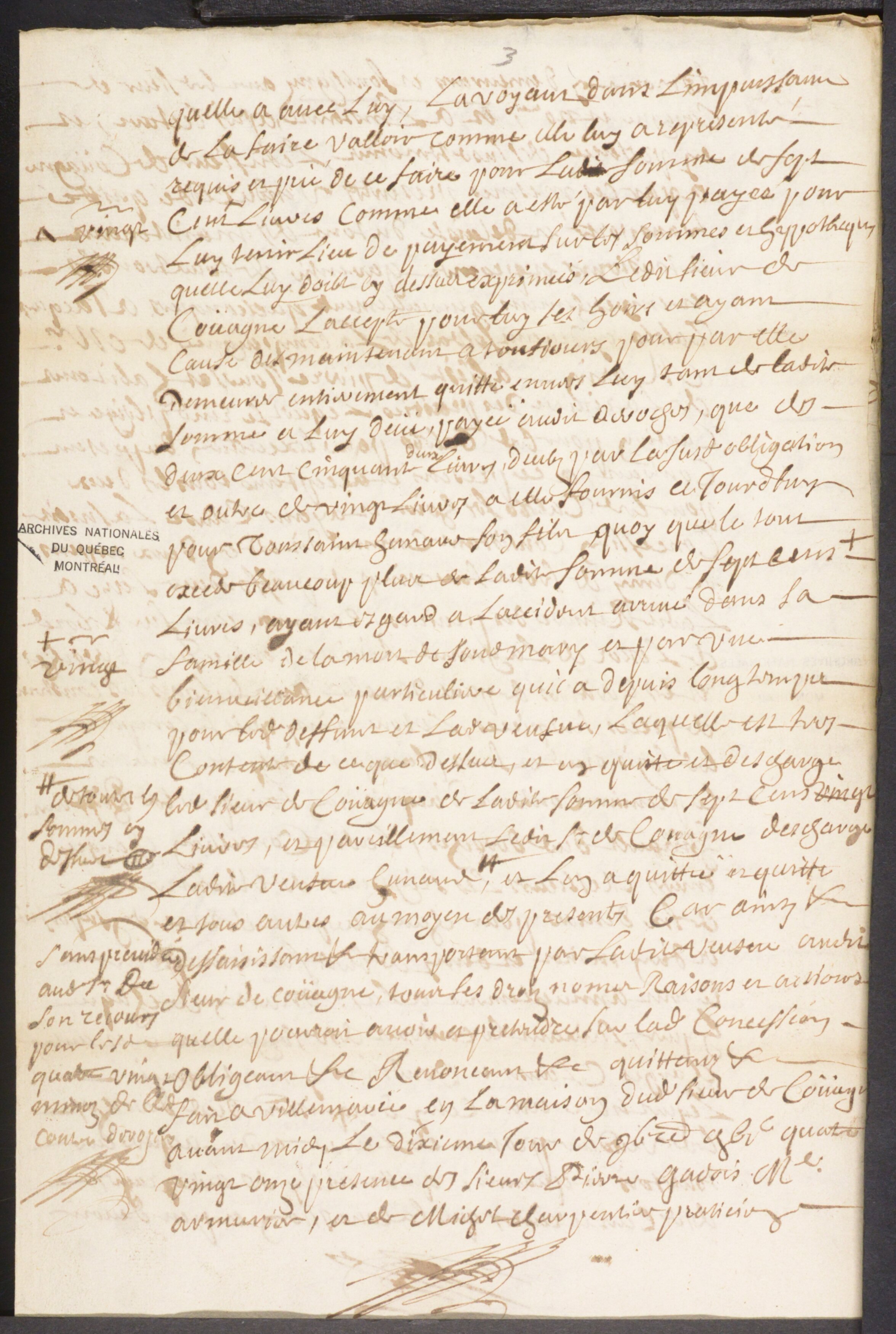
In settling the land, Couagne records that his terms were shaped not only by accounts but by regard for what had befallen the family. The passage is brief, but for a widow otherwise visible only through deeds of debt and loss, it is a rare glimpse of how she was seen.
“…ayant égard à l’accident arrivé dans sa famille de la mort de son mari, et par une bienveillance particulière qu’il a depuis longtemps pour ledit défunt et ladite veuve…”
…having regard to the accident that befell her family in the death of her husband, and out of a particular benevolence he has long held for the late [Toussaint] and the widow…
Maugue, Act 2492 · 10 Nov 1691 Confirmed
The 1690 cession and the 1691 land settlement are separate acts, before different notaries, concerning different assets. Keeping them distinct is what earlier accounts failed to do.
1690 — The Lawsuit
Basset, Act 2064, 10 October 1690. Marie cedes the right of action against Blaignac for the murder — a legal claim — for 520 livres. This is the legal-agency story.
1691 — The Land
Maugue, Acts 2491–2492, 10 November 1691. Marie cedes the Rivière-des-Prairies concession to clear debts owed to Couagne since 1688; he re-conveys it to Talebot. This is the property story.
Earlier versions of this research fused these two into a single “1691 widow’s settlement.” The originals show they are distinct: a 1690 sale of a lawsuit and a 1691 sale of land, thirteen months apart, linked only by the merchant who stood at the center of both—because he had been the family’s creditor since 1688.
Established from original acts
- The Hunaults purchased the Rivière-des-Prairies concession from Nicolas Desroches, 30 May 1688 (Adhémar), with dimensions and neighbours named.
- Couagne financed that purchase (700 livres to Desroches) and secured it by mortgage, 5 June 1688 (Adhémar).
- The 1690 Blaignac cession (Basset 2064) and the 1691 land cession (Maugue 2491–2492) are separate acts concerning separate assets.
- Couagne re-conveyed the concession to Jacques Talebot, former Marine soldier, for 720 livres, the same day (Maugue 2492).
- The printed inventory’s “30 mars 1688” is corrected to “30 May 1688” against the original recital.
- The standalone Adhémar acts of 30 May and 5 June 1688 have been located by reference within Act 2491; direct images of those two minutes would further corroborate the exact terms.
- The precise relationship, if any, between Nicolas Desroches and the “Jean Desroches” named as the concession’s neighbour is not yet established.
None of this alters the 1690 cession as told in the case study and Episode 5. It adds the missing context around it: the merchant who received both the lawsuit and the land was, from 1688, the family’s creditor—which is why, when the widow needed to convert what she held into what she could use, both times the road led to Charles de Couagne.
The Documents Behind This Note
The 1690 cession has its own case study and methodology. This land chain is its companion — the property story that runs alongside the legal one.
The 1690 Case Study → The Methodology Page →