
Reading the Deed That Sold a Lawsuit
The case study argues that a single notarial act proves a colonial widow’s legal standing. This page shows the work behind that claim — document by document, phrase by phrase, and honest about where the reading stops and the record goes silent.
When a nobleman murders a habitant and flees, what legal move is actually open to the widow — and can a single deed prove she held the standing to make it?
The case study’s conclusion rests on one instrument: the cession of 10 October 1690, by which Marie Lorgueil transferred the family’s right to sue Dumont de Blaignac to the merchant Charles de Couagne. This page reconstructs how that document was located, dated, and read — and sets it among the corroborating records that make its meaning legible. Where the seventeenth-century hand can be read with confidence, the phrase is given in French and English. Where it cannot yet be read faithfully, that is marked plainly rather than filled in.
Act 2064 runs across three imaged leaves: the endorsement (dorse), the opening recto, and the continuation with signatures. Read together, they fix the date, the parties, the price, and the thing being sold.

Cession & Transport of Rights
The act opens with the standard notarial preamble — “before the royal notaries of the river and seigneury of the Isle of Montréal” — then names the appearing party: Marie Orgueil, widow of the late Toussaint Hunault, habitant of Rivière-des-Prairies. She appears in her own name and answers (se faisant fort) for the minor children of the deceased and herself; the adult sons André and Pierre Hunault, described as the deceased’s children of full age, act for themselves. Together they cede to Charles de Couagne, merchant, all rights and actions arising from the murder — committed, the act recites, by sword-blows to the body — in return for 520 livres.
Only folio-anchored phrases are transcribed above; the linking passages of the act are not yet given a faithful word-for-word reading and are marked accordingly. The phrases shown were read directly from BAnQ image 254 at magnification. Two readings are given as written rather than resolved: the widow-word (veuve/feue) and the spelling of the surname, which appears doubled (“Hunnault”). The role-word for Marie is read from the “se faisant fort” construction rather than a single term such as tutrice, which is not cleanly legible on this image.
Actes de notaire, Bénigne Basset dit Deslauriers, nos 2001–2200, 14 December 1689–13 September 1693; Fonds Cour supérieure, District judiciaire de Montréal, greffes de notaires, Bibliothèque et Archives nationales du Québec (BAnQ), CN601,S17, ID 488296. Marie Lorgueil, cession and power of attorney to Charles de Couagne, Act 2064, 10 October 1690; images 253–255 of 837.
The date (10 Oct 1690), the instrument type (cession of rights + power to sue, not a post-suit settlement), the price (520 livres), the three acting cedents, and Marie’s exercised capacity — appearing in her own name and answering (se faisant fort) for the minor children, while the adult sons André and Pierre act for themselves. The murder’s method — sword-blows to the body — is recited within the act itself.
The Price, the Date, the Signatures
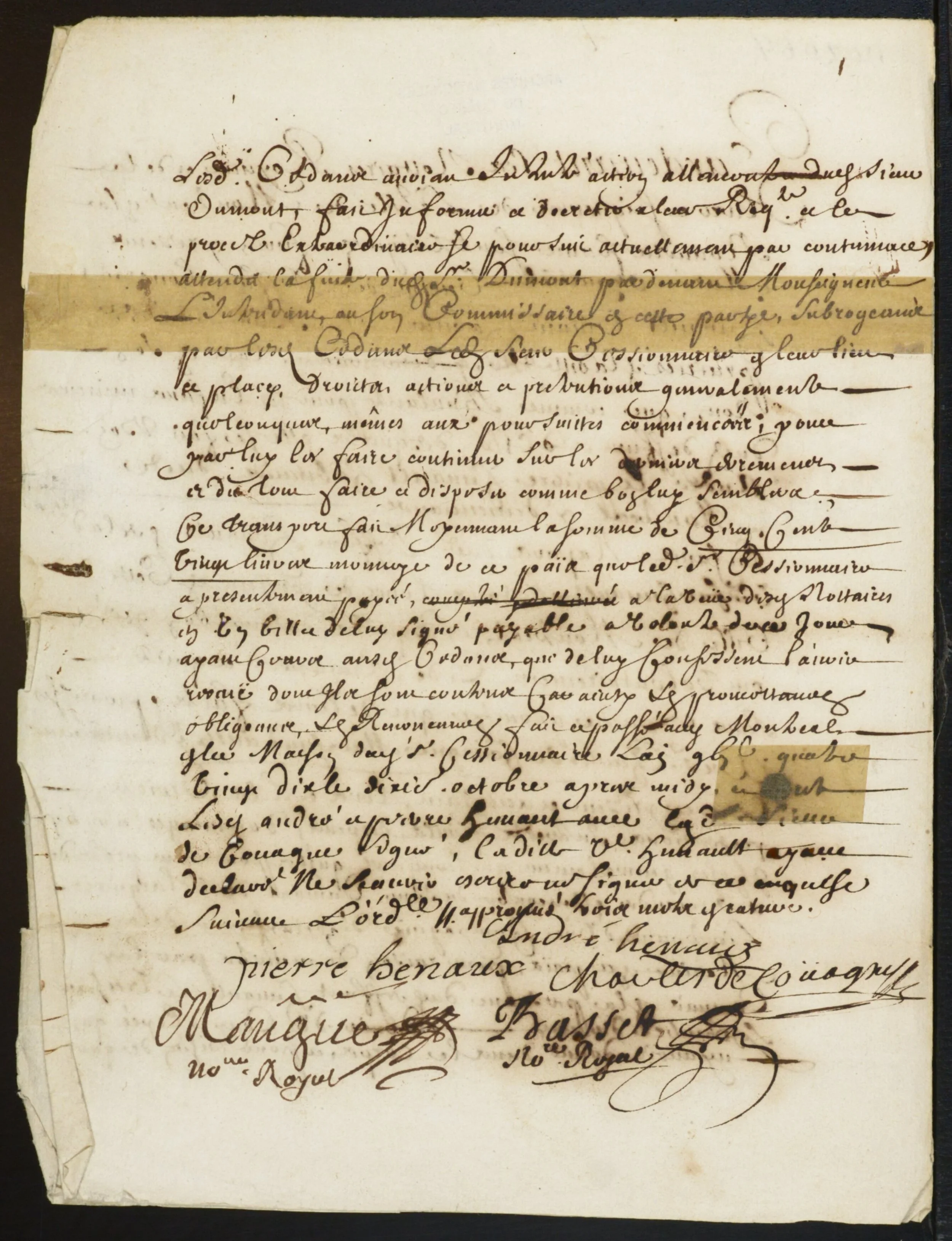
The continuation carries the power-of-attorney language — Couagne is subrogated to the cedents’ rights and may pursue the prosecution already begun against Blaignac — then states the consideration and closes with the date and the signatures. The sum and the day are both legible here, which is what allows the date correction to be made with confidence.
The obligation and subrogation clauses between the sum and the dateline are not yet transcribed word-for-word. “Cinq cent vingt livres” and “dixième octobre” were both read directly from BAnQ image 255.
The 520-livre figure is stated in words on the page, confirming the price independent of any secondary source. The dateline “dixième octobre” anchors the correction from the previously-published “1691.” That Marie did not sign — a notation follows her name — reflects illiteracy, not absence: she appeared and acted in person.

The Dorse That Dates the Act
The back of the folded act carries the notary’s own filing summary — the line a researcher checks first to place a document. It names the date, the nature of the instrument, and the parties in a single breath, and it is the cleanest confirmation that the act belongs to October 1690, not the year that later retellings assigned it.
This endorsement reads cleanly and is the primary basis for the date correction. It also, in the notary’s own words, calls the instrument a “cession et transport de droicts” — not a settlement.
The date and the instrument type, in the record’s own hand. Two independent points in the same document — dateline and dorse — agree, which is what makes the correction from “1691, post-suit settlement” to “10 October 1690, cession of rights” defensible rather than merely asserted.
A deed is only as meaningful as the life around it. Three records supply the context that turns 520 livres from a number into a decision: what the family owed, who they were, and what they had already survived.

307 Livres, Owed to Their Own Son
An obligation by which Toussaint and Marie acknowledge owing 307 livres to their son André Hunault. Roughly one to two years of a habitant’s wages, it shows a household already under financial strain well before 1690 — and helps explain why immediate cash weighed as it did in the 1690 cession.
Obligation, Toussaint Hunault and Marie Lorgueil to André Hunault, 307 livres, 15 November 1683; notarial records, French Regime, as calendared in the printed inventory of notaries of the French Regime; BAnQ Montréal.
Documented financial strain predating the murder — the material context for reading the 1690 settlement as pragmatic rather than defeatist.

The Family, Enumerated
The census fixes the household a generation before the cession — Toussaint and Marie with their children — and establishes the family whose minor and adult members later appear as cedents. It is the backbone for identifying which children were still minors in 1690 and which, like André and Pierre, acted in their own names.
Royal Census of New France, 1666, household of Toussaint Hunault, habitant, Montréal; Library and Archives Canada.
Family composition — the roster against which the cedents of 1690 (Marie answering for the minors; André and Pierre as adults) are identified.
Thirteen Months Before the Sword
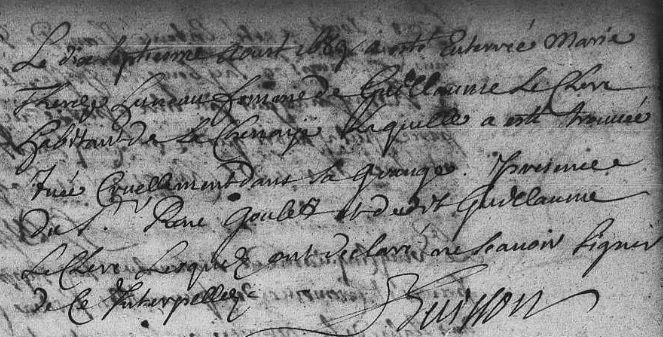
Marie’s daughter Marie-Thérèse, wife of Guillaume Leclerc, died in the raid at Lachenaie. The burial record places a second violent bereavement just over a year before Toussaint’s murder — establishing that the decision recorded in the 1690 cession was made by a woman already carrying fresh grief, not in the abstract.
Burial record, Marie-Thérèse Hunault, wife of Guillaume Leclerc, 17 August 1689, Lachenaie; parish register (digitized images).
The immediate emotional and chronological context: two violent family deaths within thirteen months, framing the 1690 choice.
The Genealogical Proof Standard asks for a reasonably exhaustive search and an honest account of what was — and was not — found. Negative results are evidence too.
What the search covered
- The full Basset act located and imaged (BAnQ CN601,S17, Act 2064, images 253–255), with date and instrument type confirmed on both the dateline and the dorse.
- The 520-livre consideration verified against the act’s own wording rather than a secondary summary.
- The acting cedents (Marie answering for the minor children; André and Pierre Hunault acting for themselves) read from the opening recto.
- Corroborating records — 1683 obligation, 1666 census, 1689 burial — assembled to frame the transaction.
- No trial record, sentence, or transfer order located for Dumont de Blaignac. The officer’s fate is unrecorded in the sources searched.
- No record found that Charles de Couagne ever pursued the acquired claim against Blaignac.
- No separate figure for the pre-existing Couagne debt appears in this act; the 520 livres is the stated price for the rights of action. (That separate debt — a 1688 land mortgage — was settled later, in 1691; see the Research Note.)
- A faithful word-for-word transcription of the act’s connective passages remains to be completed from the originals; only anchored phrases are transcribed here.
The claim the case study makes — that this deed documents a widow exercising legal capacity under the Custom of Paris — rests on directly-read, internally-corroborated features of the act (date, instrument type, price, parties, and Marie’s role answering — se fait fort — for her minor children). What remains open (Blaignac’s fate, the exact debt sum, the full transcription) does not bear on that central claim; it bears on the surrounding story.
Go to the Source
Every claim on this page can be checked against the original. The complete Basset register is digitized and open at BAnQ — Act 2064 begins at image 253.
View Act 2064 at BAnQ → Back to the Case Study →