
Françoise Baiselat Bizelan
Reveal Twelve Years of Colonial Justice
Methodology & Evidence Analysis
This methodology documents the complete research process and primary source analysis behind the Françoise Baiselat inheritance case study. Seven legal proceedings — spanning from June 1694 to June 1706 — are examined chronologically, with each document analyzed for what it reveals about colonial justice, family dynamics, and the institutional mechanisms that protected minor children in 17th-century New France.
The analysis draws on 32 primary source documents: notarial acts from the greffes of Antoine Adhémar and Bénigne Basset, parish registers from Saint-Enfant-Jésus (Pointe-aux-Trembles) and Notre-Dame-de-Québec, guardianship proceedings from the Bailliage de Montréal, the 1681 census, PRDH database records, BAnQ archival documents, and the Intendant's ordonnance. Secondary analysis is informed by the biographical research of Irène Belleau.
When a Fille du Roi dies in childbirth leaving heirs from three marriages to three soldiers, how does a colony with no established precedent untangle three estates, protect six minor children, and resolve disputes that span over a decade?
The Woman: Françoise Baiselat's Life in Context
To understand the inheritance crisis, we must first understand the woman at its center. Françoise Baiselat was born around 1651 in the parish of Saint-Sauveur, Paris — the daughter of Benjamin Baiselat, a master enamel maker and sexton at the church of Saint-Sauveur, and Claude Proulx. Her father died in 1662, when Françoise was approximately eleven years old. She was orphaned, but not destitute: when she left France in 1668 as a Fille du Roi, she brought possessions worth 300 livres — possibly from the inventory of her father's estate drawn up before a notary on February 10, 1662.
She arrived in Quebec on July 3, 1668, aboard the ship La Nouvelle-France, approximately seventeen years old. What followed was a quarter century of marriage, childbearing, widowhood, and remarriage that would define her legacy — and create the inheritance crisis that engaged every level of colonial authority.
First Marriage — Laurent Cambin dit Larivière (August 16, 1668): Françoise married Laurent Cambin in Quebec City, just six weeks after her arrival. Laurent was a 32-year-old sergeant in the company of Sidrac Michel Dugué de Boisbriand, of the Carignan-Salières Regiment. He had arrived in New France on September 12, 1665, aboard La Justice. Their only child, Marie, was baptized on June 13, 1669, at Ville-Marie. Laurent died at the Hôtel-Dieu hospital and was buried on May 5, 1670 — at just 35 years old, leaving Françoise a widow at approximately nineteen with an infant daughter.
Second Marriage — Pierre Marsan dit Lapierre (September 22, 1670): Four months after Laurent's death, Françoise married Pierre Marsan, a sergeant in the Chambly company, originally from the parish of Saint-Nicolas in Rouen. The marriage took place in Quebec City — not in Montréal, where Françoise was living — with a dispensation from two banns of publication. Over the next twenty years, Françoise and Pierre had ten children at Pointe-aux-Trembles, seven of whom survived to adulthood. By the 1681 census, the family farm comprised six arpents of cleared land and three head of cattle. Pierre died sometime between 1691 and 1693, leaving Françoise a widow for the second time at approximately forty, with five children still at home.
Third Marriage — André Corbeil dit Tranchemontagne (January 4, 1693): Françoise married the 26-year-old soldier André Corbeil at Saint-Enfant-Jésus in Pointe-aux-Trembles. The PRDH marriage record notes she was described as "widow in her third marriage of Pierre Mercan." This marriage would last barely sixteen months.

Marie Françoise Bizelan — three marriages listed

First marriage: Cambin–Baiselat, Aug 16, 1668

Second marriage: Marsan–Baiselat, Sept 22, 1670

Third marriage: Corbeil–Bizelon, Jan 4, 1693

Notre-Dame-de-Québec, 1668
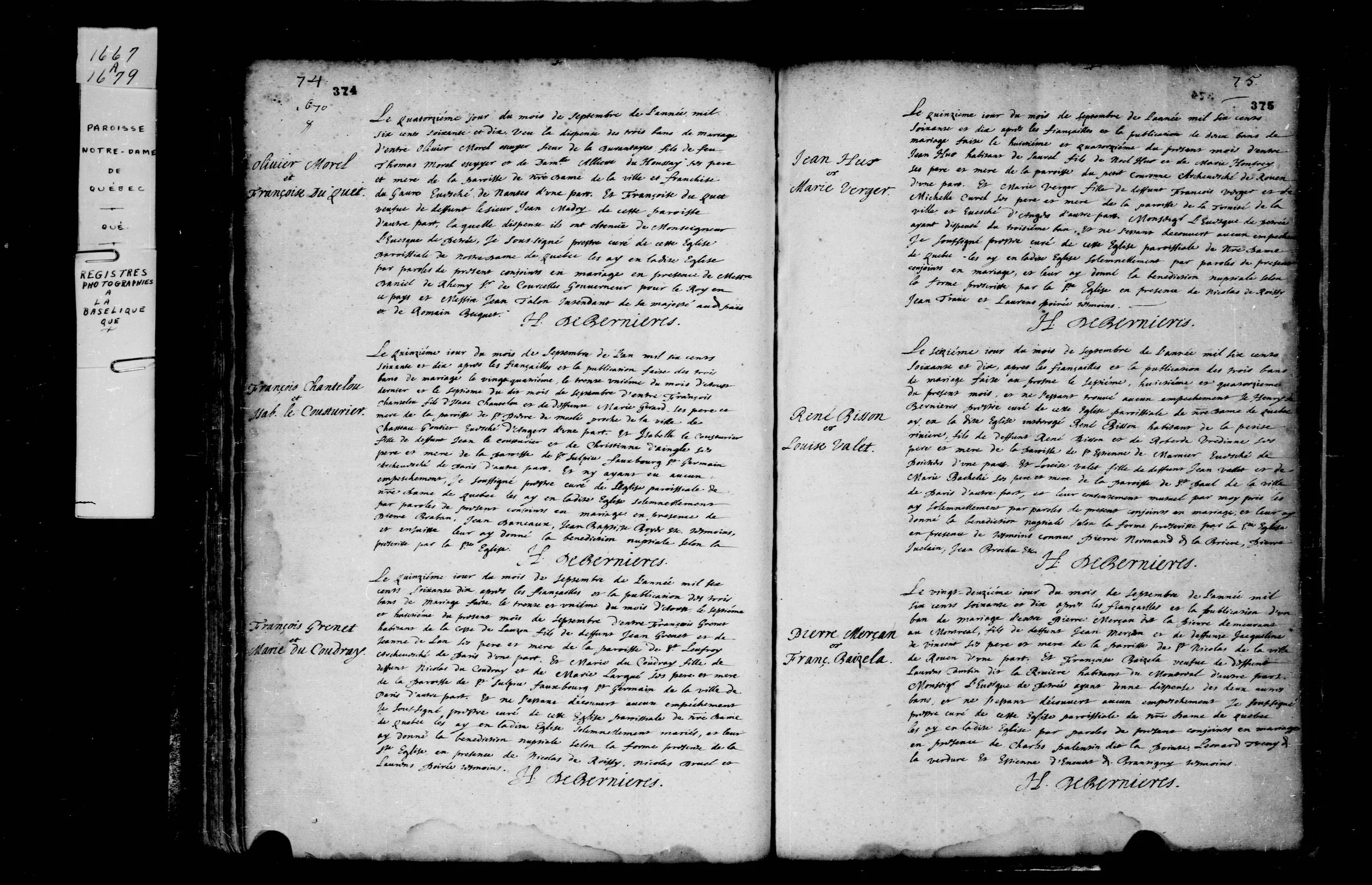
Notre-Dame-de-Québec, 1670

Laurent Cambin, May 5, 1670 — "pris à l'Hôpital"
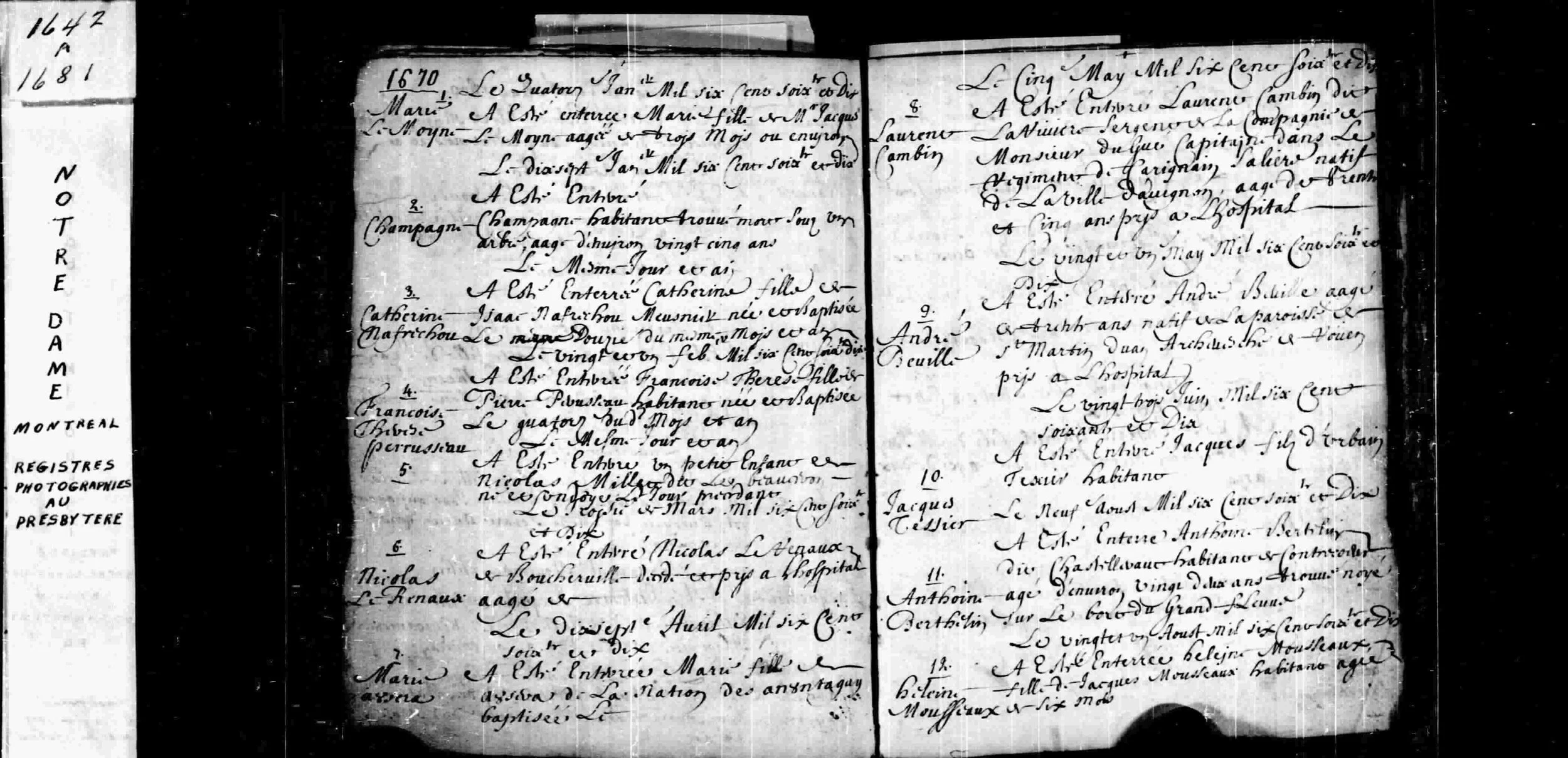
Notre-Dame de Montréal, 1670
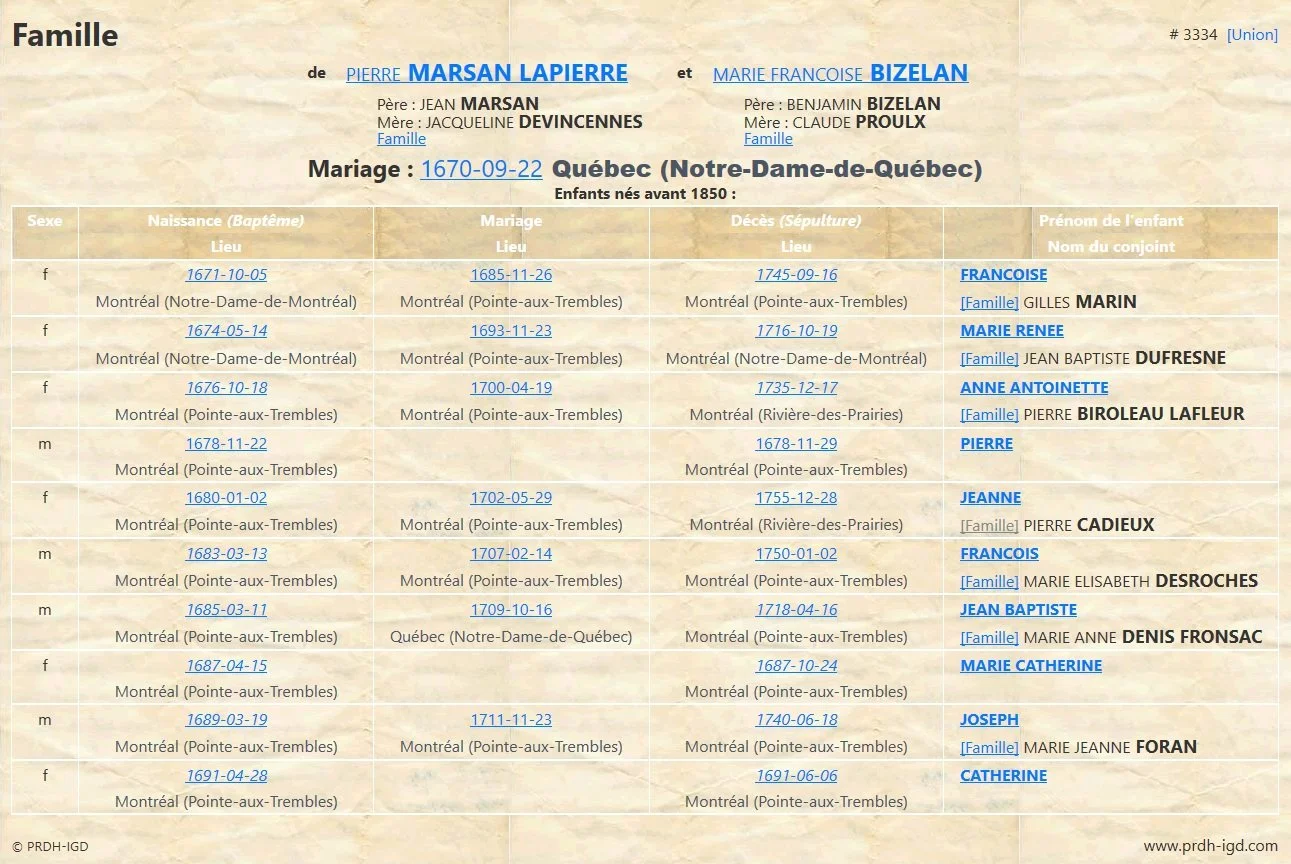
Marsan–Bizelan: ten children, 1671–1691

Marsan farm: 6 arpents, 3 cattle
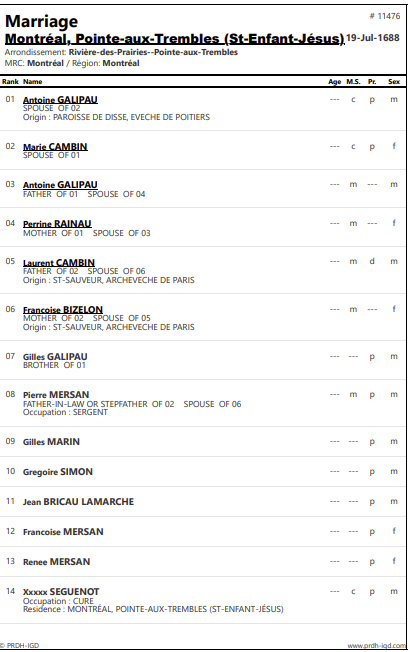
Galipeau–Cambin, Jul 19, 1688 — 14 witnesses

Saint-Enfant-Jésus, 1688
The Death and the Birth
On the same page of the parish register of Saint-Enfant-Jésus, Curé Séguenot recorded two events that would set everything in motion. First, Françoise Baiselat was buried: "Le 30 may 1694 a esté inhumée dans notre cimetière Françoise Bizelan femme d'André Gourbeil dit Tranchemontagne..." Among the witnesses who signed: gillemarin, Jean Beauchamp, François Raignault.
Immediately below, on the same page, the baptism of her newborn son: "Le 30 may 1694 a esté bastisé François fils de andré gourbeil et de Françoise Bizelon... le parrain le dit François Planchard, la marraine Marie Roy fille qui a declaré ne scavoir signer, mesme le pere de cet enfans..." In the margin of the baptism, a later hand wrote the devastating annotation: "died after giving birth to her son François."
The PRDH records confirm the details: Burial #11824 notes "THE DECEASED WAS MR. GOURBEIL'S THIRD WIFE," while Baptism #10431 lists André Gourbeil as father, Françoise Bizelan as mother, François Rainau Planchard as godfather, Marie Roy as godmother, and Curé Séguenot as officiant. The PRDH Individual record for François Corbeil (#32500) shows only his baptism date — no burial, no marriage. He vanishes from the historical record. Nothing more is known of this child.

Saint-Enfant-Jésus, May 30, 1694 — same page

"The deceased was Mr. Gourbeil's third wife"

François Gourbeil, May 30, 1694
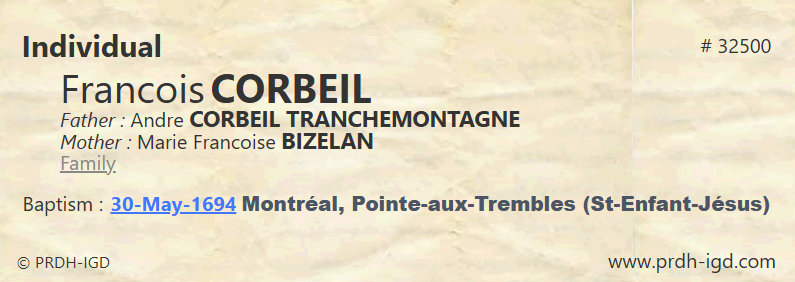
François Corbeil — baptism only. He vanishes.
The Guardianship Petition
Before any inheritance could be divided, the law required that guardians be formally appointed for the minor children. Antoine Galipeau — husband of Marie Cambin, Françoise's eldest daughter from her first marriage — initiated the process. His petition to the Lieutenant général de l'Isle de Montréal is a remarkable document, badly damaged by water and age but still legible in its essential details.
The petition identifies Galipeau as a "habitant de la paroisse de la Pointe-aux-Trembles en cette Isle, gendre de deffunte françoise Bistolay" — son-in-law of the late Françoise. He then recites the chain of three marriages: his wife Marie is the daughter of "deffunt Laurent Cambin dit La Rivière" (first husband), Françoise was widow of "deffunt Pierre Mersan dit La Pierre" (second husband), and third wife of "André Gourbeille dit Tranchemontagne, le dit Gourbeille."
Galipeau states the death occurred "sept ou huit jours" ago — seven or eight days — and that Françoise left "plusieurs enfants mineurs" who need guardianship "pour avoir leur biens" — to secure their property. He explicitly requests the appointment of "tuteur et subrogé tuteur" for the minor children.
Judge Juchereau granted the petition, ordering an assembly "pardevant nous en la chambre de l'audience aujourd'huy cinq heures" — at the audience chamber at five o'clock that very day. In the proceedings that followed, the assembled family and community members elected Gilles Marin as tuteur (Marin was married to Françoise Marsan, the eldest Marsan daughter) and designated André Corbeil as subrogé tuteur specifically for his infant son François. The document names all the minor children with their ages: Antoinette, Jeanne, François, Jean Baptiste, Joseph Marsan, and François Gourbeille.
The signatures on the final page tell the story of who held authority in this community: Juchereau (judge), de Deschambault, Séguenot (curé), gillemarin (the new tuteur), and Adhémar (the notary who would oversee the subsequent transactions).

"sept ou huit jours" after the death
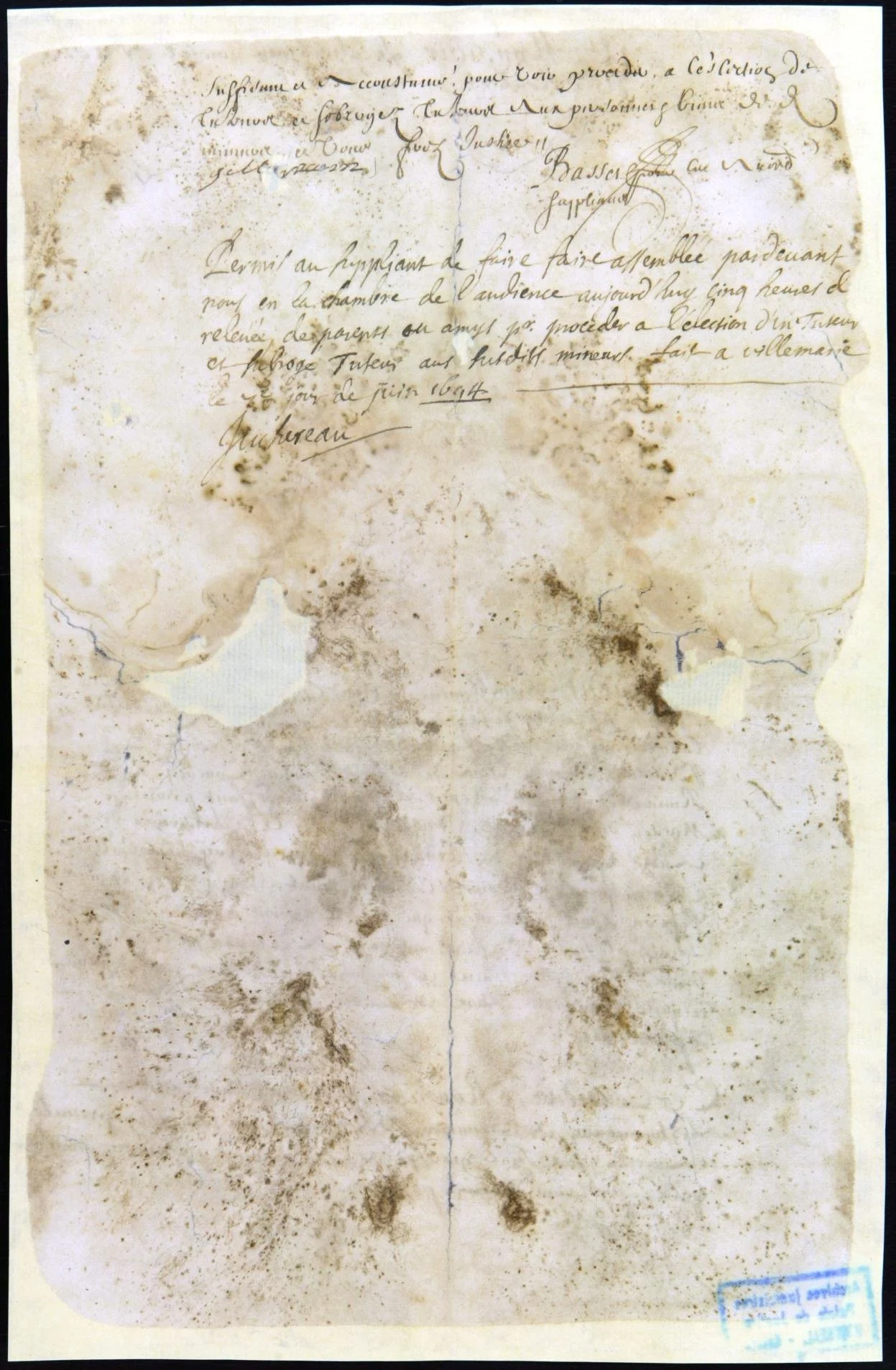
"cinq heures" — at five o'clock

Children named with ages

Gilles Marin elected tuteur

Juchereau, Séguenot, gillemarin, Adhémar

André Corbeil Tranchemontagne

First marriage — establishing Marie Cambin's claim
The Three-Family Transaction
With the guardianship formally established, the three families assembled before the Royal Notaries at Ville-Marie on June 7, 1694. The cover sheet — "Transaction entre les héritiers feu Cambin, Marsan, & françoise Bizelan," No. 2226 — announces the scope of what follows: not one inheritance but three, intertwined across twenty-six years of colonial life.
The transaction document identifies the parties with meticulous care. André Gourbeil appears as "veuf de deffunte Françoise Bislay" — widower. Antoine Galipeau appears with his wife Marie Cambin, representing the interests of the first marriage. Gilles Marin appears as the newly elected tuteur, supported by Curé Séguenot and Jean-Baptiste Dufresne as community witnesses. The document notes that the parties assembled "pour éviter et prévenir les procès qui pourvoient naistre deux demeure familles, à cause qu'il vise reste de six trois mariages" — to avoid the lawsuits that could arise between two families, because of the three marriages.
The Marie Cambin Claim: Marie Cambin, daughter of the first marriage to Laurent Cambin, claimed her share of her late father's estate: a concession of 60 arpents by 20, granted by the Sulpicians on January 8, 1670. The habitation was appraised "par arbitres et gens à ce connoissance" — by arbitrators and experts. Her share was settled at 50 livres. André Corbeil, having no money, agreed to pay in two annual installments.
The Marsan Children's Portion: The remaining inheritance — the Pointe-aux-Trembles habitation, land, and Françoise's personal acquisitions — was divided among the Marsan children and the infant François Corbeil. The 350 livres total was to be paid by Corbeil in three equal portions over three years (1695, 1696, 1697), payable "en monnoye ou bled froment bon, loyal et marchand au prix courant du marchand" — in currency or in good, fair, and merchantable wheat at the current market price.
The Galipeau Renunciation: In exchange for the 50 livres, Antoine Galipeau and Marie Cambin renounced all further claims "à toutes les pretentions qu'ils pourvoient avoir sur ladite habitation" — to everything they might claim on the property. This was a clean break — the first marriage's claims were settled permanently.

"Transaction entre les héritiers feu Cambin,
Marsan, & françoise Bizelan" — No. 2226

Three families assemble — Marie Cambin claim settled
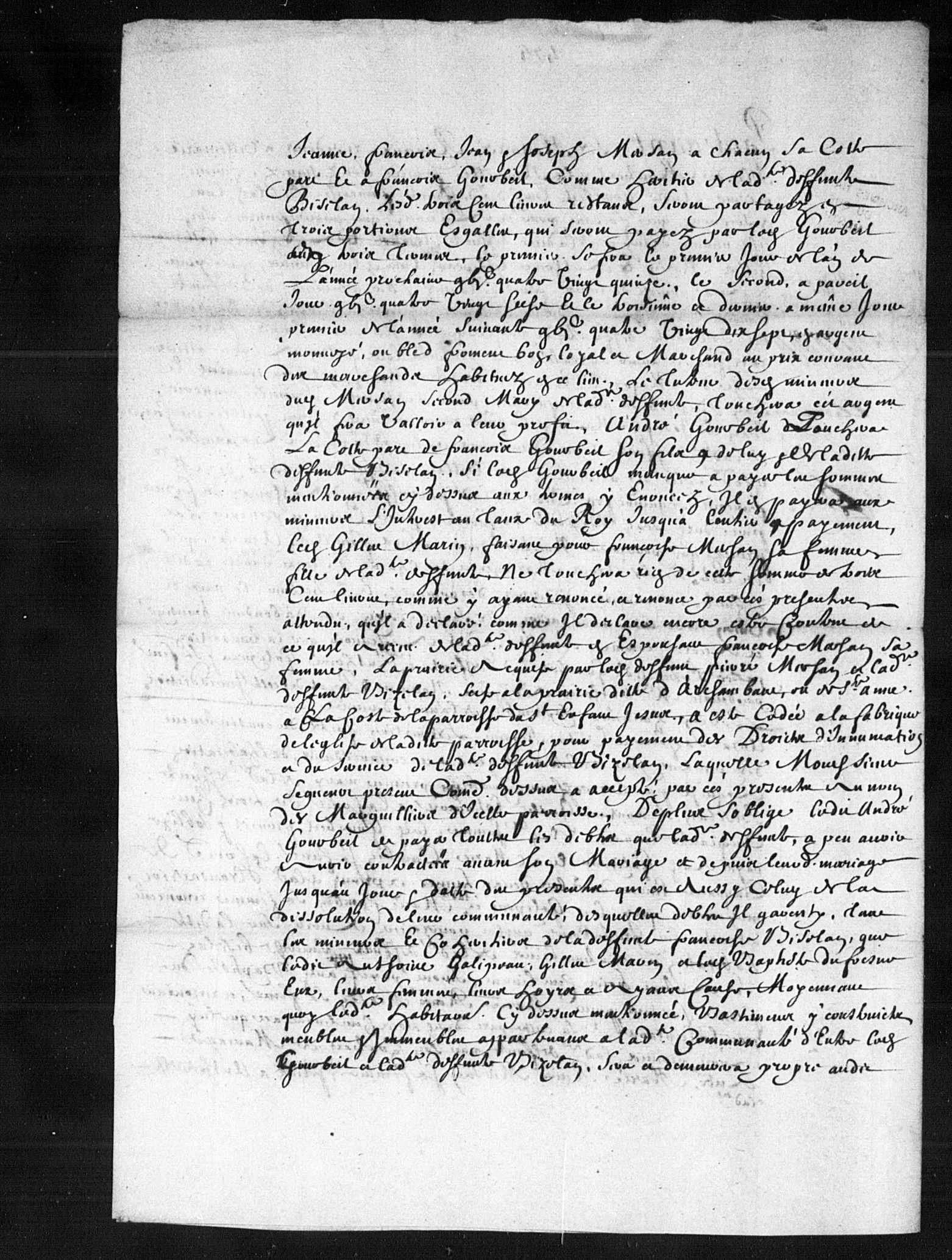
Payment terms — "en monnoye ou bled froment"
The Séguenot Compromise: The Church as Mediator
A separate but related proceeding addressed the burial costs for Françoise — and revealed the church's dual role as spiritual authority and financial stakeholder. Curé François Séguenot of the parish of Saint-Enfant-Jésus entered into a formal "compromis" with André Gourbeille dit Tranchemontagne, Gilles Marin (tuteur), and Antoine Galipeau (curateur).
Under the compromise, Séguenot took personal responsibility for paying the cost of Françoise's funeral service and inhumation. In exchange, a piece of prairie land that Pierre Marsan had acquired at Ste-Anne, on the côte de Ste-Anne within the parish, was ceded to the parish "à la fabrique de l'église" — to the church vestry — for payment of burial rights and funeral services.
The cost was to be deducted from the 100 livres that Corbeil owed on January 1, 1695. The burial expense — calculated at a certain sum — was to be "partagée également entre les dits six mineurs": divided equally among the six minors. Those six were explicitly named: Antoinette, Jeanne, François, Jean, Joseph Marsan, and François Gourbeille — Corbeil's own infant son, treated equally with his stepchildren under the law.
The prairie itself was to be held for the benefit of the minors. If sold, the proceeds would be divided equally among all six. Gilles Marin as tuteur and André Corbeil as father/subrogé tuteur "ont accepté pour en jouir et la rendre si besoin est au profit des dits mineurs" — accepted the arrangement to manage and, if necessary, sell for the children's benefit.
The agreement was formally ratified on November 24, 1694, before Notaries Maugue and Basset. The signatures reveal the community power structure: Tranchemontagne (Corbeil's mark), Donay, gillemarin, Séguenot — the curé, the tutor, and the widower all bound together in a single legal instrument.

Prairie ceded — six minors named equally
Land cession to parish for burial costs

Maugue & Basset, Nov 24, 1694
The Du Fresne Exclusion: Enforcing Reciprocal Obligation
Three years after the initial settlement, a second page of the Séguenot compromise reveals an unresolved conflict — and the colonial system's response to those who refused to participate.
Jean-Baptiste Dufresne had married Marie Renée Marsan — Françoise's second daughter from her marriage to Pierre Marsan — on November 23, 1693, just seven months before Françoise's death. When the burial costs came due, Dufresne refused to contribute his share. The document is explicit: "ne pourra rien prétendre le nommé Baptiste du fresne pour avoir esposé marie Renée Mersan fille mineur des dits mersan et Bisselan attendu qu'il n'a jamais voulu consentir à payer sa part des d. service et inhumation" — he shall claim nothing, because he never agreed to pay his portion.
The matter had festered for three years. Séguenot himself references the original 1694 transaction "passée entre eux tous par devant Bénigne Cosset notaire royal" and notes that his attempt to retain the prairie as security for the burial costs was refused by the family. Finally, on September 27, 1697, a new assembly was called — Jean Beauchamp (churchwarden), Gourbeille, Marin, and Galipeau — and a resolution was reached.
Séguenot personally forgave 14 livres owed by the minors: "je leur ay fait grace de mes droits et quelques autres montant à la somme de quatorze et dont il les decharge et tient quitte" — he discharged them and held them free. The curé absorbed the loss himself. The agreement was witnessed by Jean Beauchamp (churchwarden), Donaty, and signed by Séguenot, Gilles Marin, and Gousbeille.
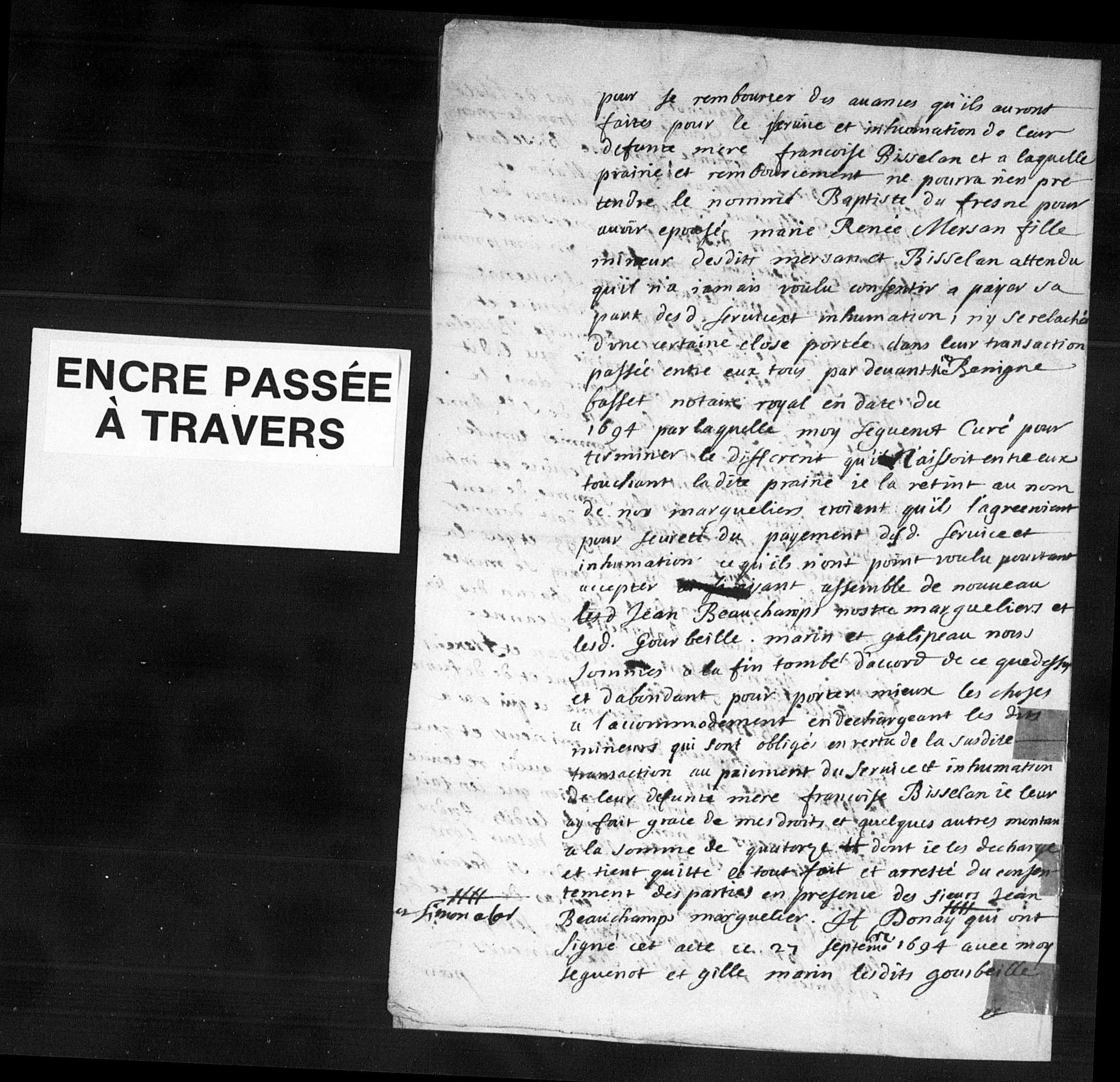
"il n'a jamais voulu consentir à payer" — Sept 27, 1697
Séguenot, gillemarin, Gousbeille
The Raudot Ordonnance: A Grown Child Challenges
Twelve years after his mother's death, François Marsan — now twenty-three years old and about to marry Marie Élizabeth Desroches — decided to reopen the settlement. He demanded a new appraisal of the land his mother had purchased on March 4, 1693, and a review of his share of the inheritance.
The case reached the highest colonial authority: Intendant Jacques Raudot himself. The two-page ordonnance reveals the complete financial history of the settlement as Raudot examined it.
The Land Exchange: On November 18, 1698, André Corbeil had exchanged his Pointe-aux-Trembles habitation with André Archambault for a property in Rivière-des-Prairies. Archambault agreed to pay Corbeil 350 livres ("trois cent cinquante livres"), but 300 livres of this payment went directly to Pierre Marsan's children — "à la charge de payer les dettes de la succession de Françoise Bezelan et de deffunts Laurent Cambin et Pierre Musan."
Corbeil's Defense: Corbeil argued that the habitation had been appraised at more than the 350 livres, and that he had already paid 42 livres beyond the 500 livres total according to a previous act of September 28, 1693 ("suivant l'acte du sept. juin quatre vingt quatorze"). He demonstrated that his total payments exceeded what was owed — and requested discharge from the remaining 150 livres.
Raudot's Ruling: The Intendant examined the evidence, considered the arguments, and ruled in Corbeil's favor: "Nous déchargeons les dit Gourbil du paiement de la somme de cent cinquante livres portée par notre dite ordonnance" — "We discharge the said Gourbil from the payment of 150 livres." The ordonnance was signed at Montréal on June 25, 1706, and attested by notary Adhémar.
François Marsan's challenge failed. The original settlement stood. Twelve years of colonial justice had run its course, and the man who began with nothing — an illiterate 27-year-old soldier with no money — had met every obligation the system imposed.
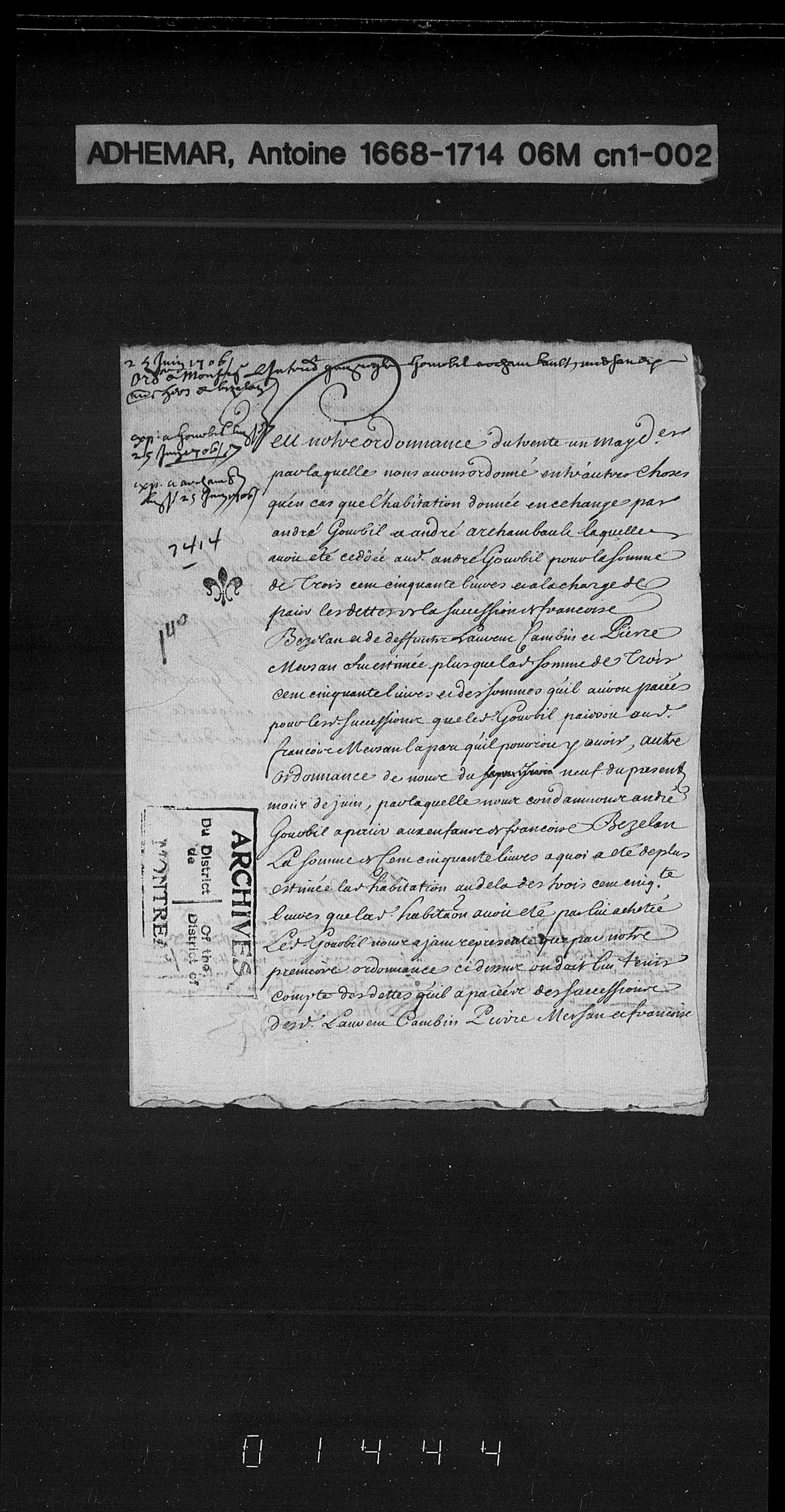
The challenge — land exchange and succession debts reviewed

"Nous déchargeons les dit Gourbil" — case closed
What the Documents Tell Us
The seven documents of Françoise Baiselat's inheritance — spanning from the tutelle petition of June 1694 to the Raudot ordonnance of June 1706 — reconstruct not just the division of one family's property but the functioning of an entire colonial justice system.
The documents reveal a system that was practical rather than rigid. When Corbeil had no money, the colony accepted wheat. When he needed to settle debts, he exchanged land. When the church demanded burial costs, it also absorbed losses. The system accommodated poverty, illiteracy, and complexity — not by lowering its standards but by finding creative mechanisms to meet them.
The system was protective of the vulnerable. Six minor children — five from one marriage, one newborn from another — were treated as equal heirs and given formal legal protection through the tutelle. The subrogé tuteur system created checks against conflicts of interest. The prairie was held in trust. And when one family member (Du Fresne) refused to participate in the collective obligation, the system excluded him rather than penalizing the children.
The system had institutional continuity. Twelve years after the initial settlement, a grown child could petition the Intendant to review the proceedings — and the Intendant could examine the original documents, trace the payment history, and render a definitive ruling. The notarial record-keeping that made this possible is the same archival infrastructure that allows us to reconstruct the story today.
And at the center of it all stands Françoise Baiselat — a woman who left no written words, who appears in the record only through the men who married her, the children she bore, and the legal proceedings that followed her death. Yet her legacy — the inheritance, the disputes, the resolutions — tells us more about how colonial New France actually functioned than any administrative history could.
She was approximately forty-three years old. She had crossed an ocean, married three soldiers, raised twelve children, and built a life from nothing in a colony on the edge of a continent. The system she left behind — imperfect, improvisational, but ultimately just — honored that life by protecting the children she left behind.