
Tuberculosis and the McKenny–Kenny–Robertson Line — How the Research Was Done
A document-by-document account of five obtained death certificates, one four-year records barrier now resolved, the comparative reading of five cause-of-death fields across seventy-two years, and the convergent-evidence argument that stood during the barrier period until the New Jersey State Archives released the fifth certificate on September 22, 2026.
Research Methodology
Six steps from identifying the family pattern to a BCG-standard proof of continuous disease transmission across three generations — including the four-year records barrier and its September 2026 resolution
The Central Problem This Case Addresses
Most family narratives of hereditary disease rest on oral tradition and one or two death certificates. This study asks whether a pattern of continuous tuberculosis transmission through a single biological line can be established from primary documents alone across seventy-two years — and what happens to the argument when one of the five principal documents appears unobtainable through standard channels.
The question is methodological. The argument is conjunctive: it requires both biological descent proven across three generations and shared cause of death documented at each generational link. No single element is sufficient; together they demonstrate continuous transmission. The methodology below documents how each element was established, which sources were consulted, how a four-year records barrier was managed under BCG convergent-evidence standards, and how that barrier was ultimately closed in September 2026 through a targeted request to the New Jersey State Archives.
Establish the Five Decedents as One Biological Line
The argument requires that the five persons named — George McKenney, Margaret McKenny Kenny, John Kenny, Mary Agnes Kenny Robertson, and Helen Robertson Verhoek — constitute a single documented biological family. Three of the five are related by direct descent (George to his daughter Margaret to her daughter Mary Agnes to her daughter Helen); one (John Kenny) enters the chain by marriage as Margaret’s husband and Mary Agnes’s father.
Descent was established through three independent record types. Federal and state census schedules place George with his daughter Margaret in one household (1860, 1870) and document John Kenny and Margaret as a married couple raising Mary Agnes’s older sister Elizabeth (1880). A Catholic baptismal register at St. Patrick’s Church, Brooklyn names John Kenny and Margaret McKenny as Mary Agnes’s parents (February 1882). New York City Department of Health Certificate of Birth No. 36480 names Joseph Robertson and Mary Kenny (mother’s maiden name) as Helen’s parents (August 1907), and Mary Agnes’s 1924 New Jersey death certificate names her own mother as Margaret McKenny — closing the four-generation triangle through the maternal line.
Retrieve the Four Obtainable Death Certificates
Three of the five death certificates were issued by the Department of Health of the City of Brooklyn (1870, 1884, 1888) and retrieved through the New York City Municipal Archives. The fourth was issued by the New Jersey State Department of Health, Bureau of Vital Statistics (1924) and retrieved through standard genealogical channels.
Each certificate was examined in the original. Cause-of-death fields were transcribed exactly as written, including secondary terms and durations. Attending physicians were identified by name and address. Place of death, place of burial, and informants were recorded. The four certificates are reproduced in full in the document gallery below, with transcriptions of every field material to the methodological argument.
Read the Cause-of-Death Field Comparatively
The core analytical move of this study is the comparative reading of the cause-of-death field across all five certificates in chronological order. The field records not just the disease but the contemporary medical vocabulary for it — and the terms shift across the seventy-two-year span in ways that track the bacteriological revolution and its slow migration into routine clinical and bureaucratic practice.
The comparative reading is done at two levels. At the primary level, the cause-of-death terms are compared across the four obtained certificates and the fifth (Helen’s) attested cause. At the secondary level, the secondary modifiers (asthenia in two Brooklyn certificates; duration 1 year in the 1924 New Jersey certificate; geographic attribution contracted in Brooklyn in the same certificate) are examined as windows into what contemporary physicians believed they needed to record. The expanded analysis of the language shift is the subject of the dedicated section below.
Document the Fifth-Certificate Barrier — and Its Eventual Closure
Helen Gladys Robertson Verhoek died on July 21, 1942, in North Caldwell, Essex County, New Jersey. From 2022 through September 2026, her death certificate could not be obtained through the standard channels. The barrier was twofold and well documented. First, the New Jersey Department of Health’s published vital records page explicitly states that the death index for 1930–1948 could not be located by the state, even under an Open Public Records Act (OPRA) request. Second, New Jersey is not an open-records state for death certificates: eligibility for non-relative access to post-1930 individual certificates is restricted. A 2026 order attempt through VitalChek was blocked at the grandchild-eligibility verification step with a $37.95 charge authorized only upon confirmation of qualifying applicant status.
Documenting the barrier as a matter of primary record was not ancillary to the methodology — it was central. A BCG-standard argument requires that unobtainable evidence be distinguished from unsearched evidence. The screenshots of the New Jersey Department of Health notice and the VitalChek block are reproduced in the document gallery as primary records of the barrier itself.
Update, September 2026. Four years after the barrier was first documented, a paper request to the New Jersey State Archives — not to the New Jersey Department of Health — produced Helen’s certificate. The channel that opened is the archives’ Death Record Search Request form (a standard order form on the NJSA website, for records dated May 1, 1848 through December 31, 1950), which accepts a $10.00 fee for a single-year search based on decedent name, county, month, and year, with no relationship-eligibility requirement imposed on the requestor. This is a different regulatory framework from the New Jersey Department of Health’s VitalChek-mediated genealogy channel: the Archives operate under Department of State authority under records-preservation statutes, and their release standard for a documented decedent named in a correctly-completed request form is administrative rather than genealogical-relationship-based.
The archives fulfilled Order #202608-90492 by digital PDF on September 22, 2026, released by Catherine Medich, New Jersey State Archives. The certificate itself confirms the convergent-evidence conclusions at every point and adds one datum — a ten-year disease duration — that the convergent argument alone could not have predicted. Full transcription appears in the document gallery below.
Methodological finding. This case documents that where the New Jersey Department of Health barrier holds and no lineal descendant is available, a targeted New Jersey State Archives paper request is a productive alternative channel for the 1848–1950 death certificate range. This is a workaround worth citing in future BCG case studies where the equivalent barrier is encountered.
Apply the Convergent-Evidence Standard for Helen’s Cause of Death
The convergent-evidence argument set out below constituted the sufficient case for Helen’s cause of death from the beginning of this study through September 22, 2026, at which point the state certificate obtained through the New Jersey State Archives paper channel confirmed each of the four convergent strands independently. The convergent argument is preserved in full as an example of the standard that governed the case during the barrier period, and as a record of how a BCG-standard case is built when a principal record is unobtainable. The convergent-evidence conclusions have now been corroborated by direct primary evidence.
Where a principal record is demonstrably unobtainable, BCG’s Genealogical Proof Standard permits a cause to be established by convergent evidence — the independent agreement of multiple sources of different record types, each of which alone would be insufficient. For Helen’s cause of death, four convergent strands are available.
First, family tradition through two independent chains of descent: Helen’s sister Lillian Robertson O’Brien to her daughters Lillian and Barbara Hamall (the researcher’s mother); and separately through Helen’s younger brother Joseph Jay Robertson Jr. to his daughter Judy Robertson Apicella. Second, Barbara O’Brien Hamall’s firsthand testimony that her Aunt Helen had been treated at Essex Mountain Sanatorium, Verona, for tuberculosis — a recollection grounded in Barbara’s own c. 1945 chest x-ray at the same institution for suspected pneumonia. Third, the published Brooklyn Eagle obituary of July 22, 1942 — whose funeral and burial timing (Tuesday death, Thursday requiem mass, standard Catholic schedule) is consistent with a 1940s tuberculosis progression and contains no alterations that would indicate a contagious-disease protocol exception. Fourth, pattern consistency: Helen’s cause, in this particular biological line at age 34 in 1942, would fall within the prior statistical probability established by four immediate prior-generation family deaths of the same attested disease.
No single strand constitutes proof. The four together, taken with the documented barrier that prevents direct verification, constitute a convergent-evidence case that the BCG standard recognizes as sufficient where a principal record is unobtainable.
Document Negative Evidence for Missing Marriage and Birth Records
Two records relevant to the descent chain could not be located despite reasonable search: the Margaret McKenny–John Kenny marriage (c. 1878, Brooklyn) and the civil birth record for Mary Agnes Kenny (February 8, 1882, Brooklyn). Under BCG negative-evidence standards, absence of a record must be distinguished from absence of the event itself. In both cases the event is independently attested by three or more other record types.
The Margaret–John marriage is attested by the 1880 U.S. Federal Census (head of household with wife), the February 1882 St. Patrick’s baptismal record (both named as parents at a Catholic sacrament), and John Kenny’s 1888 death certificate (Margaret named as predeceased wife). The specific date and parish of the marriage remain unestablished; the existence of the marriage is not in doubt.
Mary Agnes Kenny’s civil birth record was not located. This is typical for Brooklyn Irish Catholic infants of the 1880s, for whom parish baptismal registration commonly replaced civil filing. The February 12, 1882 St. Patrick’s baptismal register entry serves as birth substitute and names both parents explicitly. The baptismal certificate itself was retrieved as a certified transcript issued by St. Patrick’s on May 7, 1924 — presumably in connection with Mary Agnes’s own funeral paperwork.
The Language of the Cause-of-Death Field, 1870–1942
The five cause-of-death fields do not record five different diseases. They record the same disease, named five different ways, as medical understanding and bureaucratic convention shifted around it.
The Five Terms in Parallel
| Year | Term as Written | Secondary Modifier | Jurisdiction |
|---|---|---|---|
| 1870 | Phthisis Pulmonalis | Duration: several years | Brooklyn Dept. of Health |
| 1884 | Pulmonary Consumption | Asthenia | Brooklyn Dept. of Health |
| 1888 | Pulmonary Phthisis | Asthenia | Brooklyn Dept. of Health |
| 1924 | Pulmonary Tuberculosis | Duration: 1 year; contracted in Brooklyn | N.J. State Dept. of Health |
| 1942 | Tuberculosis (by convergent evidence) | — | N.J. State Dept. of Health · certificate unobtainable |
1870: Phthisis Pulmonalis — Description Without Etiology
When George McKenney’s attending physician Charles T. Chase, M.D. wrote Phthisis Pulmonalis on Brooklyn Certificate of Death No. 10660 on December 31, 1870, he was using a Greek-Latin compound of considerable antiquity. Phthisis — from the Greek φθισισ, meaning the wasting or dwindling away — had been the standard medical term for the disease since Hippocrates. The Latin adjective pulmonalis localized the wasting to the lungs, distinguishing it from phthisis of other organs that older medical literature had classified separately.
The language is descriptive, not etiological. No one in 1870 knew what caused the disease. They knew what it looked like: a slow progressive wasting, a productive cough, night sweats, increasing weakness, and death. Dr. Chase’s note in the duration field — “several years” — reflects the era’s understanding of consumption as a slow constitutional decline rather than a transmissible infection. The 1870 medical consensus held that the disease was hereditary or constitutional, arising from inherited family weakness, poor living conditions, bad air (miasma), or moral failings. It was understood as something a person was rather than something they caught.
This understanding has a direct methodological consequence for the certificate: nothing in the form asks about contacts, exposure, household members, or geographic origin of the disease. The form is designed to record what kind of death this was, not how it arrived.
1884: Pulmonary Consumption — English in the Working-Class Record
Fourteen years later, on May 24, 1884, Dr. W. A. Little of 443 Bedford Street, Brooklyn, who had attended Margaret McKenny Kenny since April 9 of that year, wrote Pulmonary Consumption followed by Asthenia on Brooklyn Certificate No. 4937. The same disease George had died of, in a slightly different register.
The English term consumption — the literal translation of the Greek phthisis, emphasizing that the disease consumed the patient’s body — had largely replaced the Greek term in Brooklyn’s ordinary medical vocabulary by the early 1880s. The shift from phthisis to consumption is not a change in understanding of the disease; it is a change in register. Working-class patients and their attending physicians in the tenement districts used the English word. Hospital-based and academic physicians continued to use the Greek. The same disease, the same body of knowledge, different audiences.
The secondary term asthenia — Greek for weakness or loss of strength — describes the terminal phase of the disease: the patient’s final exhaustion. Its appearance in two of the three Brooklyn certificates (Margaret 1884; John 1888) reflects contemporary certifying practice of distinguishing the immediate agonal cause from the underlying disease. The 1924 and 1942 New Jersey certificates do not use this term; the bureaucratic convention had evolved.
Robert Koch had identified Mycobacterium tuberculosis as the bacterial cause of the disease on March 24, 1882 — two years and two months before Margaret’s death. The bacteriological theory was known to academic medicine in New York and Brooklyn by May 1884. It had not migrated onto the cause-of-death field of an ordinary Brooklyn housewife’s certificate, and would not for another decade.
1888: Pulmonary Phthisis — The Greek Reasserted
Four years later, on November 30, 1888, Dr. George J. Hanley of 153 Bushwick Avenue, who had attended John Kenny since November 7 at St. Catherine’s Hospital, wrote P. Phthisis followed by Asthenia on Brooklyn Certificate No. 16522. The abbreviated form P. Phthisis reverts to the Greek-Latin compound that Dr. Chase had used on George’s 1870 certificate eighteen years earlier.
The Koch discovery was now six years old. Physicians trained in bacteriology were using the term tuberculosis in medical journals and in hospital diagnostic notes by the mid-1880s. Yet Dr. Hanley, a hospital attending physician in Brooklyn, did not use the bacteriological term on the death certificate. The reason is not that he was unaware of it. It is that the cause-of-death field was not where the new terminology went first. The form was standardized; the conventions were slow to change; and Greek-Latin clinical nomenclature retained its authority over English translation in the hospital-physician register even as the underlying theory of the disease had revolutionized.
The 1888 certificate is thus a record of a particular moment in the migration of Koch’s finding: six years after the bacillus was identified, the disease still had its old name on an ordinary death certificate.
1924: Pulmonary Tuberculosis — The Bacteriological Revolution on the Form
Thirty-six years later, on January 26, 1924, at 12 Elm Road, North Caldwell, New Jersey, Dr. Geo. E. Harlan of Caldwell, N.J. wrote Pulmonary Tuberculosis on New Jersey Certificate No. 16. The bacteriological revolution had now reached the standardized form.
Four methodological observations. First, the field itself has changed: the 1924 New Jersey form asks not only for the cause of death but for the duration (“1 year”), where the disease was contracted (“Brooklyn, N.Y.”), and whether the disease confirmed by any particular test (blank on this certificate). These questions reflect the 1920s public-health understanding of tuberculosis as a transmissible infection with a traceable epidemiology, not as a constitutional inheritance. The form is now designed to gather data that would be useful for public-health tracking.
Second, the term Pulmonary Tuberculosis — in English, compound and precise — has now fully replaced both phthisis and consumption as the primary cause-of-death term. The older language survives in lay speech and memoir but not on the certified record.
Third, the specific geographic attribution “contracted in Brooklyn” is remarkable. Dr. Harlan was not present in Brooklyn; he could not know this independently. The attribution came from the informant — in this case Mary Agnes’s husband Joseph Robertson — and was recorded on a form that explicitly asks for it. This tells us that by 1924 the public-health bureaucracy was routinely collecting contagion-geography data from next of kin. That is a profound epistemological shift from 1870, when no such question would have been asked because no such etiology was recognized.
Fourth, the duration “1 year” — much shorter than George’s “several years” — is not a disease difference but a clinical-practice difference. In 1870, the onset of consumption was dated by the family to the earliest symptoms they could recall. In 1924, the onset was dated by the physician to the confirmed diagnosis, probably by sputum test or x-ray. The disease had not become shorter; its documented duration had.
1942: Tuberculosis — The Adjective Dropped
By the 1940s, the adjective pulmonary had been dropped in common medical usage. Tuberculosis alone sufficed; everyone understood it meant the lung form unless otherwise specified. This is the language that family tradition attributes to Helen Robertson Verhoek’s unobtained New Jersey certificate of July 21, 1942, and it is the standard language of the 1940s New Jersey death certificate form.
The trajectory across seventy-two years, then, traces three distinct transformations. The vocabulary shifted from Greek (phthisis, 1870) through English (consumption, 1884) back to Greek (phthisis, 1888) and forward to the bacteriological compound (pulmonary tuberculosis, 1924) and finally to the single clinical noun (tuberculosis, 1942). The underlying etiology shifted from constitutional inheritance to bacterial infection. And the form itself shifted from a simple descriptive record to an epidemiological data-gathering instrument.
Five terms, one disease, seventy-two years. The biology did not change. The language did. Reading the cause-of-death fields in parallel is a miniature history of how medicine learned to name what it could not yet cure — and of how the bureaucracy of death learned to ask the questions that eventually made the cure possible.
Primary Documents
Every primary source cited in this case study, reproduced with full transcriptions and analytical notes, organized by record type

Certificate of Death issued by the Department of Health of the City of Brooklyn. The earliest of the five family tuberculosis deaths. George died on the last day of 1870 at Schanck Street near Willoughby, 7th Ward, after an illness of “several years.”
Name: George McKenney
Age: 42 years
Color: White
Occupation: Laborer
Birthplace: Ireland (29 years in the United States)
Father’s birthplace: Ireland
Place of death: Schanck Street near Willoughby, 7th Ward, Brooklyn
Last seen alive: December 26, 1870
Died: December 31, 1870
Cause of Death (Primary): Phthisis Pulmonalis
Time from attack till death: Several Years
Place of Burial: Holy Cross Cemetery [pencil correction from “Flatbush”]
Date of Burial: January 1, 1871
Undertaker: J. Tracy, 176 Graham St.
Medical Attendant: Charles T. Chase, M.D., 160 Classen Ave., near Willoughby
This is the earliest surviving documentary evidence of tuberculosis in the family biological line. Dr. Chase’s “several years” duration is consistent with the 1870 clinical convention of dating onset to earliest lay-recalled symptoms. The burial-place correction from Flatbush to Holy Cross, in pencil on the original certificate, is noteworthy: the correction was made before filing, and the January 1, 1871 burial date at Holy Cross matches the day Ann Lynch McKenna purchased the family plot at that cemetery.

George McKenney’s daughter, dead of the same disease fourteen years later at age 33. Two small daughters surviving (Elizabeth, age 5; Mary Agnes, age 2). An infant daughter Margaret would die seven weeks later of cholera infantum — a different cause, not counted among the five TB deaths.
Name: Margaret [McKenny] Kenny
Age: 33 years
Sex: Female
Color: White
Marital status: Married
Birthplace: United States
Occupation: Housewife
Length of residence in U.S.: Life
Father’s birthplace: Ireland
Mother’s birthplace: Ireland
Place of death: 39 Nostrand Avenue, Brooklyn, Ward 21
Attended from: April 9, 1884 to May 24, 1884
Last seen alive: May 23, 1884
Died: May 24, 1884, approximately 4 A.M.
Cause of Death (Primary): Pulmonary Consumption
Cause of Death (Secondary): Asthenia
Certificate delivered to: John Kenny, May 25, 1884
Medical Attendant: W. A. Little, M.D., 443 Bedford Street, Brooklyn
Margaret’s certificate is the second death in the biological line. Dr. Little attended her for six weeks and seventeen days before her death — a period consistent with the terminal phase of advanced pulmonary tuberculosis in a 1884 working-class Brooklyn household. The certificate shift from George’s Phthisis Pulmonalis (Greek) to Margaret’s Pulmonary Consumption (English) reflects the register shift between hospital-trained physicians and neighborhood-practice physicians in 1880s Brooklyn, not a change in disease understanding. Both describe the same pulmonary tuberculosis.

Margaret’s widower, Mary Agnes’s father, dead of the same disease four years after his wife. John enters the biological line by marriage; his position as Mary Agnes’s father is established by the 1880 federal census and the February 1882 St. Patrick’s baptism. Hospital death at St. Catherine’s; the certificate reverts to the Greek-Latin compound P. Phthisis.
Name: John Kenny
Age: 56 years [overstated; records indicate approximately 42]
Sex: Male
Color: White
Marital status: Widower
Birthplace: United States
Occupation: Hatter
Father’s birthplace: Ireland
Mother’s birthplace: Ireland
Place of death: St. Catherine’s Hospital, Brooklyn
Attended from: November 7, 1888 to November 30, 1888
Last seen alive: November 29, 1888
Died: November 30, 1888, approximately 1 A.M.
Cause of Death (Primary): P. Phthisis [Pulmonary Phthisis]
Cause of Death (Secondary): Asthenia
Medical Attendant: George J. Hanley, M.D., 153 Bushwick Avenue, Brooklyn
Third death in the biological line. John’s age overstatement (56 recorded, approximately 42 actual) is common in late-nineteenth-century Brooklyn Irish vital records and does not affect the identification — name, occupation (hatter), widower status, and parentage fields corroborate identity. The reversion to the Greek-Latin term P. Phthisis on a hospital-issued certificate six years after Koch’s bacillus identification is a central datum for the language-progression analysis: the new etiological knowledge had not yet migrated onto the standardized hospital death certificate.

Margaret’s daughter, Helen’s mother, dead of the same disease thirty-six years after her father. The first of the five certificates to use the bacteriological term Pulmonary Tuberculosis. The New Jersey form has evolved to include epidemiological data collection: duration and geographic origin of the disease.
Name: Mary Agnes Robertson
Sex: Female
Color / Race: White
Marital status: Widow
Husband: Joseph Robertson
Date of Birth: February 8, 1883 [actual: 1882]
Age: 40 years, 11 months, 8 days
Occupation: Housewife
Birthplace: U.S.A.
Father: John Kenny
Father’s birthplace: U.S.A.
Mother (maiden name): Margaret McKenny
Mother’s birthplace: Ireland [corroborated by 1880 census recording Margaret as U.S.-born]
Place of Death: 12 Elm Road, No. Caldwell, Essex County, New Jersey
Attended from: November 1923 to January 26, 1924
Last seen alive: January 25, 1924
Died: January 26, 1924, 11 A.M.
Cause of Death: Pulmonary Tuberculosis
Duration: 1 year
Where was disease contracted: Brooklyn, N.Y.
Operation preceding death: No
Autopsy: No
Place of Burial: Immaculate Conception Cemetery, Upper Montclair, N.J.
Date of Burial: January 29, 1924
Informant: Leslie J. Robertson [son of the family; 12 Elm Road]
Medical Attendant: Geo. E. Harlan, M.D., Caldwell, N.J.
Fourth death in the biological line. The first certificate in the five-death series to use the bacteriological term and the first to gather epidemiological data. The “contracted in Brooklyn” field establishes that Mary Agnes’s tuberculosis predated her family’s c. 1922 move to North Caldwell — corroborating the hypothesis that the family’s relocation was motivated in part by her illness and the known therapeutic reputation of the Essex County “fresh-air” district. Dr. Harlan attended her for approximately one year before her death.

The fifth of the five death certificates and, until September 2026, the one held behind New Jersey’s records barrier. Released by the New Jersey State Archives four years after this study first documented the barrier. The barrier documentation that follows below is preserved as originally written — it is the record of what the standard channels refused, and what a direct archival request accomplished in their place.
Registrar’s No.: [not entered on this certificate copy]
Full Name: Helen Gladys Verhoek
Sex: Female
Color/Race: White
Marital status: Married
Husband: Leslie John Verhoek, age 37
Birth date: August 29, 1907
Age at death: 34 years, 10 months, 22 days
Birthplace: Brooklyn, N.Y.
Occupation: At home
Father: Joseph Robertson (Brooklyn)
Mother (maiden name): Mary Agnes Kenny (Brooklyn)
County of death: Essex
City/Borough of death: North Caldwell
Place of death: 254 Mountain Avenue, North Caldwell
Former or usual residence: 254 Mountain Avenue, North Caldwell, Essex Co., N.J.
Attending physician’s period of attendance: August 1941 to July 20, 1942
Last seen alive: July 20, 1942
Date of death: July 21, 1942, 8:00 A.M.
Immediate Cause of Death: Advanced Pulmonary T.B.
Duration: 10 years
Statistical code (underlined by physician): 13b
Signature of informant: Mr. Leslie J. Verhoek, 254 Mountain Ave., N. Caldwell
Place of Burial: Gate of Heaven Cemetery, Hanover, N.J.
Date of Burial: July 23, 1942
Funeral Director: Arthur K. Brown, Inc., 77 Roseland Ave., Caldwell, N.J.
Medical Attendant: R. E. Gardner, M.D., Bloomfield, N.J.
Certificate signed: July 21, 1942
The fifth and terminal death in the biological line, and the certificate that transforms this study’s evidentiary status from convergent-evidence-with-barrier to five obtained primary certificates. The cause-of-death field — Advanced Pulmonary T.B., ten years’ duration — confirms the language-progression analysis exactly (the 1942 bacteriological shortening from the 1924 Pulmonary Tuberculosis) and provides a datum the convergent argument could not have supplied: the duration of Helen’s illness. Ten years back from July 1942 is July 1932, four months after her third child Mary Catherine was born. Helen lived with active tuberculosis for the entire decade she was raising her surviving children. Dr. R. E. Gardner of Bloomfield attended her for nearly a year before her death, corroborating the family’s Essex Mountain Sanatorium recollection with independent institutional physician-attendance documentation.

The New Jersey Department of Health’s public vital-records page carries the notice that the death index for 1930–1948 could not be located, even under an Open Public Records Act (OPRA) request, and notes that reference microfilms of the actual death certificates for these years are held at the New Jersey State Archives. The 1920–1929 index (accessible alongside the notice) shows the standard form that the missing 1930–1948 index would have taken — a typewritten county-by-county, then alphabetical, index arranged by surname.

New Jersey requires relative status (spouse, child, parent, grandchild, sibling) for non-genealogical death certificate orders. The researcher’s order attempt in 2026, identifying Helen’s date of death as 7-21-1942 and specifying the Death Genealogy certificate type, was blocked at the eligibility verification step. The charge of $37.95 ($25.00 agency fee + $12.95 processing) was authorized conditional upon confirmation of qualifying applicant status, which the researcher does not hold — the researcher is Helen’s grand-niece, not grandchild.

The published obituary names Helen by her maiden name — “Helen Gladys Robertson” — identifies her as wife of Leslie J. Verhoek and mother of Leslie John Jr. and Mary Catherine, and records funeral at the Arthur K. Brown funeral home, Caldwell, Thursday at 8:30 A.M., followed by requiem high mass at St. Aloysius R.C. Church at 9:00. The same St. Aloysius where her mother Mary Agnes had been buried from eighteen years earlier.
HELEN GLADYS ROBERTSON, wife of Leslie J. Verhoek and
mother of Leslie John Jr. and Mary Catherine Verhoek. Funeral
will be held at the Home for Services (Arthur K. Brown, Inc.),
77 Roseland Avenue, Caldwell, on Thursday at 8:30 o’clock; thence
to St. Aloysius R. C. Church, where a requiem high mass will be
offered at 9 o’clock.
The obituary is the first convergent-evidence strand supporting the TB attribution. The Tuesday death / Thursday requiem schedule is standard 1940s Catholic practice; the lack of contagious-disease modifications (such as private burial or closed casket language that would appear for certain other deaths) is consistent with tuberculosis, which by 1942 was routinely handled through standard funeral protocols. The cause of death is not stated in the obituary itself — which was also standard 1940s practice for tuberculosis among working-class families, which was still stigmatized.

Gate of Heaven Cemetery’s online burial database records Helen’s burial at Section 40, Section C, Tier G, Grave 10, Depth 1A. The system lists the burial date as 7/23/1943 — off by one year from the 1942 death documented by the obituary, consistent with a transcription error in the cemetery’s digital index rather than a factual anomaly. Additional deceased in the same plot: Leslie John Verhoek Jr., burial May 24, 2010. The plot itself is unmarked.
The Gate of Heaven record provides the second convergent-evidence strand. The cemetery identification independently confirms Helen’s burial in East Hanover, New Jersey — not with her mother at Immaculate Conception Upper Montclair, nor at Prospect Hill Caldwell where her husband Leslie J. Verhoek Sr. would later be buried. The burial pattern (mother-son pairing with the 2010 addition of Leslie Jr.) documents the specific family-choice geography that attended Helen’s death, a datum useful for the cemetery-scatter analysis but not itself diagnostic of cause of death.
The attribution of tuberculosis as Helen’s cause of death passes through two independent chains of family transmission. Through the Hamall line: Helen’s sister Lillian Robertson O’Brien (1905–1991) to her daughters Lillian O’Brien Ambrosio and Barbara O’Brien Hamall (1935–2022), the researcher’s mother. Through the Robertson line: Helen’s younger brother Joseph Jay Robertson Jr. (1920–1991) to his daughter Judy Robertson Apicella, who confirmed the attribution independently in 2025 correspondence with the researcher.
An additional testimony from Barbara Hamall adds institutional specificity. Barbara recalled having a chest x-ray for suspected pneumonia at Essex Mountain Sanatorium in Verona, New Jersey, at approximately age 10 (c. 1945). On that occasion Barbara was told by her mother Lillian that her Aunt Helen had been a patient at the same institution in earlier years for tuberculosis treatment. Essex Mountain Sanatorium (“Hilltop”), opened in 1907 at the highest elevation in Essex County, was the primary tuberculosis treatment facility for northern New Jersey through the 1940s and closed in the 1970s.
This is the third and fourth convergent-evidence strands. Independent family-tradition transmission through two separate descent chains provides evidentiary weight that a single chain would not; institutional specificity (the named sanatorium) moves the attribution from general family knowledge toward potentially verifiable institutional record. The Essex Mountain Sanatorium patient records question is the highest-priority open lead identified by this study (see Open Research Questions, below).

Enumerated July 21, 1860 by John McLaughlin, Asst. Marshal. Household 720, family 1065, Ward 7 Brooklyn. The entry records George McKenna (age 30, day laborer, Ireland), Ann (age 30, Ireland), daughter Margaret (age 9, New York) and infant Mary (age 7 months, New York). Value of personal estate: $50. This is the earliest federal census recording the complete George-Ann-Margaret household and is the foundational primary document establishing Margaret as George’s daughter.
The 1860 enumeration is the primary-source anchor for the Gen 1 → Gen 2 descent claim. Margaret is recorded as George and Ann’s daughter in their household at age 9, consistent with her c. 1851 birth. No other McKenna household with a daughter named Margaret appears in Ward 7 in 1860.
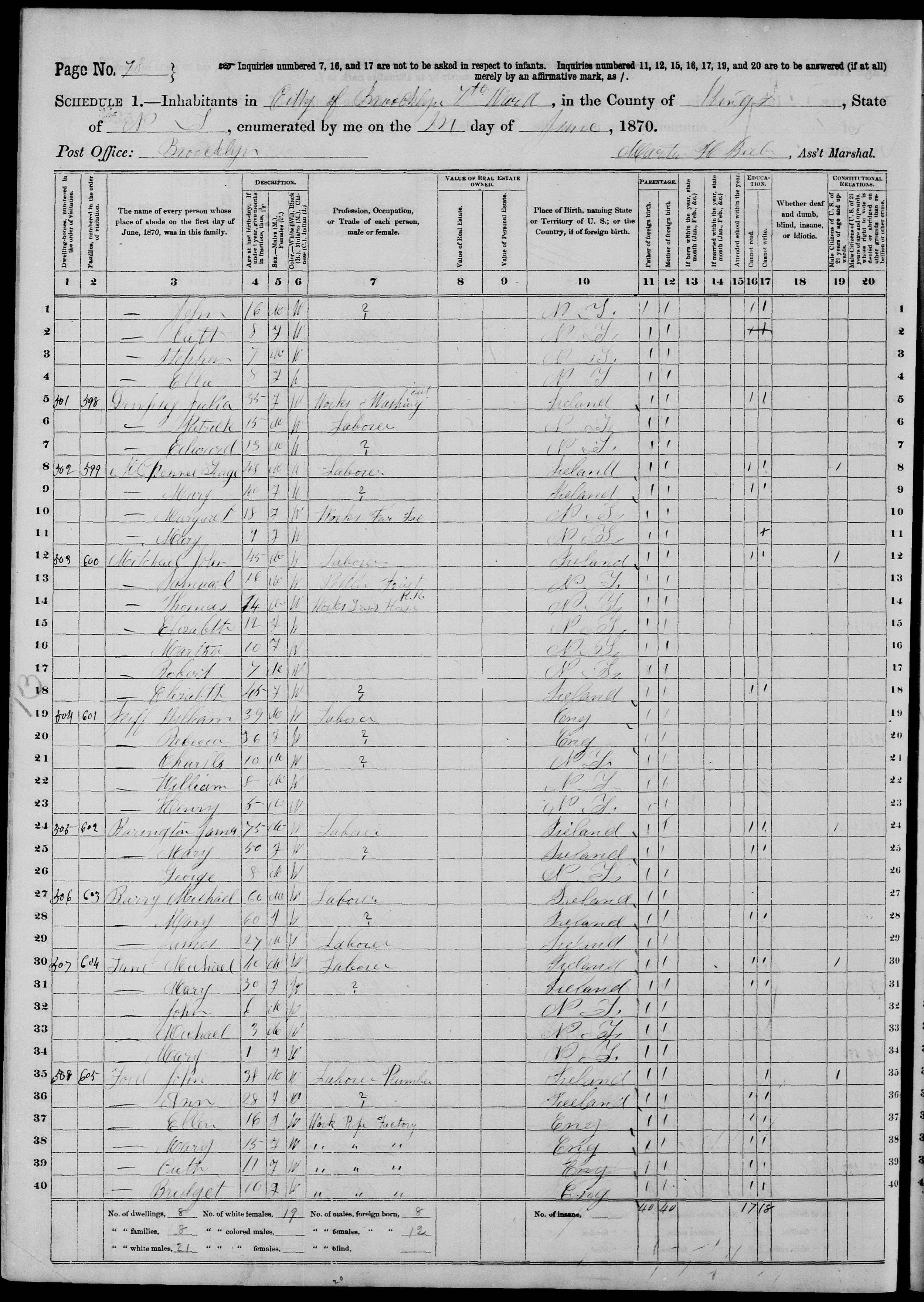
Enumerated June 21, 1870 by Martin H. Bab, Asst. Marshal, months before George’s December 31, 1870 death. The 1870 record continues the 1860 household, with Margaret now 19 and Mary now 10. The enumeration establishes household continuity across the decade and places Margaret as an adult daughter still in her father’s Ward 7 household in the last year of his life.
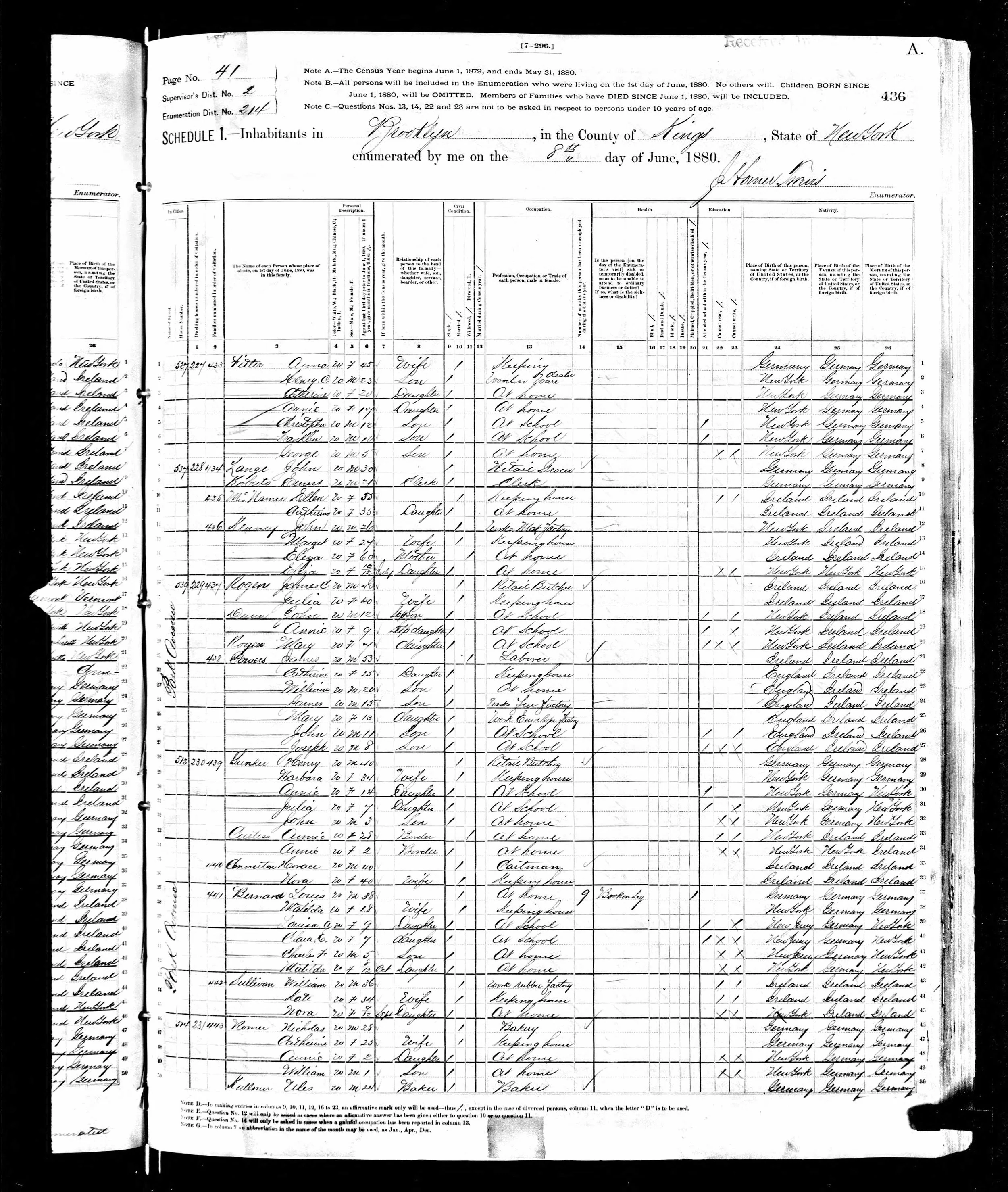
Enumerated June 8, 1880. Dwelling 512, family 230, enumeration district 214. The entry records John Kenny (mat maker, age 26), wife Margaret (age 27, keeping house, parents Ireland), daughter Eliza [Elizabeth] (age 10 months, born July 1879), and Eliza Kenny (mother-in-law, age 70, widow, parents Ireland). The household is the earliest documentary record of Margaret and John as a married couple, and of Mary Agnes’s older sister Elizabeth as infant.
The 1880 enumeration is the primary-source anchor for the Gen 2 → Gen 3 descent claim via marriage. Two years later the St. Patrick’s baptismal register (February 1882) would record Mary Agnes’s birth to these same two parents. The 1880 census is also the negative-evidence anchor for the absent Margaret-John marriage record: the couple is attested as married by this census, even though the marriage document itself has not been located.

Enumerated May 7, 1910. The entry records Joseph Robertson (salesman, hardware, age 27), wife Mary (age 26, married 7 years, 2 children born, 2 living), daughter Lillian (age 4), daughter Helen (age 2). The record confirms Mary Agnes as Helen’s mother and places the complete three-generation biological line (George’s granddaughter married to Joseph Robertson, raising Helen) in a single household three years after Helen’s birth.

Certificate of Baptism issued by St. Patrick’s Church, Kent & Willoughby Avenues, Brooklyn, on May 7, 1924 — presumably in connection with Mary Agnes’s funeral paperwork, which followed her January 26, 1924 death. The certificate is a certified transcript of the original baptismal register entry of February 12, 1882.
Rectory: 285 Willoughby Ave., Brooklyn, N.Y.
Register Date: February 12, 1882
Name of Baptized: Mary Anna [Agnes] Kenny
Date of Birth: February 8, 1882
Father: John Kenny
Mother: Margaret McKenny
Sacrament administered by: Rev. Thomas Taaffe
Sponsors: James Kenny and Mary A. Dunne
Certificate Issued: May 7, 1924
Signed: Rev. John F. Buckley, Pastor [ant]
This certificate is the Gen 2 → Gen 3 descent-proof document. It names both Margaret McKenny and John Kenny as Mary Agnes’s parents at a Catholic sacrament, independently of the 1880 census that records them as a married couple. The issuance of the certificate in May 1924 — four months after Mary Agnes’s death — indicates the family was retrieving it in connection with her funeral and the settlement of her affairs. The sponsor James Kenny is presumably John’s brother, a relationship that will bear further documentation in future Brooklyn Irish research.

State of New York, City of New York Department of Health Certificate and Record of Birth No. 36480. This is the civil birth certificate for Helen Robertson, the fifth TB decedent and the fourth-generation terminus of the biological line.
Name of Child: Helen Robertson
Sex: Female
Color: White
Date of Birth: August 29, 1907
Place of Birth: 808 Marcy Avenue, Brooklyn
Father’s Name: Joseph Robertson
Father’s Residence: 808 Marcy Ave.
Father’s Birthplace: U.S.A.
Father’s Age: 24
Father’s Occupation: Clerk
Mother’s Name: Mary Robertson
Mother’s Name before Marriage: Mary Kenny
Mother’s Residence: 808 Marcy Ave.
Mother’s Birthplace: U.S.A.
Mother’s Age: 23
Number of previous children: 1
Number now living: 2
Signature of person making report: Edward Anderson, 612 Bedford Ave.
This certificate is the Gen 3 → Gen 4 descent-proof document. It names Mary Kenny — that is, Mary Agnes Kenny Robertson — as Helen’s mother, with maiden name stated explicitly. Mary Agnes’s own 1924 death certificate names Margaret McKenny as her mother, and Margaret’s 1884 death certificate is consistent with her being George McKenney’s daughter (corroborated by the 1860 and 1870 censuses). The four-generation descent triangle is therefore closed by this single record: George → Margaret → Mary Agnes (confirmed by 1924 certificate) → Helen (confirmed by this 1907 certificate).
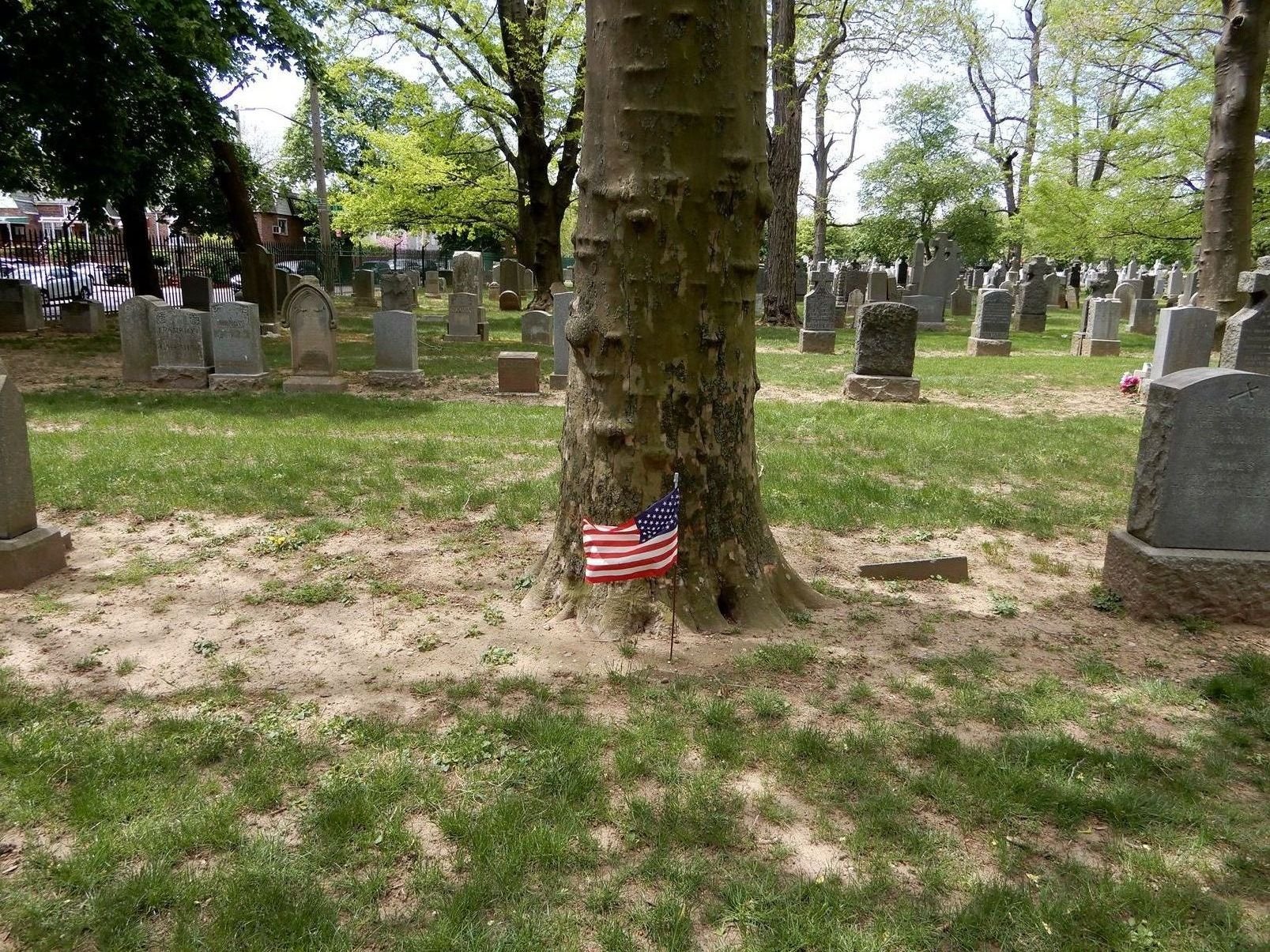
Ann Lynch McKenna purchased Lett Row L, Plot 336 at Holy Cross Cemetery on January 1, 1871 — the same day she interred her husband George McKenney there. George was the plot’s first occupant. Six additional family members subsequently entered the same plot: Margaret McKenny Kenny (1884), her infant daughter Margaret (July 1884, bronchial cause, not TB), Ann Lynch McKenna herself (1888), Mary F. MacKinney (1935), John J. Corbett (1949), and Elizabeth Kenny Corbett (1950). Seven family members total, across seventy-nine years. Two of the seven — George and Margaret — are among the five TB decedents documented in this study. John Kenny, the third TB decedent whose family relationship might suggest interment with his wife Margaret in this plot, is buried separately in the Kenny family section at Holy Cross with his mother Eliza Kenny (d. 1887) and other members of the Kenny natal family — a separation by natal family rather than by marriage.
Methodological note on the plot identification. Holy Cross Cemetery’s online index does not list George McKenney’s Lett Row L Plot 336 burial. An unrelated George McKenna, buried at a separate Holy Cross plot on January 17, 1871, appears prominently in the online index and had been mistakenly identified as our decedent in prior research iterations. Direct verification with the cemetery office on September 23, 2026 confirmed that our George McKenney, who died December 31, 1870 and was buried January 1, 1871, is in Lett Row L, Plot 336 — the plot Ann purchased the same day. This is an instructive case for genealogical researchers: online cemetery indexes are often incomplete for the earliest burials in a plot, and same-name coincidences within a single cemetery can produce persistent mis-identifications that only direct office verification will resolve.

Cemetery index showing Mary A. Robertson at position 1A (died January 26, 1924, buried January 29, 1924) and Janet Verhoek at position 1B (died March 3, 1931, buried March 4, 1931). The two graves are unmarked. Janet was Helen Robertson Verhoek’s infant daughter; her cause of death (broncho pneumonia, contributory second-degree burns) is not in the TB line.
Mary Agnes is the only one of the five TB decedents buried at Immaculate Conception Upper Montclair. When her daughter Helen died in 1942, the family did not bring Helen here to join her mother; Helen was buried instead at Gate of Heaven, East Hanover — approximately sixteen miles away. The reason for the separate interment is not documented but follows the pattern of generational cemetery scatter visible across the full 72-year span.
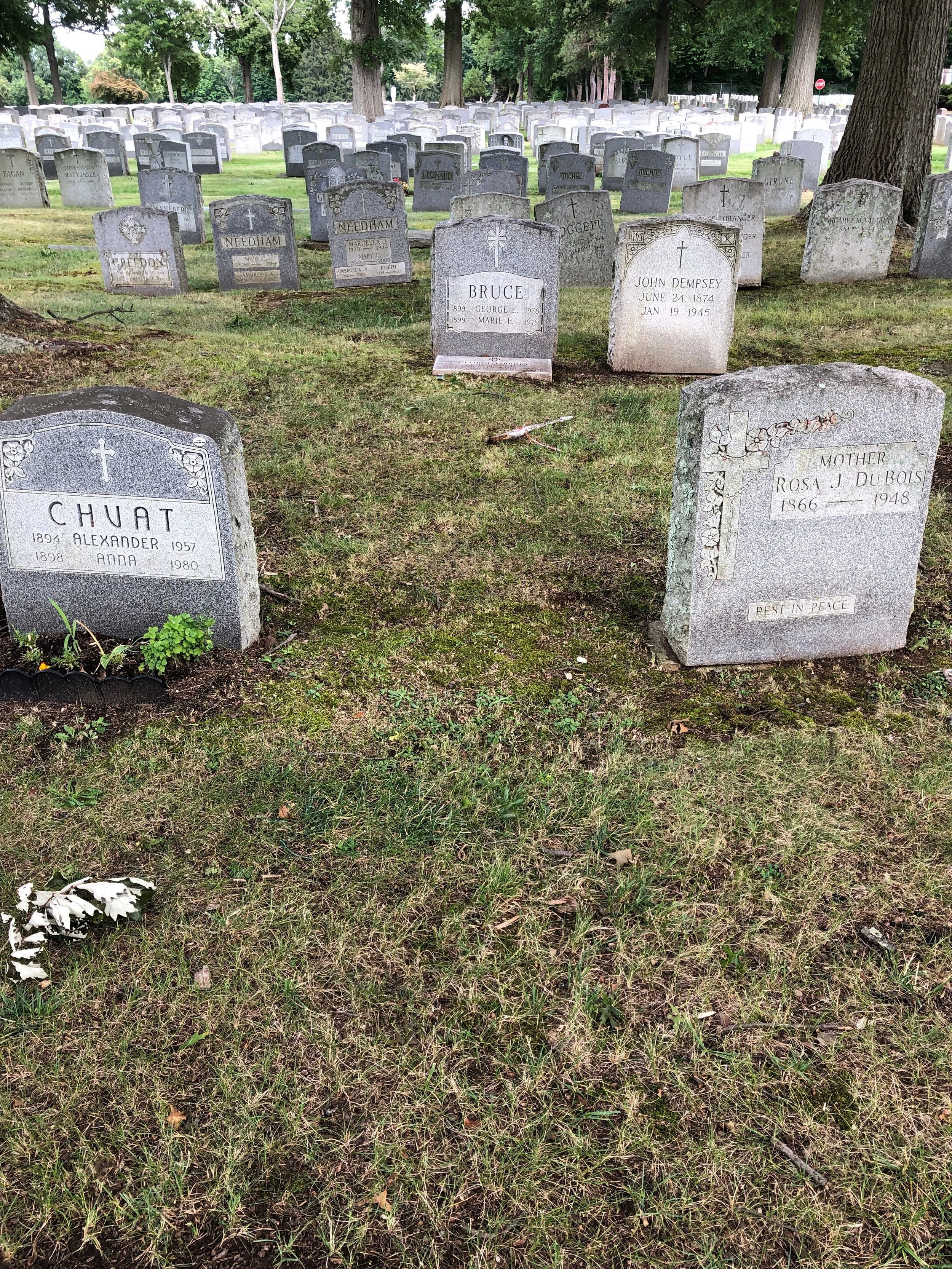
Helen’s grave at Gate of Heaven is unmarked. She was interred in 1942; her son Leslie John Verhoek Jr. joined her in May 2010, 68 years later, in the same plot. The plot has never been marked.
The five TB decedents are buried in three cemeteries across two states: Holy Cross Brooklyn (three decedents — George and Margaret together in Lett Row L Plot 336; John separately in the Kenny family section), Immaculate Conception Upper Montclair (one decedent, Mary Agnes), and Gate of Heaven East Hanover (one decedent, Helen). The biological line was continuous; the burial geography was not.
Source Inventory
All primary and convergent-evidence sources cited in this case study, organized by record type, with status notations
Dec 31, 1870
May 24, 1884
Nov 30, 1888
Jan 26, 1924
Jul 21, 1942
Rel. Sept. 2026
Notice
Order Attempt
Jul 22, 1942, p. 9
Testimony
Testimony
Cemetery Record
Brooklyn Ward 7
Brooklyn Ward 7
436 Park Ave, Bklyn
Brooklyn Ward 29
Brooklyn
68 E 5th St, Bklyn
Feb 12, 1882
Aug 29, 1907
Lett L / Plot 336
Kenny family section
Upper Montclair, N.J.
Blk-W Tr-19 Gr-58
East Hanover, N.J.
Sec 40 C, Tier G, Gr 10
Marriage c. 1878
Civil Birth 1882
Sanatorium Records
1942 Essex Co. Microfilm
Death Cert. 1945
Parishes · 1878 Marriage
Open Research Questions
The leads this study has identified but not yet closed, in order of priority for future work
N.J. State Archives — Helen’s 1942 Death Certificate
Closed September 22, 2026. The New Jersey State Archives fulfilled the standard $10 Death Record Search Request (Order #202608-90492) and released Helen’s certificate by digital PDF. The archives’ certificate-search channel — distinct from the New Jersey Department of Health’s VitalChek route — accepts requests on name, county, and month/year with no lineal-relationship restriction imposed on the applicant. Full transcription in the document gallery above; barrier documentation preserved as the record of the four-year interval during which the certificate was inaccessible.
Essex Mountain Sanatorium — Helen Verhoek Patient File
With Helen’s state certificate now in hand, an Essex Mountain Sanatorium patient file is no longer necessary to establish cause of death. It remains a lead of biographical interest: it would document the timeline of Helen’s treatment before Dr. R. E. Gardner of Bloomfield took over her care in August 1941. The likeliest custodians of surviving records are the Rutgers George F. Smith Library of the Health Sciences Special Collections (whose special-collections librarian Robert Vietrogoski has presented publicly on Essex Mountain), the Essex County Clerk’s office, and the New Jersey State Archives. A records inquiry is a reasonable future step but no longer time-sensitive.
Leslie J. Verhoek Sr. — 1945 Cause of Death
Helen’s husband Leslie died three years and three months after her at age 41. His obituary does not state cause of death and his Find a Grave memorial is silent. A New Jersey death certificate for Leslie Sr. (obtainment subject to the same state records barrier) would establish whether secondary household tuberculosis transmission occurred beyond the biological line. Not material to the main argument of continuous biological transmission but methodologically interesting for the edges of the household-contagion hypothesis the 1924 certificate’s “contracted in Brooklyn” field implies.
Margaret McKenny – John Kenny Marriage · c. 1878, Brooklyn
The marriage is attested by three other record types (1880 census, 1882 baptism, 1888 death certificate). Locating the marriage certificate itself would provide a specific date and parish and would close the negative-evidence gap documented in this study. Additional Brooklyn Catholic parishes — St. Mary’s, St. James Pro-Cathedral, and others of the 1870s — remain to be searched systematically. Lower priority because the marriage’s existence is not in doubt.
This methodology page accompanies the case study summary. The case study presents the argument; this page documents how each element was established and what each primary record contains.
← Return to Case Study The Women Who Stayed — Series Hub Episode 5: Twelve Days Episode 6: The Last Companion: The First Loss