
The Tide That Turned Both Ways — How the Research Was Done
A document-by-document account of how a transatlantic return migration was proven without a single surviving migration record — through Scottish statutory marriage citations, Brooklyn directory brackets, census immigration arithmetic, and the resolution of one certificate’s compounding errors.
Research Methodology
Six steps from a five-year silence in the American record to a proven circular migration
The Central Problem This Case Addresses
The Genealogical Proof Standard requires reasonably exhaustive research, complete citation, analysis and correlation of evidence, resolution of conflicts, and a soundly reasoned conclusion. This case puts unusual weight on the correlation element — because the direct record class that would settle the question was never created. The United Kingdom kept no inward passenger lists for arrivals from outside Europe and the Mediterranean until 1878. A family sailing from New York to the Clyde around 1875 left no arrival record anywhere, and never will. The absence of that record is not a research failure; it is a structural fact about the sources.
The proof therefore had to be assembled from independent record systems on two sides of the Atlantic — each created for its own administrative purpose, none created to document migration — that interlock on a single point: the same couple, identified by the same 1866 Dundee marriage, present in Brooklyn through 1874, in Glasgow from 1876 to 1878, and back in Brooklyn by 1880. The methodology below documents how each piece was established, and how the conflicts the records contain were resolved rather than ignored.
Anchor Both Identities in Scottish Records
Before a migration can be proven, the migrants must be unambiguously identified. Elizabeth Gray’s origins were established in the National Records of Scotland: her baptism in the Monymusk Old Parish Register (OPR 224), recording her as daughter of James Gray in Balvack and his wife Elizabeth Littlejohn, born 25 December and baptized 14 March 1846; and the 1861 census (224/3/4), which places her in her father’s household at Newcrofts — James Gray, crofter of six acres — as a scholar.
The couple’s June 23, 1866 Dundee marriage then becomes the master key. Scotland’s statutory birth registers, uniquely, record the date and place of the parents’ marriage on every entry. The first link in the chain is the 1867 Dundee birth of their first son William (282/1 714), at 11 Blackscroft, citing “1866 June 23, Dundee.” Every subsequent Scottish record of this family would carry the same citation — turning each birth entry into an identity proof.
Document the First Brooklyn Period — Bracket One
The family’s establishment in America rests on three records. The 1870 Federal Census (Brooklyn Ward 12, enumerated June 15) lists David Robertson, stone cutter, born Scotland, with wife Elizabeth and two American-born daughters. The 1874 Brooklyn city directory lists “Robertson David, stonecutter, 119 Hamilton av” — the address of his widowed mother, his father George having died in Brooklyn in July 1872. And the May 1874 Return of a Birth for George Paterson Robertson places the family in residence at that same address, naming both parents and recording the father’s full name — David Paterson Robertson — and both parents’ Scottish birthplaces.
Together these fix the family in Brooklyn, at a known address, in a known trade, through mid-1874. That is the first bracket.
Characterize the Gap and Rule Out the Alternatives
After 1874 the family disappears from Brooklyn directories and vital records until 1880. A gap of that length is conventionally read as a westward move, a death, or an enumeration miss. Each was tested and failed: no Robertson household matching this family appears elsewhere in American records of the period; the family is demonstrably alive and intact afterward; and city directories were compiled by annual canvass — a five-year absence is not an accident of coverage.
The critical methodological move was recognizing what the gap could not be filled with. Because UK inward passenger lists do not exist before 1878, the absence of an arrival record carries no evidentiary weight in either direction. The hypothesis of a return to Scotland could be neither supported nor refuted by migration records. It could only be tested where the family would have generated records by living: Scotland’s statutory registers.
Prove the Sojourn Through Statutory Marriage Citations
Two statutory birth entries close the case. William Robertson, born March 31, 1876, in the Maryhill district of Glasgow (622/1 199): father David Robertson, mason (journeyman); mother Elizabeth Robertson, maiden surname Gray; parents’ 1866 Dundee marriage cited; the father himself the informant. Elizabeth Gray Robertson, born April 6, 1878, at 122 Blackburn Street, Govan (646/1 634): same parents, same occupation, marriage cited “1866 June 23rd, Dundee”; the father again the informant.
The marriage citations match the 1867 Dundee entry exactly. Three statutory records, three registration districts, eleven years apart, one marriage — under Scottish registration practice, this is parental identity proof. The Glasgow births belong to the Brooklyn couple and to no other David Robertson and Elizabeth Gray. The occupational thread — stone mason in Dundee, stone cutter in Brooklyn, mason (journeyman) in Maryhill and Govan — is the same trade in each country’s idiom.
Close the Bracket and Correlate Across Record Systems
The 1880 Brooklyn directory lists David Robertson, stonecutter, at 119 Hamilton Avenue — the identical address and trade where the 1874 listing left off. That is the second bracket. The family then re-accumulates American records: Joseph’s 1884 birth certificate (which numbers him the mother’s tenth child, corroborating the eleven-children count later recorded in 1900), the 1892 New York State census household, and the 1900 Federal Census.
The census immigration columns encode the round trip in the family’s own later testimony. In 1900, David and Elizabeth each report immigration in 1870 — the first arrival. Their son William, enumerated separately as a Brooklyn mason, reports birth in Scotland and immigration in 1878; his 1910 entry repeats it. A Scottish-born child of Brooklyn-settled parents, arriving in 1878, is inexplicable without the return — and exactly what the Maryhill register predicts.
Resolve the Conflicts; Situate the Pattern in Scholarship
The American records of this family contain a recurring class of error that had to be analyzed, not ignored. Joseph’s 1884 certificate — completed by the attending midwife, not the family — renders the surname as Robinson and both parents’ birthplaces as “U.S.”; the 1892 state census carries “U.S.” birthplaces down the column in ditto marks; George’s 1919 death certificate gives a birth date (May 8, 1874) that conflicts with his contemporaneous 1874 birth return (May 27). In each case the resolution follows the informant: records the parents themselves informed — three signed statutory registrations and two federal censuses — outweigh derivative notations by third parties.
Finally, the proven migration was situated in its documented historical pattern. Tahitia McCabe’s 2017 study of the 1881 Scottish census identified 2,167 American-born residents of Scotland, over half of them children under fifteen, with more than three-quarters of traced parents being Scottish return migrants concentrated in the Glasgow industrial belt — construction among the leading occupations. The Panic of 1873 collapsed the American building trades while Scotland’s iron boom drove Glasgow wages up. The Robertsons match the wave point for point. The pattern is context, rated suggestive; the proof is the record correlation in Steps Four and Five.
Primary Documents
The complete research file — original images, transcriptions, and analytical notes, organized by record group
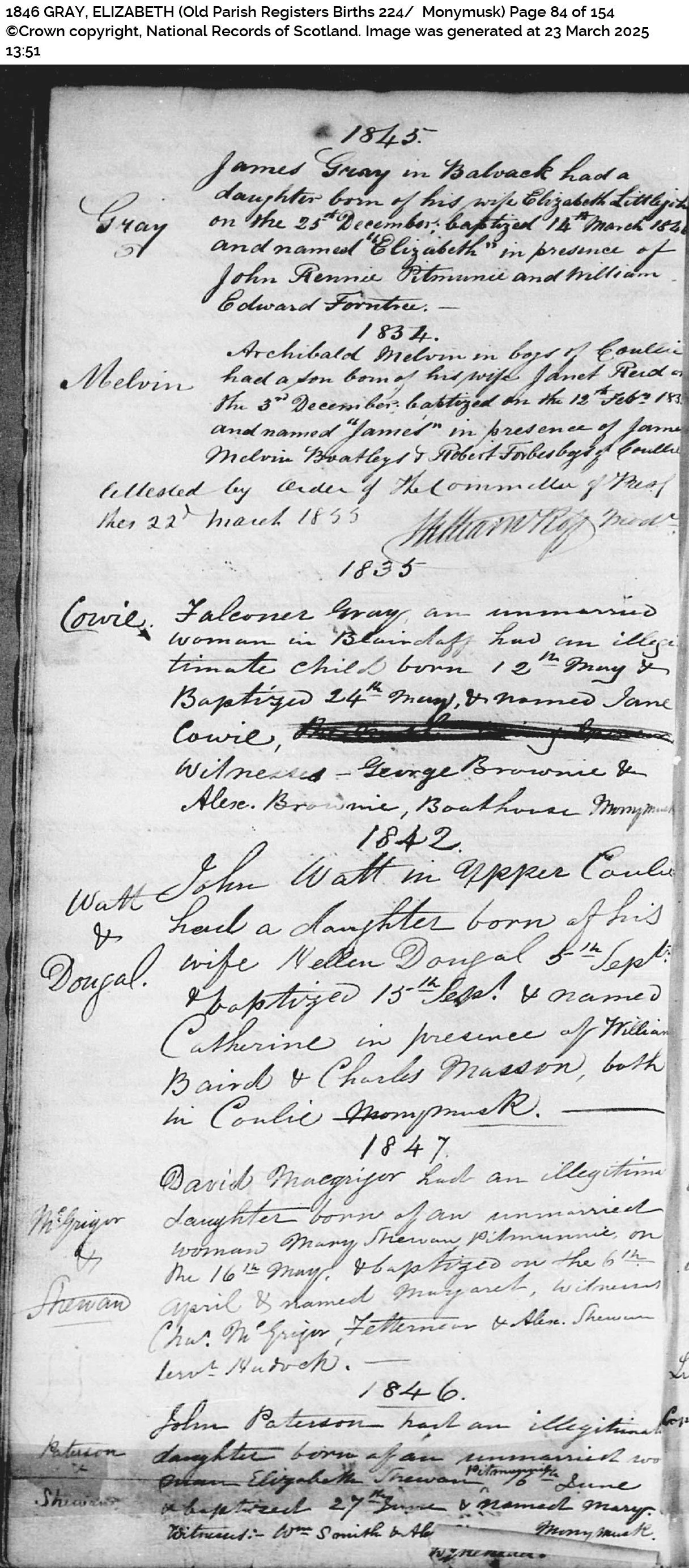
The Monymusk Old Parish Register records Elizabeth’s baptism — and, crucially, her mother’s name, which appears in no later record of the family.
This entry establishes Elizabeth’s parents — James Gray and Elizabeth Littlejohn — and her Monymusk origin, the anchor that later outweighs every American misstatement of her birthplace. The entry sits on a retrospectively attested page (attestation dated 1855) beneath an 1845 year heading, with baptism on 14 March 1846 — implying birth on 25 December 1845, while the family gravestone reads December 25, 1846. The one-year question is logged in the source inventory for resolution; it does not affect her identity, which the parents’ names and the Newcrofts census fix beyond doubt.
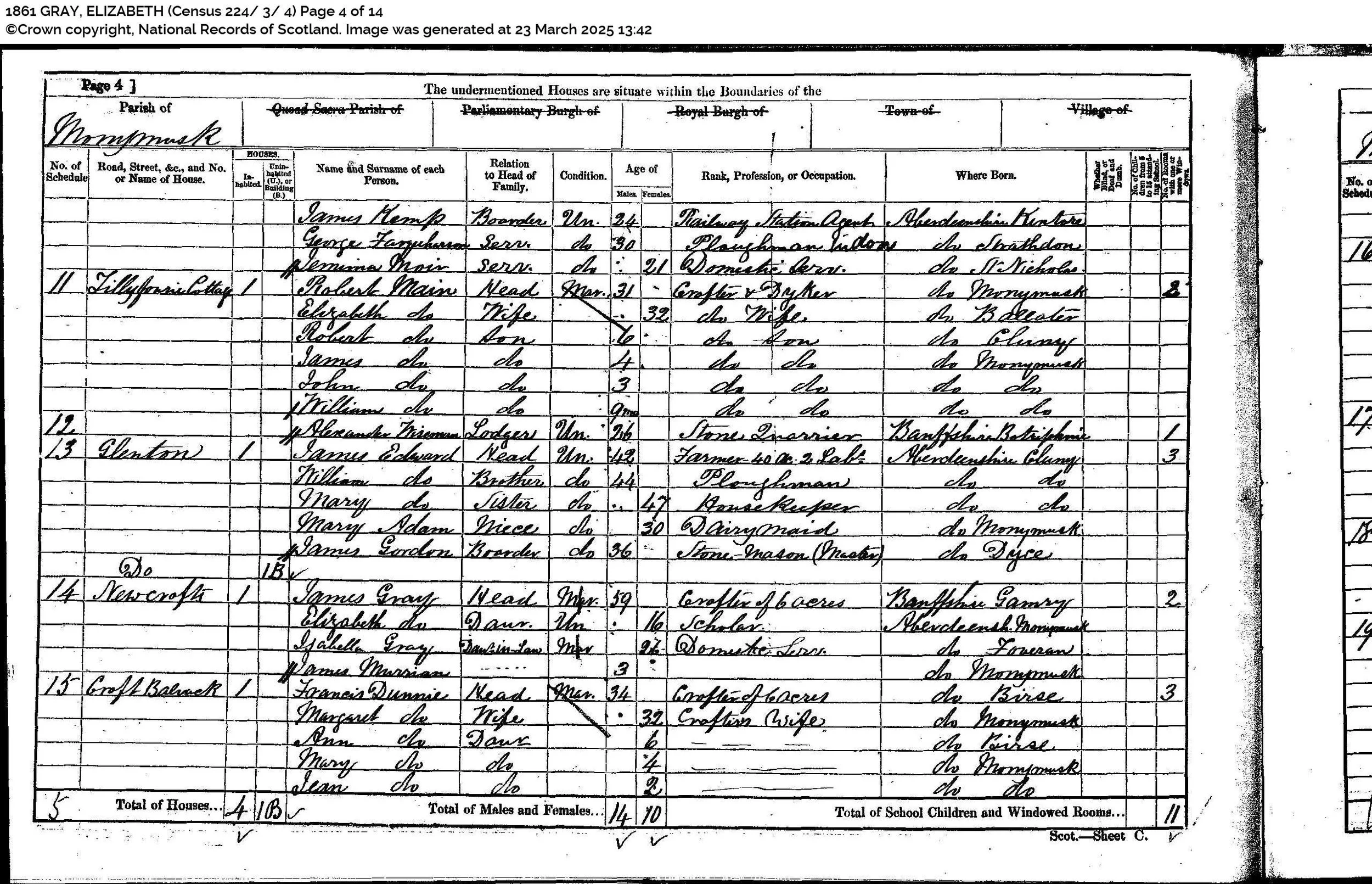
Elizabeth do., Daur., Un., 16, Scholar, b. Aberdeensh., Monymusk
Five years before her marriage, Elizabeth is documented in her father’s six-acre croft household — born Monymusk, still a scholar. The census age (16 in April 1861) is one more datum bearing on the birth-year question noted above. How a crofter’s daughter from rural Aberdeenshire came to meet a Perthshire mason’s son in Dundee remains undocumented; the marriage itself is what every later record points back to.

Father: David Robertson, Stone Mason
Mother: Elizabeth Robertson, M.S. Gray
Marriage: 1866 June 23, Dundee
Informant: David Robertson, father, present
This is the first link in the marriage-citation chain that makes the entire case provable. The 1866 June 23 Dundee citation recorded here will reappear, verbatim, on two Glasgow entries nine and eleven years later — connecting the returning family to this couple and no other. This first William died before 1870; the family would reuse his name for the son born in Maryhill during the return.
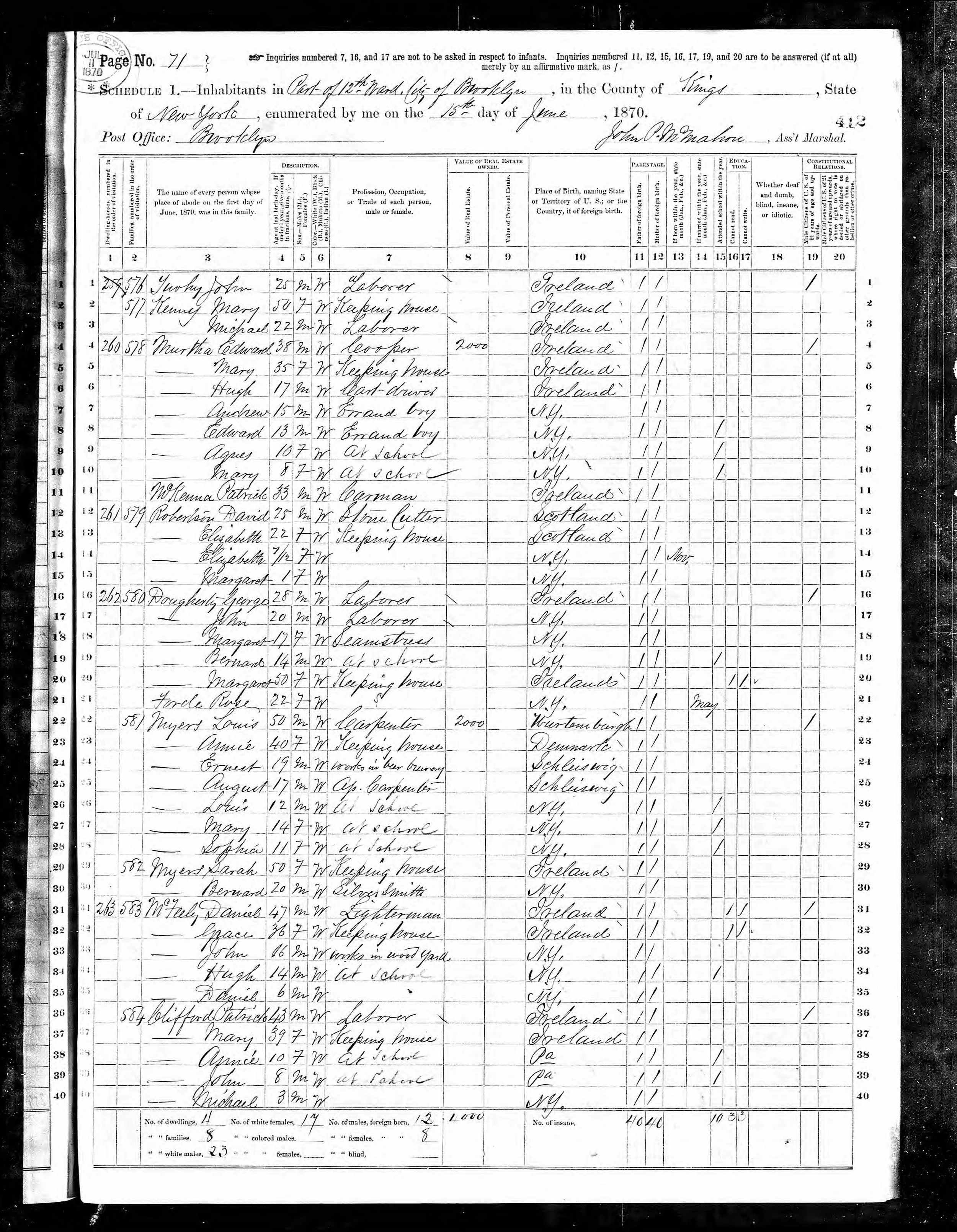
Elizabeth, 22, F, Keeping House, b. Scotland
Elizabeth, 7/12, F, b. N.Y. (born Nov.)
Margaret, 1, F, b. N.Y.
The first American record. Two American-born daughters fix the emigration window at c. 1868–69; the Scottish-born first son William is absent, having died in infancy. David’s stated age of 25 understates his 1842 birth — the first of many small numeric slippages in this family’s American records, none of which disturbs the identification.
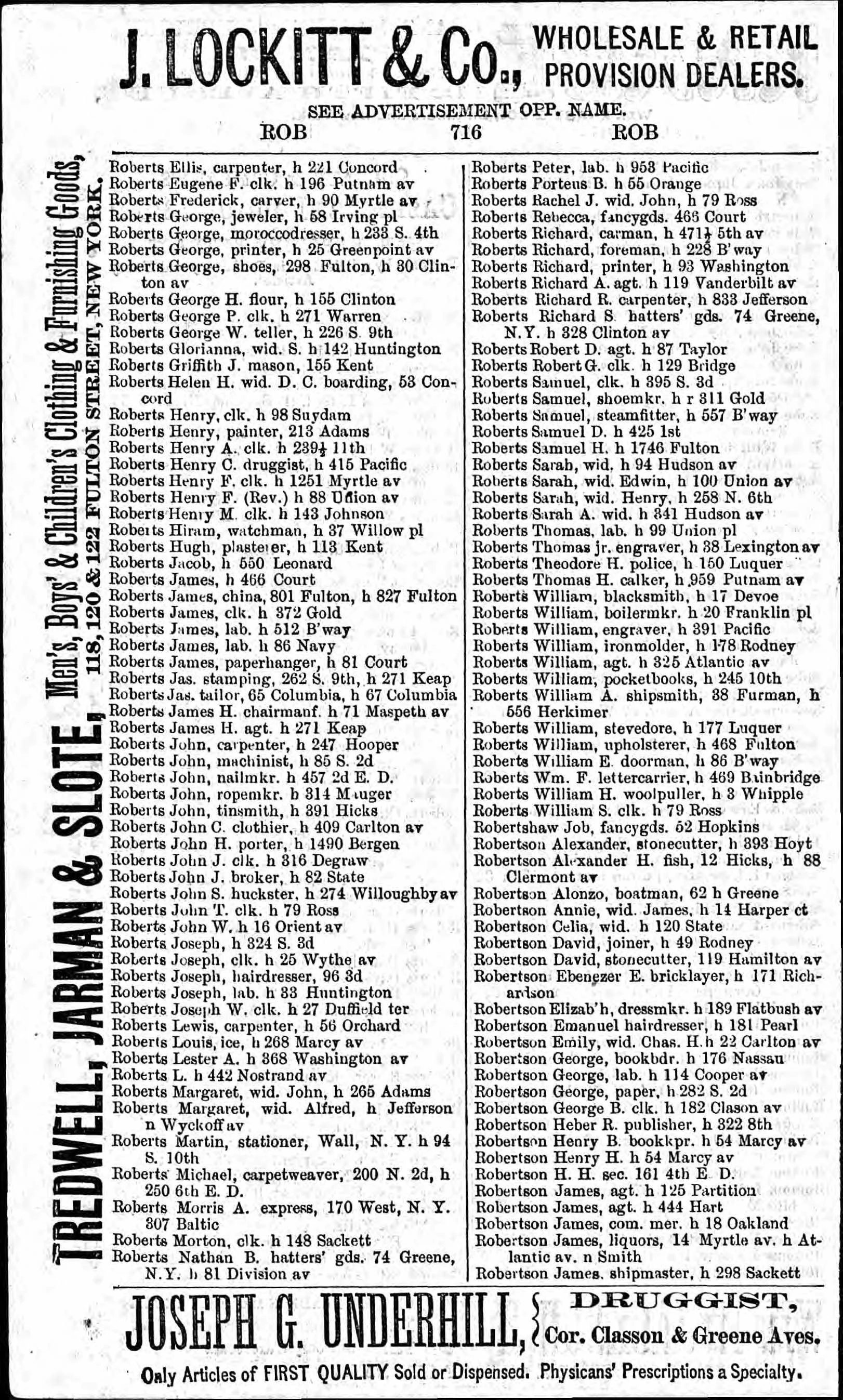
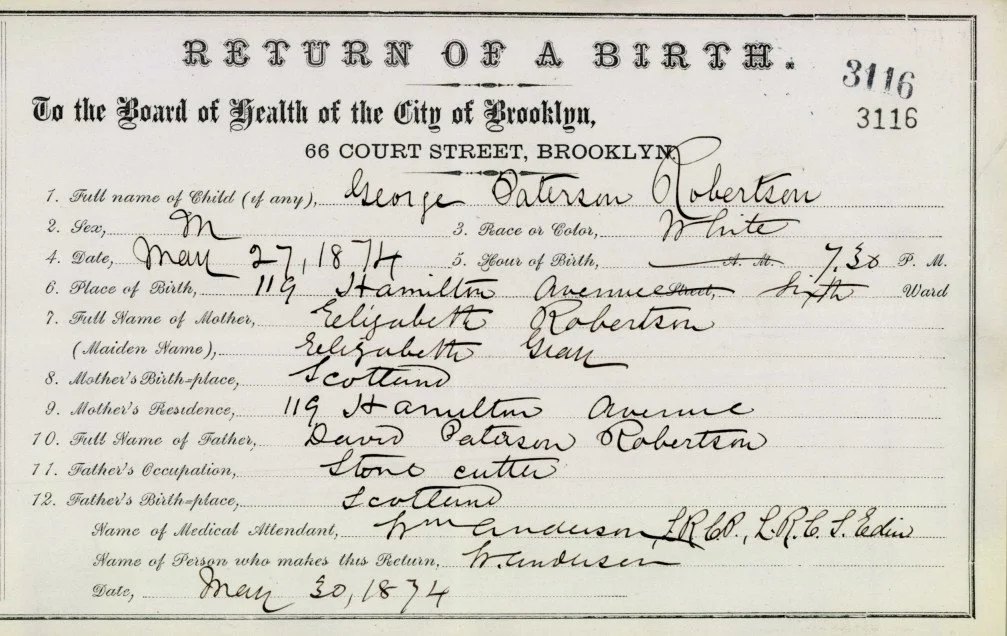
The 1874 directory lists “Robertson David, stonecutter, 119 Hamilton av” — his widowed mother’s address. The Return of a Birth for George Paterson Robertson places the family in residence there.
Place: 119 Hamilton Avenue, Sixth Ward
Mother: Elizabeth Robertson (maiden: Elizabeth Gray), b. Scotland
Father: David Paterson Robertson, Stone Cutter, b. Scotland
Returned by: Wm. Anderson, L.R.C.P., L.R.C.S. Edin., May 30, 1874
Two findings beyond the bracket itself. First, this return records the father’s full name — David Paterson Robertson — the documentary basis for his middle name, echoed in the son’s name and pointing toward his mother Margaret’s Paterson maiden name. Second, the birth date here is May 27, 1874 — a contemporaneous record returned within three days by the attending physician. George’s 1919 death certificate would later state May 8; the conflict is resolved in favor of this return (see the 1919 record below).
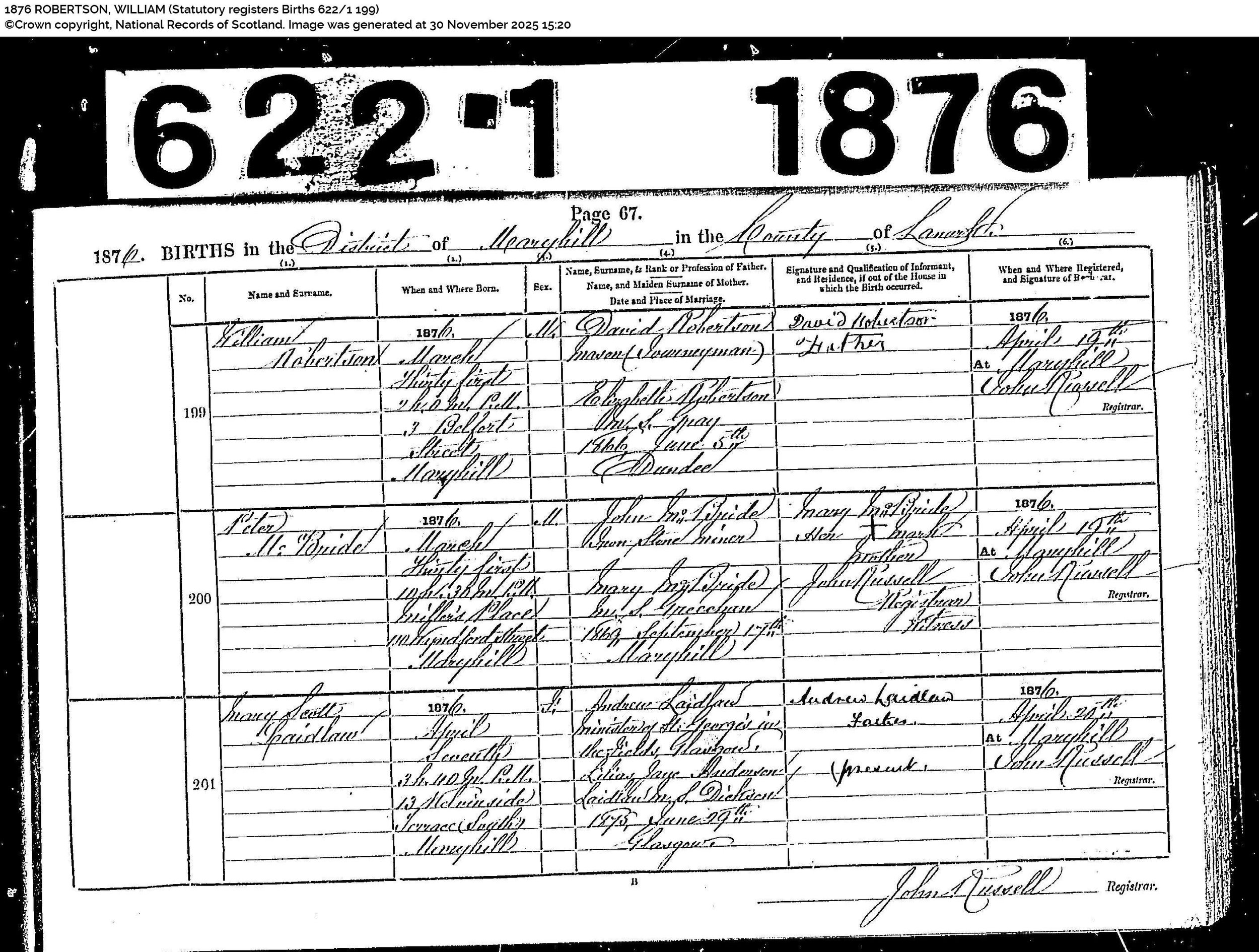
Father: David Robertson, Mason (Journeyman)
Mother: Elizabeth Robertson, M.S. Gray
Marriage: 1866 June [23d?], Dundee
Informant: David Robertson, Father · Registered April 19, 1876, at Maryhill
The record that proves the return. Twenty-three months after George’s birth at 119 Hamilton Avenue, the same couple — identified by the 1866 Dundee marriage citation and the father’s own signature as informant — registers a son in industrial Glasgow. This William, the only child of the sojourn to survive to adulthood, carries his Scottish birthplace and 1878 immigration year through every later American record, becoming the family’s walking corroboration of the journey.
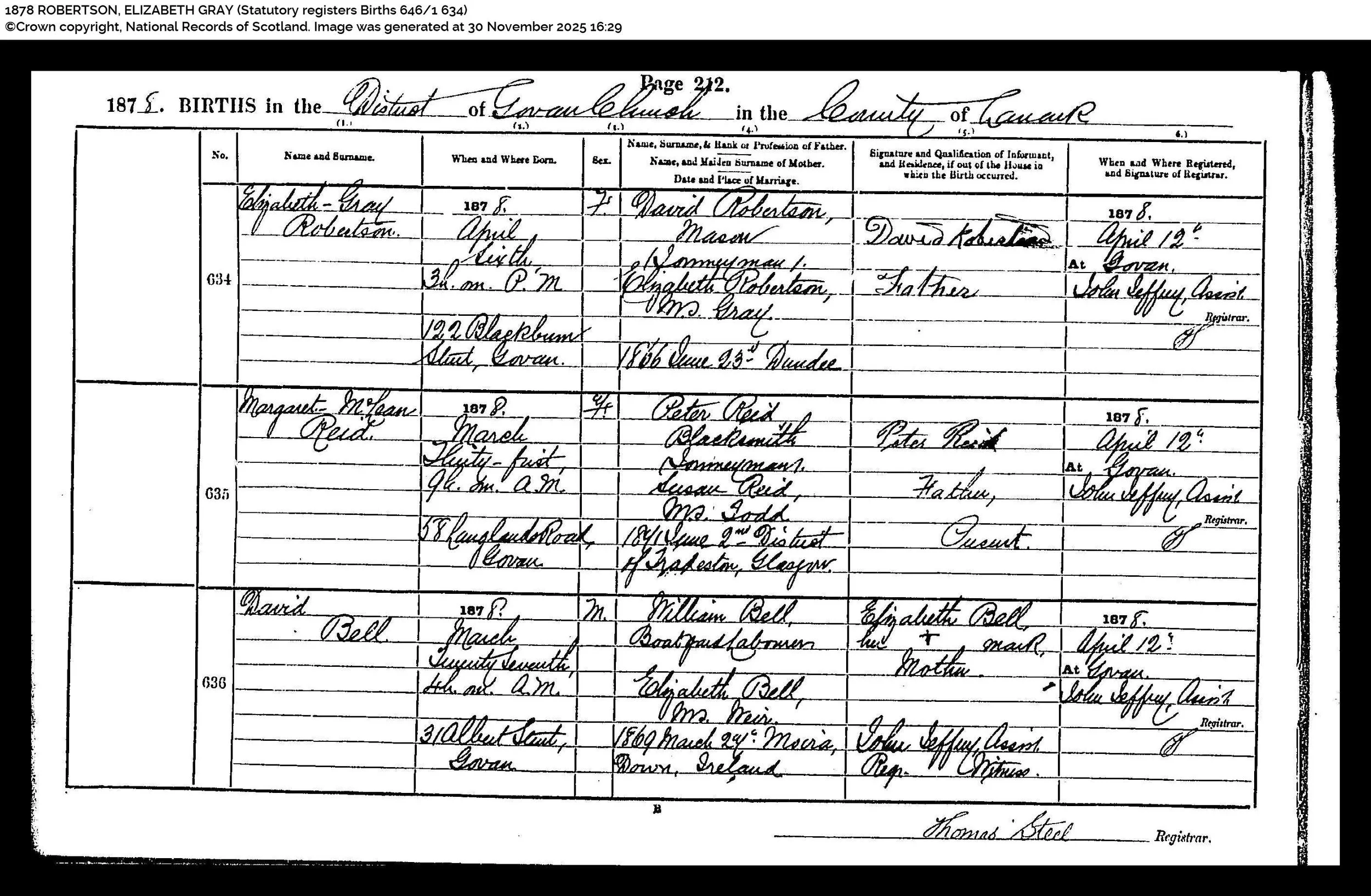
Father: David Robertson, Mason (Journeyman)
Mother: Elizabeth Robertson, M.S. Gray
Marriage: 1866 June 23rd, Dundee
Informant: David Robertson, Father · Registered April 12, 1878, at Govan
The second linchpin, with the marriage citation at its clearest: “1866 June 23rd, Dundee” — matching the 1867 Dundee entry verbatim. The daughter was named Elizabeth Gray for her mother, almost certainly because the first Brooklyn-born Elizabeth had died; this second Elizabeth would also die young. Within months of this registration the family re-crossed the Atlantic. This entry is the last Scottish record of the household.
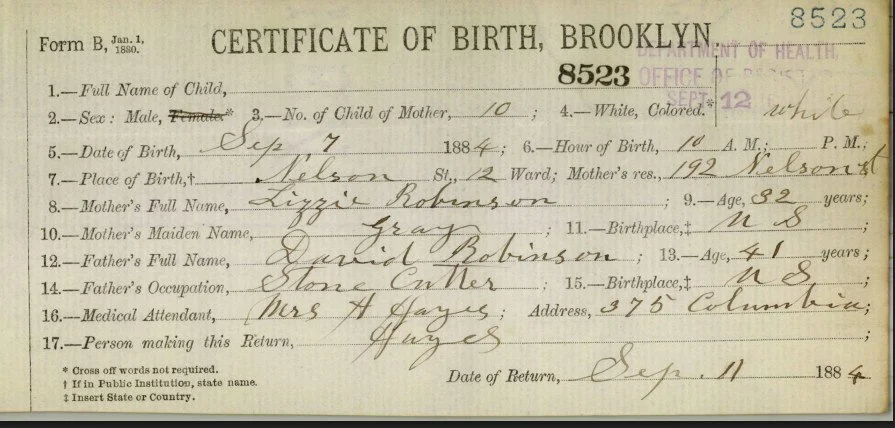
Born: Sep. 7, 1884, 10 A.M., Nelson St., 12th Ward; mother’s res. 192 Nelson St.
Mother: Lizzie Robinson, maiden Gray, age 32, birthplace U S
Father: David Robinson, age 41, Stone Cutter, birthplace U S
Return made by: Mrs. H. Hayes, medical attendant, 375 Columbia
Informant analysis. The return was completed by the attending midwife, not the family. It renders the surname as Robinson and records two Scottish-born, Scottish-married parents as born “U.S.” Taken at face value it severs the family’s documented origins entirely. It is contradicted by every record the parents themselves informed — three signed statutory registrations and two federal censuses — and is accordingly set aside on both points. Its independent contribution survives: Joseph as the mother’s tenth child corroborates the 1900 census count of eleven children born.
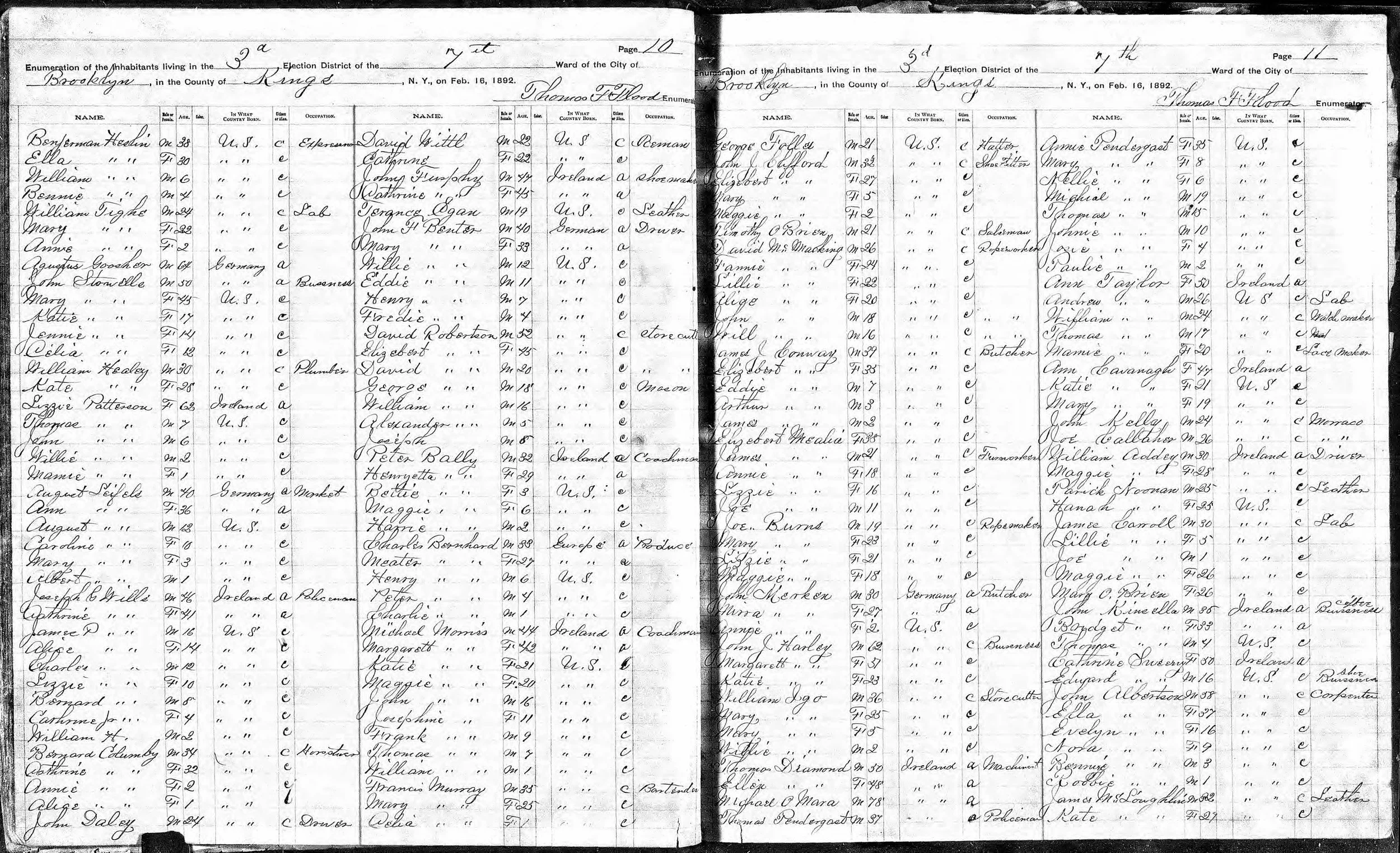
The 1892 state census documents the reassembled Brooklyn household: David, stonecutter, 52; Elizabeth, 45; sons David (20), George (18, already a mason), William (16), Alexander, and Joseph. The enumerator’s ditto marks carry “U.S.” birthplaces down the column — a second derivative record repeating the American-birth error, and one more entry in the informant analysis above.
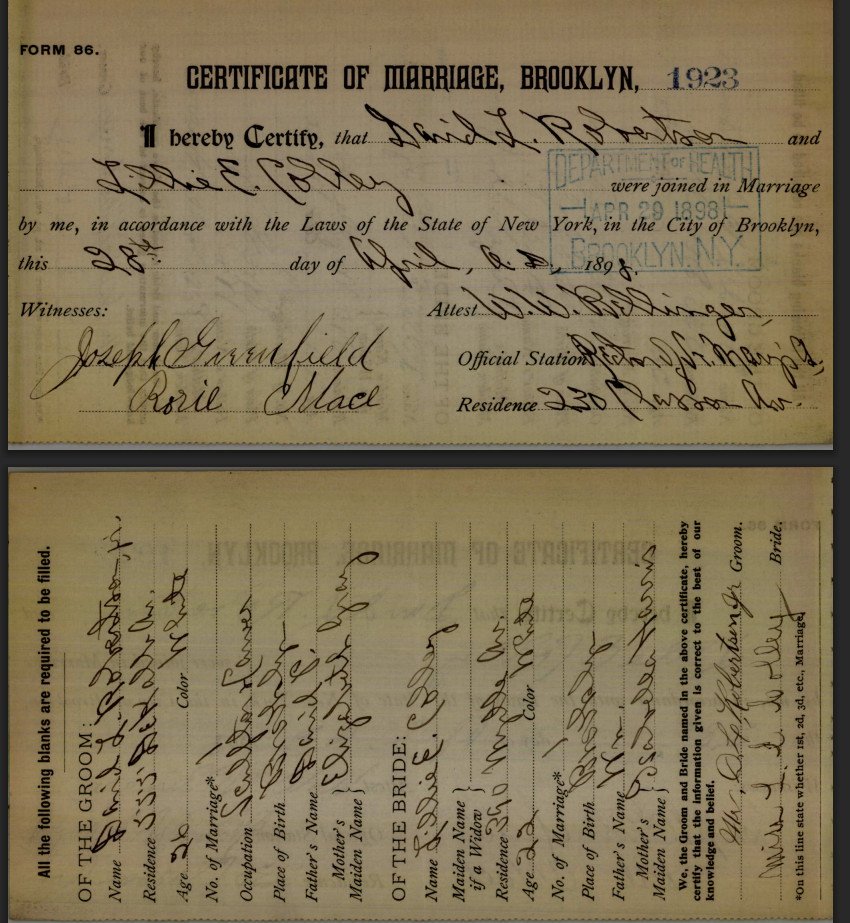
Beside it, the certificate of marriage for David L. Robertson and Lillie E. Colley — witnesses Joseph Greenfield and Rosie Mace — carries the next generation forward.
Date conflict, pending resolution. The certificate is dated “this 28th day of April, A.D. 1898” and stamped by the Department of Health April 29, 1898; earlier compilations of this family carried the marriage as 1892. The certificate’s own date governs unless an 1892 record surfaces; logged in the source inventory.
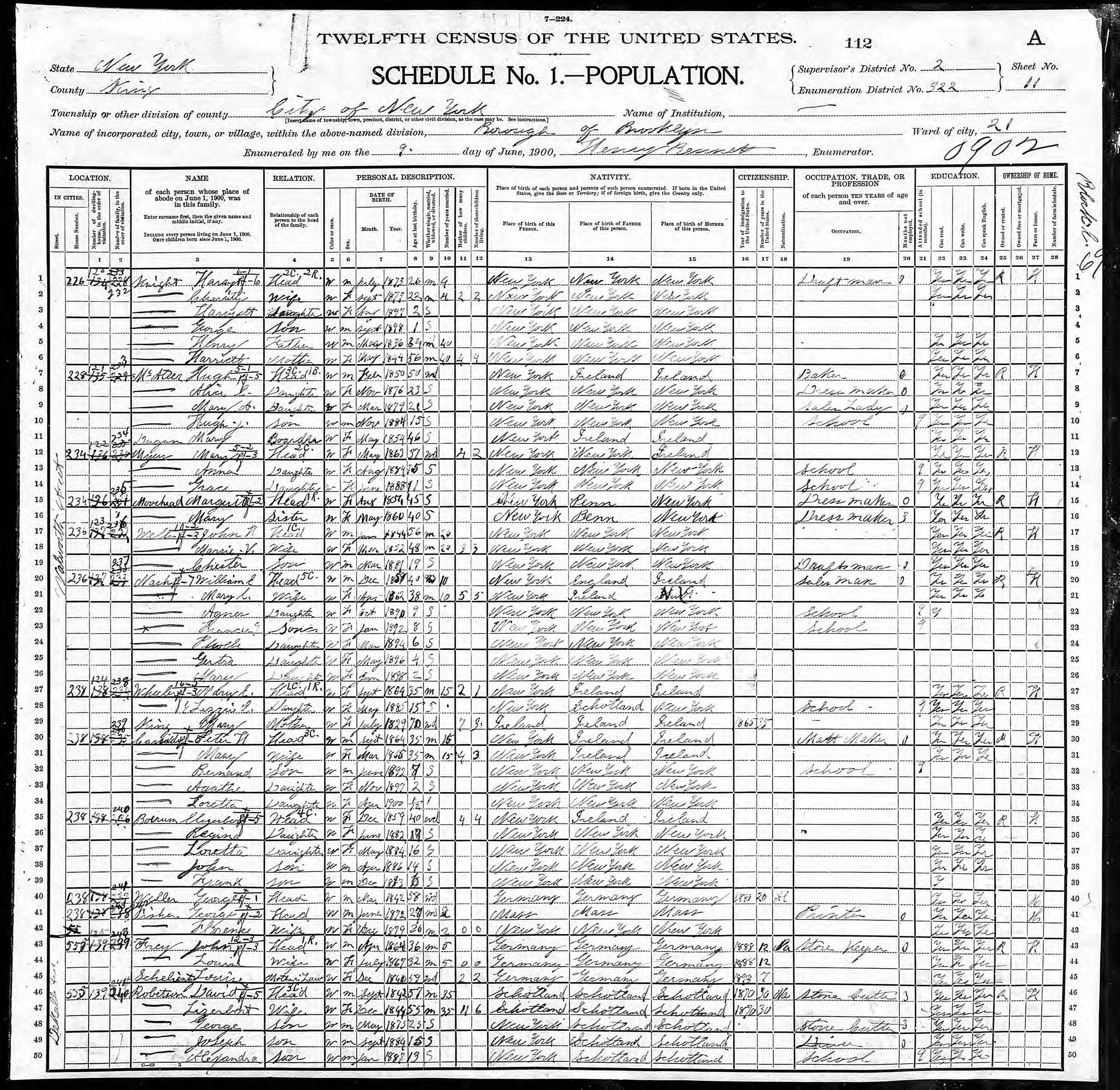
Elizabeth, wife, b. Dec 1844, Scotland — mother of 11 children, 6 living
——
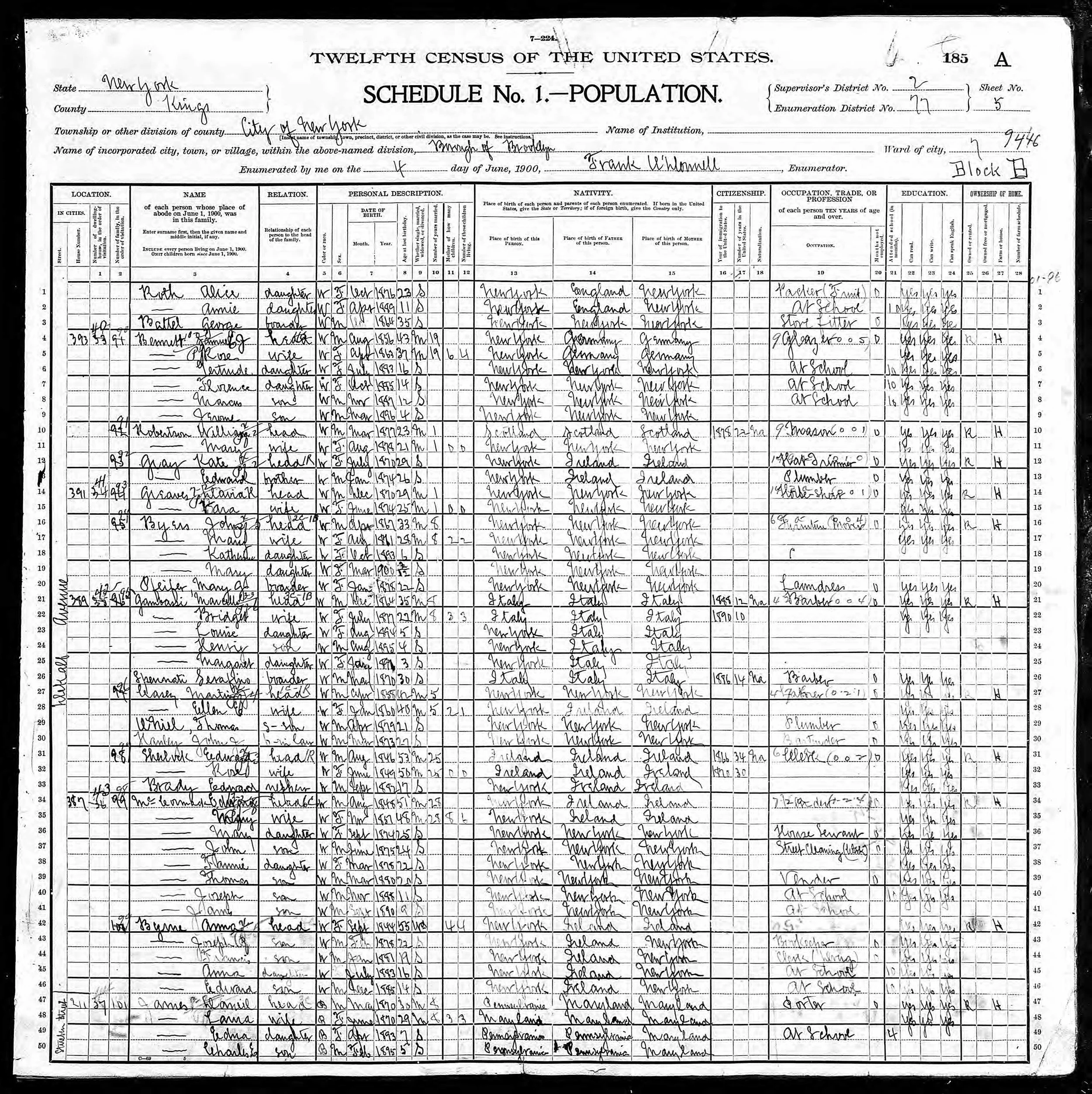
William Robertson, head, b. Mar 1877 [recte 1876], Scotland, immigrated 1878, Mason
The corroborating arithmetic. The parents report 1870 — the first arrival. Their Scottish-born son, in his own household, reports 1878 — the re-emigration. Neither informant was documenting a migration; each was answering a routine census question a generation later. The two answers are inexplicable together except by the return the Glasgow registers prove. Elizabeth’s “11 born, 6 living” sets the family’s full arithmetic of loss — corroborated by Joseph’s “child No. 10” in 1884.
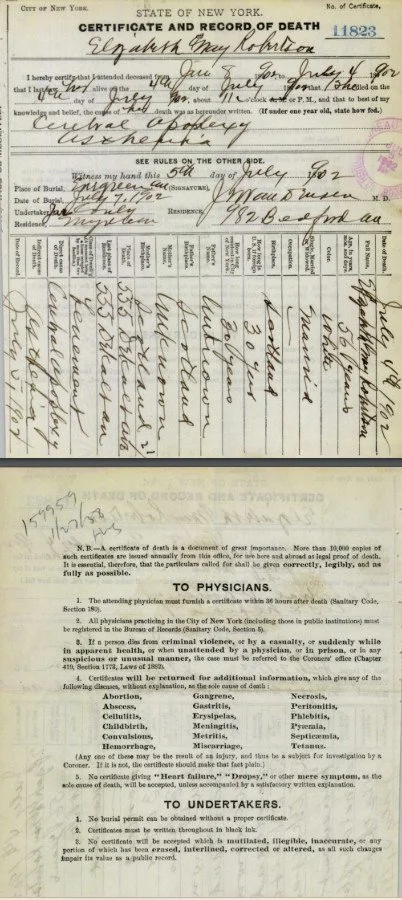

Elizabeth died of cerebral apoplexy on July 4, 1902, aged 56 by the certificate — born on Christmas Day, dead on Independence Day. The certificate records her birthplace as Scotland and her burial at Evergreens Cemetery on July 7, 1902. The Surrogate’s Court file cover records the administration petition filed and decree made July 17, 1902; the papers name all six surviving children. A Brooklyn Daily Eagle death notice independently confirms the date of death, gives David’s middle initial P., states her origin as Aberdeen, Scotland, and supplies the home address (full citation pending; see source inventory).
Two clarifications emerge from reading the documents together. July 7 is the burial date at Evergreens, from the death certificate; July 17 is the probate filing, from the Surrogate’s Court cover — two distinct events ten days apart, previously conflated. And Evergreens was only Elizabeth’s first resting place: Green-Wood’s records show her reinterment there on October 26, 1902 (see the cemetery group below).
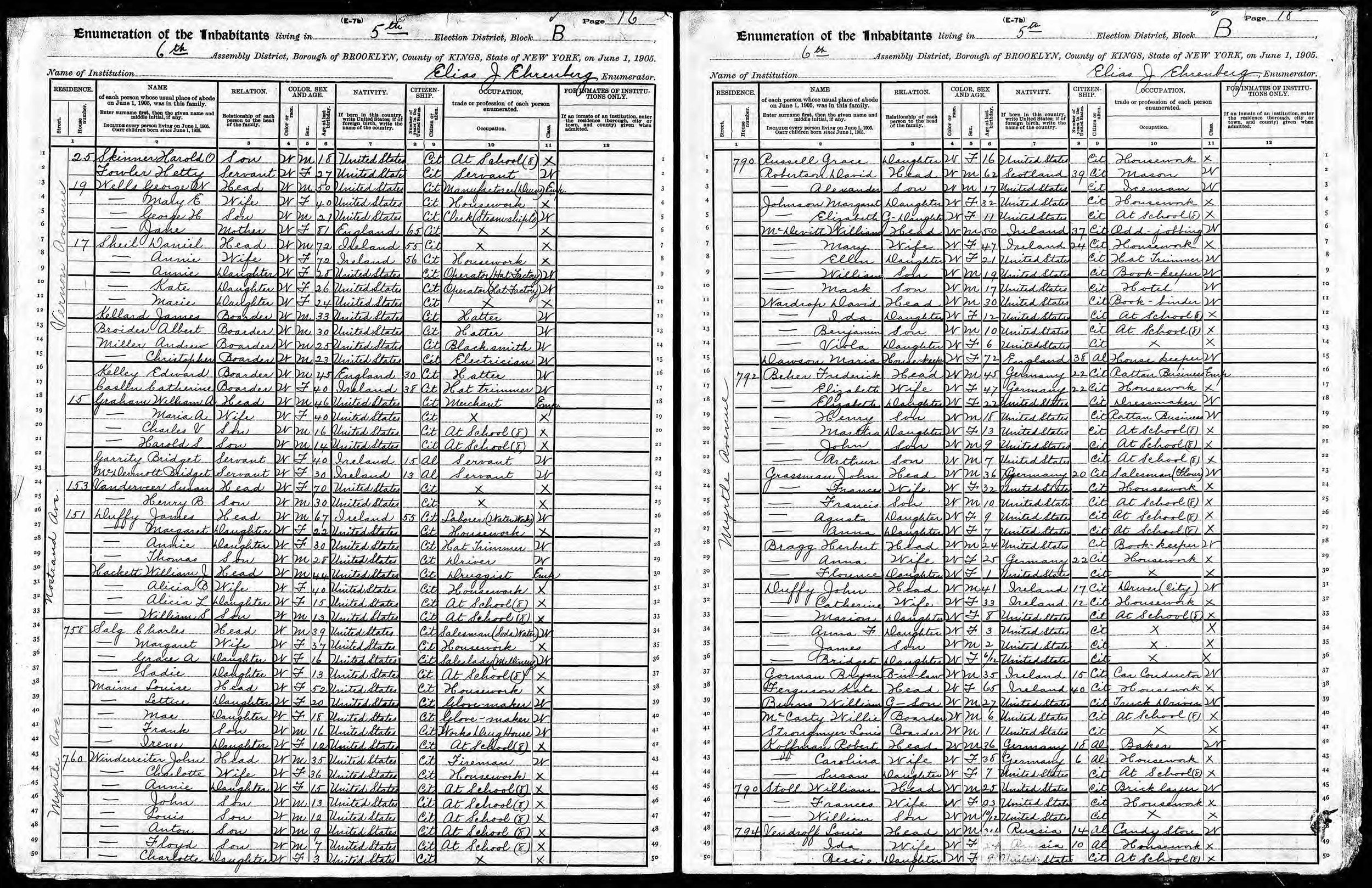
— Alexander, Son, 17, United States, Iceman
Johnson, Margaret, Daughter, 32, United States, Housework
— Elizabeth, G-Daughter, 11, United States, At School
David’s final appearance in a Brooklyn census: still a mason at 62, widowed three years, living with his youngest son, his eldest daughter, and a granddaughter. Within roughly a year he would leave four decades of stone cutting for the Georgia swamps. No record explains the decision; the next document in the file is a newspaper appeal for information about his whereabouts.
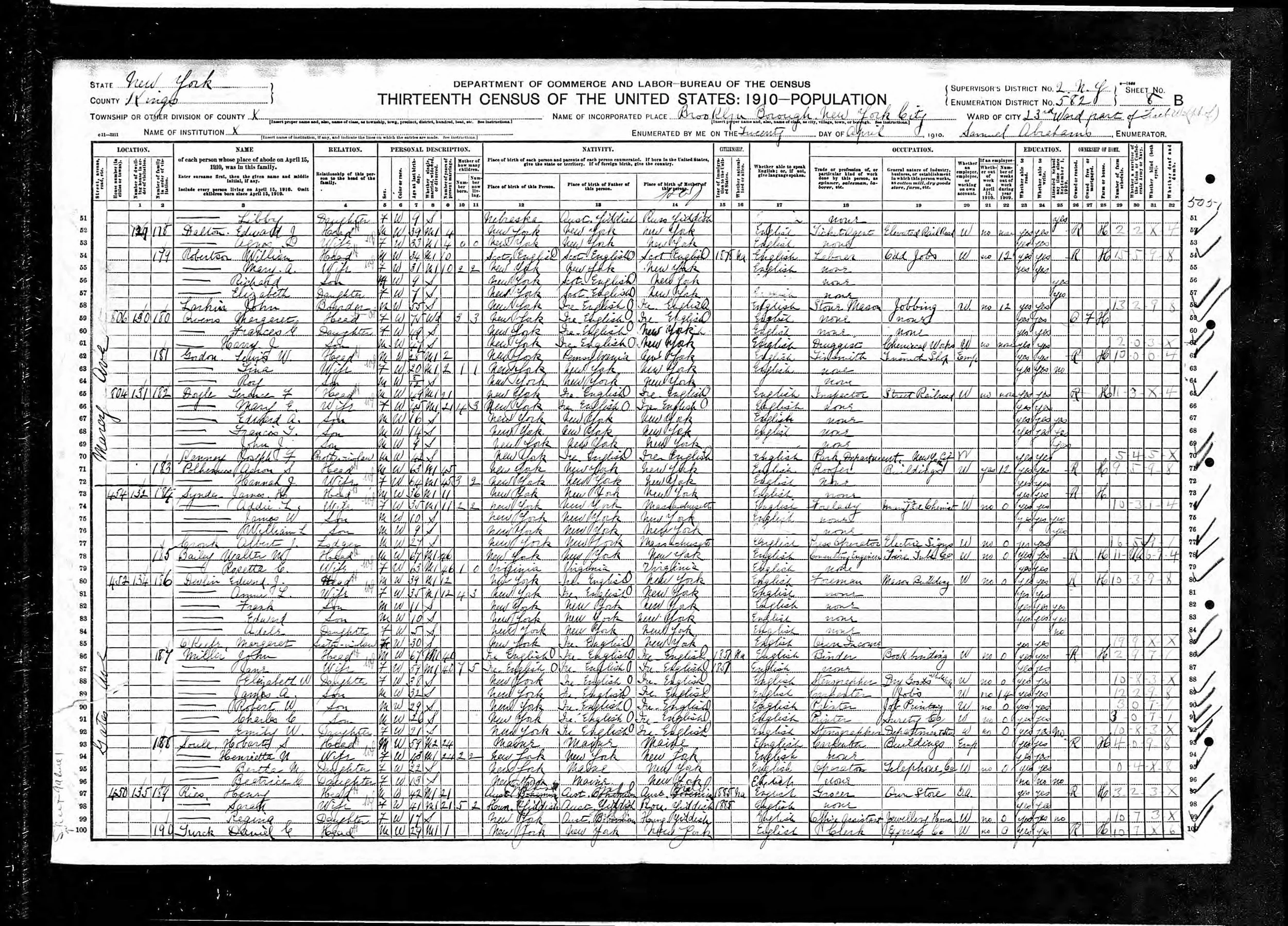
— Mary A., Wife, 31, b. New York · Richard, Son, 9 · Elizabeth, Daughter, 7
Ten years after the 1900 entry, an entirely separate enumeration repeats the same answer: born Scotland, immigrated 1878. Two censuses, one consistent immigration year, matching the Maryhill birth and the late-1878 re-emigration to the year. This census was taken in April 1910 — two months after William’s father vanished in Georgia, and weeks after his brother Alexander’s death.
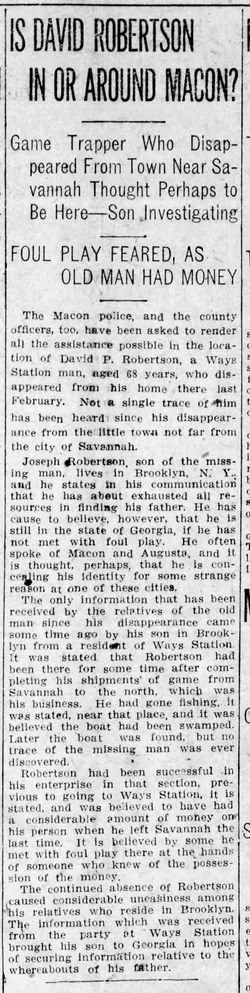
“...the location of David P. Robertson, a Ways Station man, aged 68 years, who disappeared from his home there last February... Joseph Robertson, son of the missing man, lives in Brooklyn, N.Y. ... He had gone fishing, it was stated, and was believed the boat had been swamped. Later the boat was found, near that place, and it was stated, but no trace of the missing man was ever discovered.”
The article supplies what no vital record does: the circumstances of David’s February 1910 disappearance, his age and middle initial, the swamped boat, the money he was known to carry, and Joseph’s exhausted search. No death record was ever created — David Paterson Robertson has no grave. The man whose return migration this case proves left the record the same way he crossed the Atlantic in 1875: without a document marking the passage.
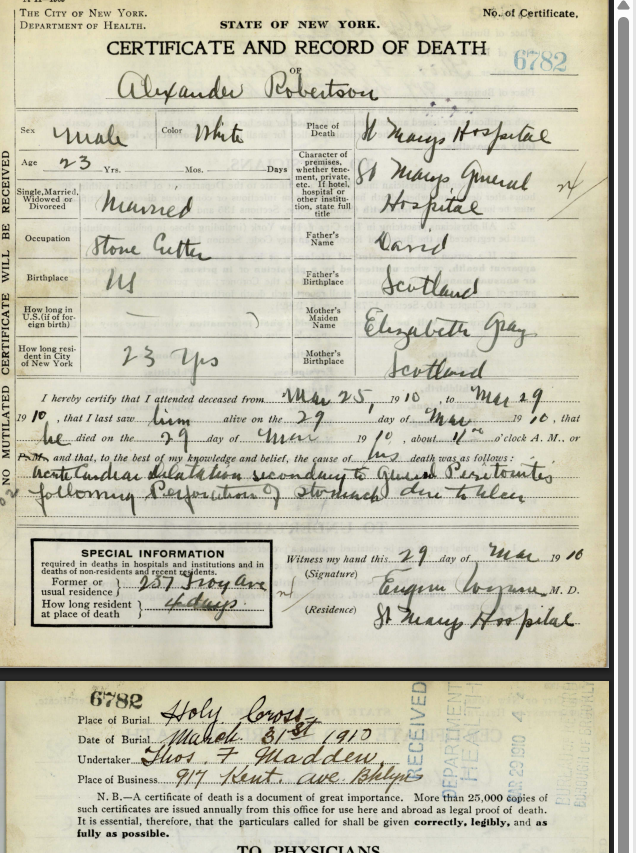
Alexander — stone cutter, the third generation in the trade — was admitted to St. Mary’s Hospital on March 25 and died March 29, 1910: acute cardiac dilatation secondary to general peritonitis following perforation of stomach due to ulcer. He left a twenty-two-year-old widow, Frances Elizabeth Barling, and an infant daughter. He was buried at Holy Cross Cemetery, apart from his Protestant family.
The timing — the youngest son dying weeks after the father’s disappearance — cannot be causally established from the records, but the duplicated pathology can be documented: his brother George would die nine years later of the same gastric ulcer complications, a possible hereditary condition or occupational hazard of the stone trade.
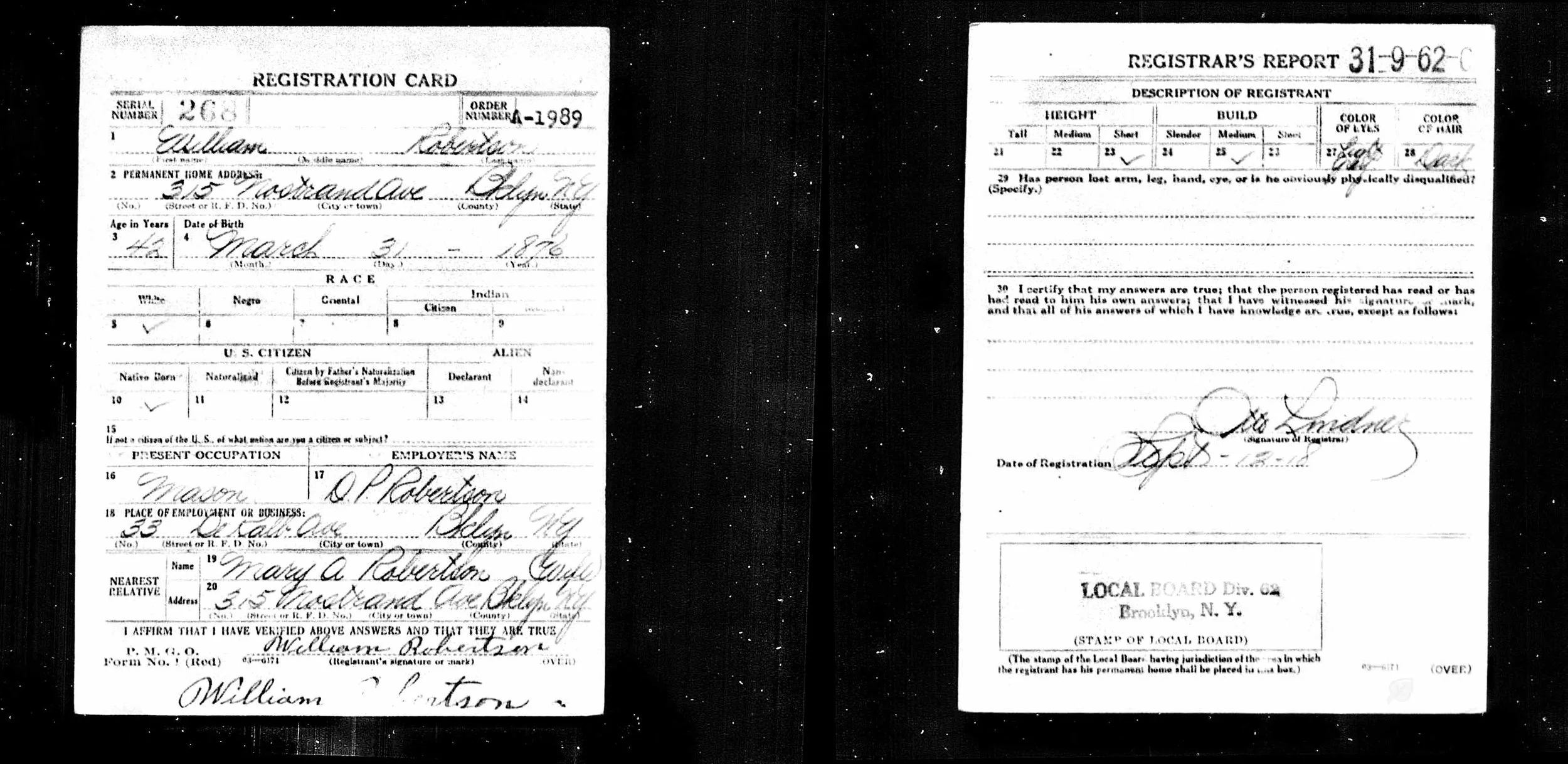
Occupation: Mason · Employer: D. P. Robertson, 33 DeKalb Ave., Brooklyn
Nearest relative: Mary A. Robertson (wife), same address
The birth date matches the Maryhill register to the day — forty-two years on. The employer line, “D. P. Robertson,” is the family firm carrying the father’s name and initials, operated by William’s brother David Lincoln: brothers in the trade their father and grandfather practiced. One inconsistency is noted for the record: the card marks William native-born despite his documented Maryhill birth — one more instance of this family’s Americanized self-reporting, resolved by the statutory register and his own census answers.
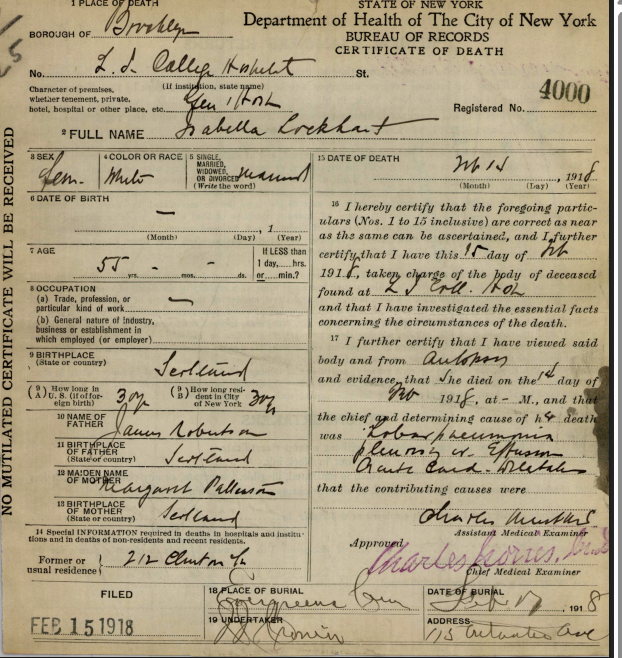
Isabella — David’s sister — died of lobar pneumonia in February 1918, aged 55 by the certificate, born Scotland, 30 years in the U.S., buried at Evergreens. Her certificate records the mother’s maiden name as Margaret Patterson — documentary corroboration of the Paterson line behind David’s middle name and his son George’s. The same certificate gives the father’s name as James Robertson, conflicting with the documented George Robertson — a hospital-informant error logged in the inventory.
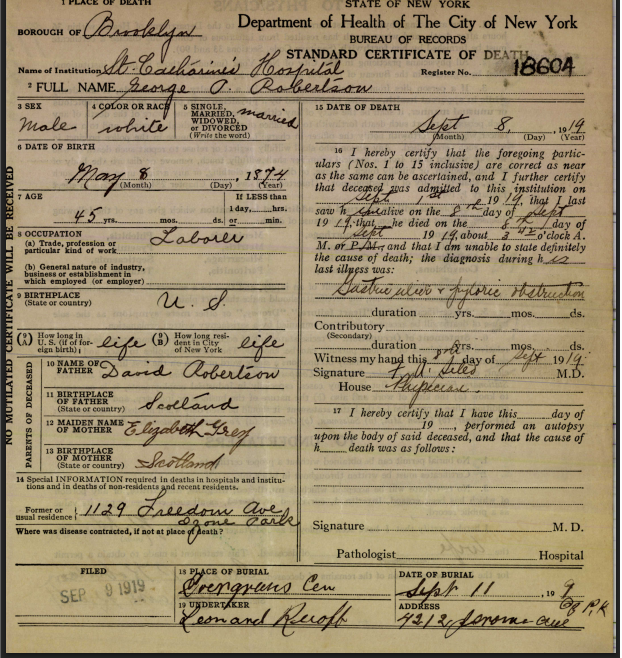
George P. Robertson died September 8, 1919, of gastric ulcer and pyloric obstruction — the same pathology that killed his brother Alexander — and was buried at Evergreens on September 11.
Conflict resolved: George’s birth date. This 1919 certificate states his date of birth as May 8, 1874 — the source of the date carried in earlier compilations. The contemporaneous 1874 Return of a Birth, completed by the attending physician within three days of the event, records May 27, 1874. Under standard evidence weighting the birth return governs: a derivative statement made forty-five years later, by an informant who was not present at the birth, yields to the original record.
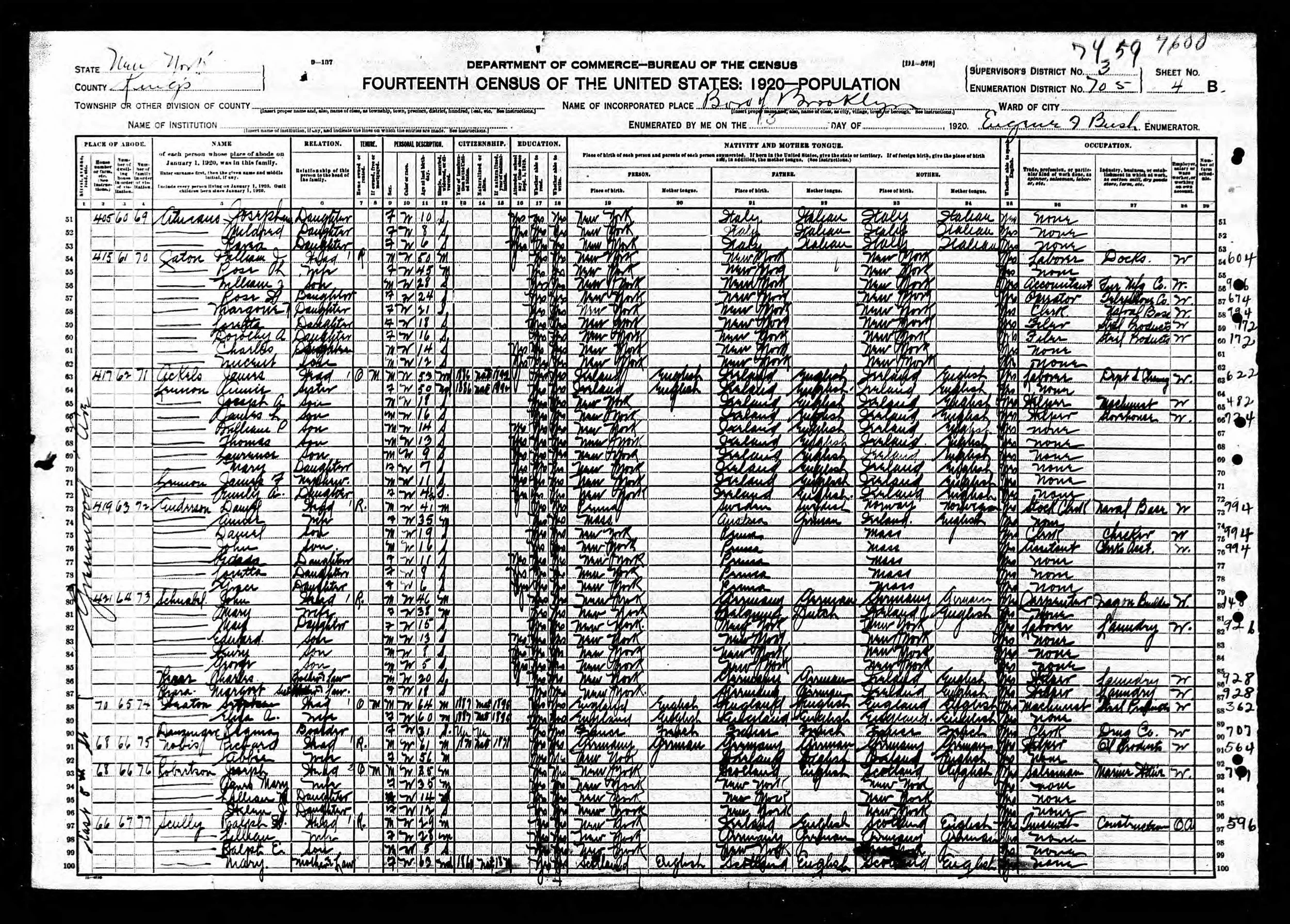
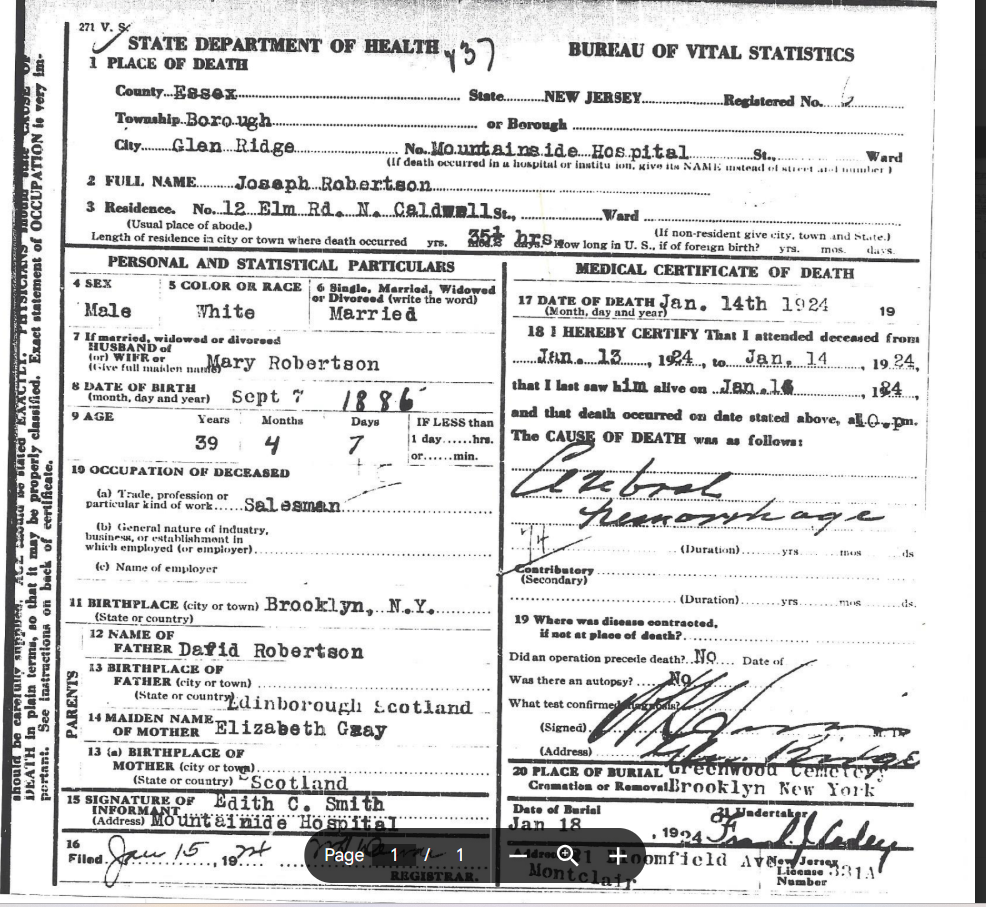
The 1920 census records Joseph as a Brooklyn salesman, born New York, both parents born Scotland — consistent with the occupation the Macon Telegraph reported during his 1910 search for his father. Four years later he was dead at Mountainside Hospital, Glen Ridge, New Jersey: cerebral hemorrhage, January 14, 1924 — the same class of stroke that had killed his mother twenty-two years earlier. He was buried at Green-Wood on January 18, joining her in the family plot.
Two details serve the evidence analysis. The death certificate’s age at death (39 years, 4 months, 7 days) computes precisely to a September 7, 1884 birth — locking onto Certificate No. 8523 and overriding the certificate’s own miswritten birth year. And the father’s birthplace is given as “Edinborough Scotland” — a third birthplace variant for Blairgowrie-born David, joining “U.S.” in the catalog of informant improvisations this family’s records required the research to resolve.
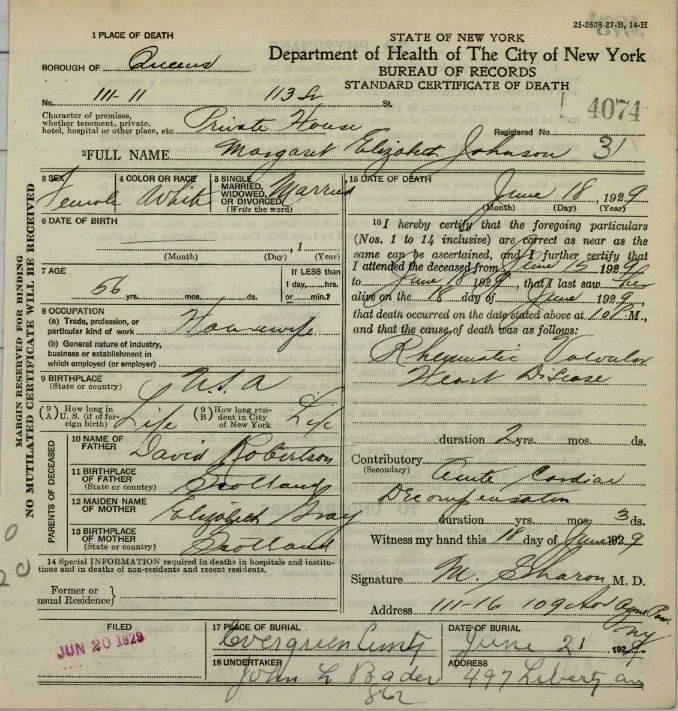
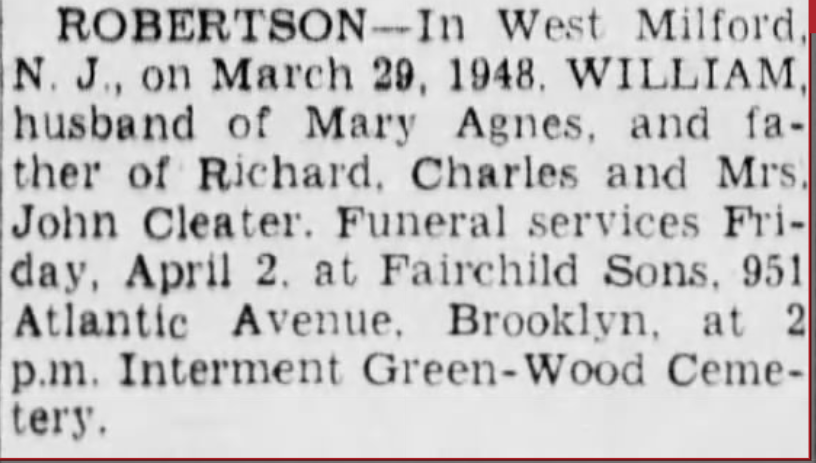
Margaret Elizabeth Robertson Johnson died in Queens on June 18, 1929, of rheumatic valvular heart disease — her certificate naming father David Robertson and mother Elizabeth Gray, both born Scotland, and recording burial at Evergreens on June 21. William, the Maryhill-born son, outlived every sibling: his death notice records his passing at West Milford, New Jersey, on March 29, 1948 — thirty-eight years to the day after his brother Alexander — as husband of Mary Agnes and father of Richard, Charles, and Mrs. John Cleater, with interment at Green-Wood.
Every one of the six surviving children’s death records names the same two parents, born Scotland — five independent late-life confirmations of the couple the 1866 Dundee marriage citation identified at the start. The proof structure built in Scotland in 1867 still holds in New Jersey in 1948.
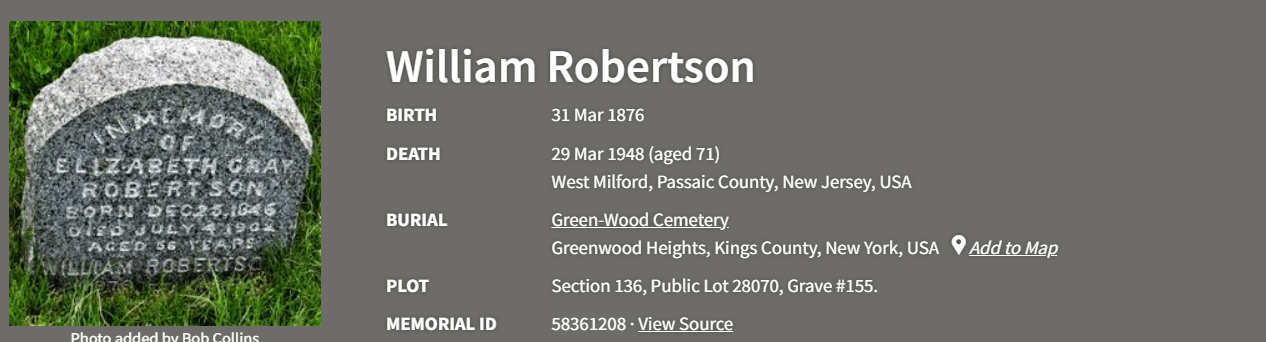
The Green-Wood plot is a public lot the width of a single gravestone, accommodating five interments. Elizabeth was the first — reinterred from Evergreens on October 26, 1902, the date Green-Wood carries as her burial of record — and her name is carved largest on the stone. The lot records identify the five:
Joseph Robertson (son) — Jan. 18, 1924
William Robertson (son, husband of Mary Agnes Durnion) — Apr. 2, 1948
Mary A. Robertson (William’s wife) — Nov. 7, 1952
Richard Robertson (grandson, son of William and Mary Agnes) — Jul. 16, 1979
Seventy-seven years of one family in one grave’s footprint: the mother who crossed the Atlantic three times, the son who searched Georgia for his father, the Maryhill-born son who carried the return in his census answers, his wife, and his son. The gravestone’s “Born Dec. 25, 1846” is the latest-made statement of Elizabeth’s birth date and stands in the birth-year question logged at the Monymusk baptism above. David himself is the absence in this plot — the only member of the household with no grave anywhere.
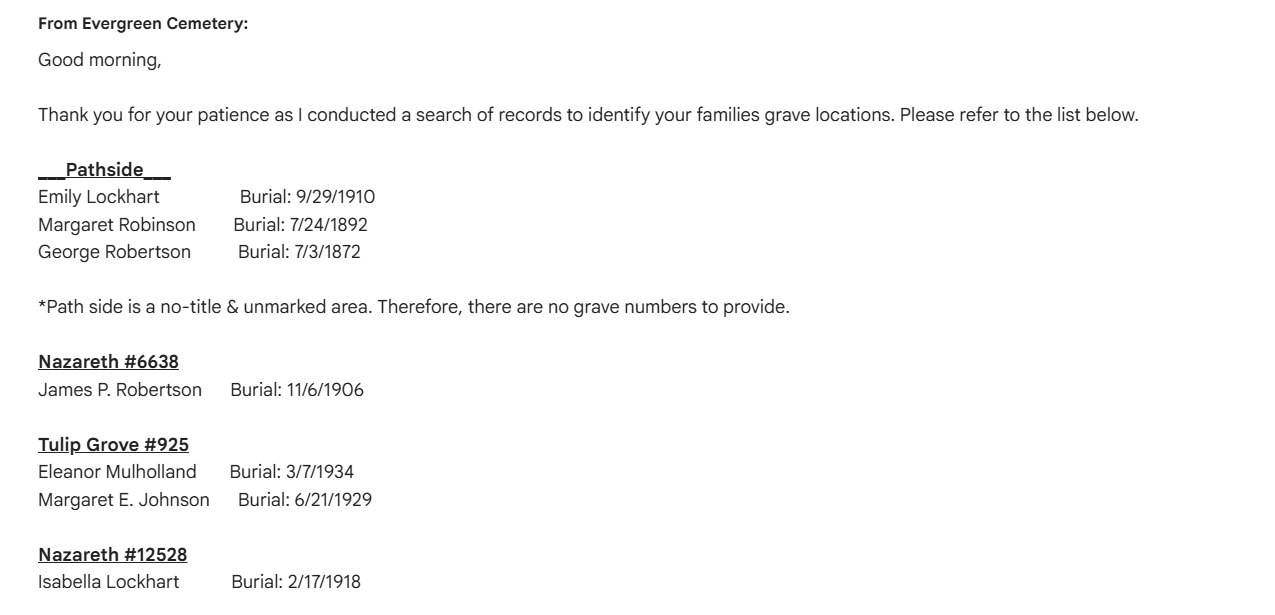
George Robertson — buried 7/3/1872 · Margaret Robinson — buried 7/24/1892 · Emily Lockhart — 9/29/1910
Tulip Grove #925: Margaret E. Johnson — 6/21/1929 · Eleanor Mulholland — 3/7/1934
Nazareth #12528: Isabella Lockhart — 2/17/1918
Nazareth #6638: James P. Robertson — 11/6/1906 [identity under investigation]
The office search explains why the patriarch and matriarch have no stones: Pathside is an untitled, unmarked section. It also delivers two analytical details. Margaret Paterson Robertson appears in the cemetery’s own ledger as “Margaret Robinson” — the Robinson variant reaching even into burial records, eight years after the same variant on Joseph’s birth certificate. And a James P. Robertson, buried 1906 in a Nazareth lot, surfaces as a new lead — the middle initial P., in this family, has a documented meaning.
Source Inventory
All primary and compiled sources cited in this case study, organized by archive and record series
Monymusk, p. 84
224/3/4, p. 4
282/1 714 (1867)
622/1 199 (1876)
646/1 634 (1878)
M593_953, p. 412A
Ward 7, E.D. 3
E.D. 322, Sheet 11
E.D. 77, Sheet 5
6th A.D., 5th E.D.
E.D. 582, Sheet 6B
E.D. 705, Sheet 4B
1874 · 1880
No. 3116 (1874)
No. 8523 (1884)
No. 1923 (1898)
1910 · 4000 (1918)
18604 (1919) · NJ (1924)
4074 (1929)
Serial 268 (1918)
Surrogate, 1902
Lot 28070, Sec. 136
Grave 155
Office Records
Oct. 1, 1910
Eagle, July 1902
March 1948
Genealogy 1:3
Passenger Lists
1869 · 1875 · 1878
Birth Year
1875–1878
Paterson
Identifications
This methodology page accompanies the case study summary. The case study presents the findings; this page documents how each finding was established and what each primary record contains.
← Return to Case Study Episode 6: The Stone Cutter’s Journey Episode 7: The Son Who Searched When the American Dream Reversed Scottish & Scottish-American Research