
How the Chromosome 8 Segment Was Proven
The full evidence behind one confirmed Indigenous triangulated group — the triangulation logic, the documented arm on each side, the evidence tiers, and the question that remains honestly open.
The question, precisely stated
A chromosome-painting estimate flagged Indigenous American ancestry on a single paternal stretch of chromosome 8. An automated segment-clustering tool, run on the proband's GEDmatch kit, grouped a set of matches that appeared to share that region. The question was not "does the proband have Indigenous ancestry" in the abstract — it was narrower and testable: is this specific shared segment real descent from a common ancestor, and can it be anchored to documented people?
A composition estimate colors a region without naming anyone. A cluster proposes that people may share a segment; it does not prove they share it with one another, nor that the sharing is genealogical rather than the dense background-sharing common in any closely connected community. Both are starting hypotheses. The methodology below is how those hypotheses were tested.
Defining the triangulated group
The cluster — labeled Cluster 31 in the AutoSegment run — contained five members whose chromosome 8 segments overlapped. AutoSegment was run with a 10 cM minimum overlap, resolving 124 clusters across 503 matches from 3,145 segments; a 10 cM floor deliberately excludes the short, by-chance segments that accumulate in endogamous populations.
Plotting the five members' segments shows the overlap directly. They converge on a common window of roughly 75.0–101.3 Mb — a 26.2 cM shared region. A sixth tester, on 23andMe, carries a chromosome 8 segment inside the same window, providing a second platform on the same locus.
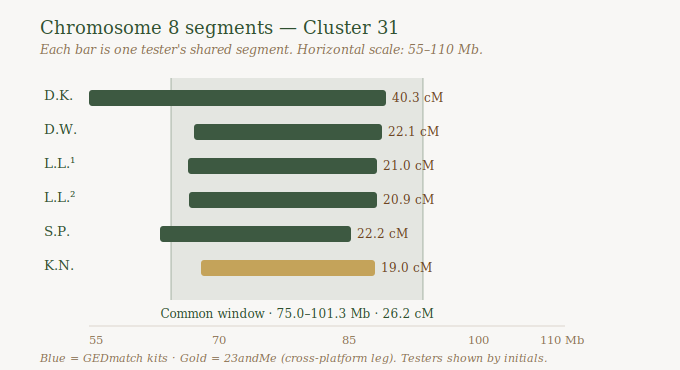
But overlap alone is still an inference from a clustering tool. Sharing a region with the proband does not establish that the members share it with each other — and that distinction is the whole difference between a cluster and a confirmed triangulated group.
The cross-platform triangulation legs
To convert the cluster into a confirmed triangulated group, the members were compared to each other — direct GEDmatch one-to-one comparisons between two non-proband kits, both public. These "legs" test whether the members genuinely share the same segment among themselves.
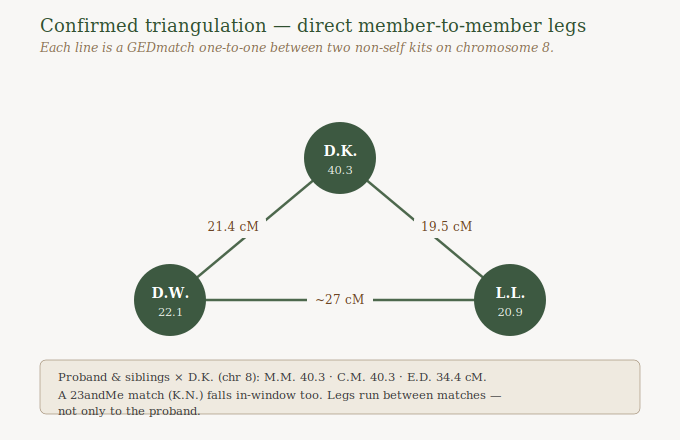
The legs returned shared chromosome 8 segments in every direction: D.W. × D.K. at 21.4 cM, L.L. × D.K. at 19.5 cM, and D.W. × L.L. at approximately 27 cM. The proband and two siblings compare to D.K. at 40.3 / 40.3 / 34.4 cM, and the 23andMe match falls in the same window. Three people who all share one segment with one another descend, at that locus, from a common ancestor. That is the genetic definition of the group, and it is demonstrated here by direct comparison rather than assumed from the cluster.
Side assignment — the segment is paternal
A confirmed segment still has to be placed on the correct parental side. The proband's family kits were compared against both arms of the group. The result is unambiguous.

The mother is excluded against both arms — she shares no segment with either side — so the segment cannot be maternal. Two of the five siblings did not inherit it, which is ordinary segregation, not a contradiction: any given segment passes to roughly half of one's children. The segment sits firmly on the paternal side, and behaves identically whether compared against Arm A or Arm B, consistent with both arms attaching to the same paternal locus.
The two documented arms
With the segment confirmed and assigned to the paternal side, each arm of the triangulated group was followed into records. Both resolve to documented Ojibwe lines — one in Quebec, one in Minnesota — reached entirely independently of each other.
Arm A — Quebec / Saulteaux
Descends from Gabriel Guilbault and his wife, named in the records as Marie Josephte Abitakijikokwe. A 1798 baptism at Saint-Paul-de-Joliette records her as "Josephte sauvagesse … de la nation des Sauteurs" — a Saulteaux (Ojibwe) woman. Three years later, two consecutive records at L'Annonciation, Oka preserve her full Ojibwe name and tribal identity: her baptism on 26 January 1801 names her "Marie Josephte Abitakijikokwe de la nation Sauteuse sur le lac Supérieur," and the marriage and légitimation des enfants the following day, 27 January, records her as "de la nation des Sauteux." The line descends through documented Quebec and Manitoba registers to the living match on this arm.
Arm B — Minnesota / Mille Lacs
Descends from a Mille Lacs Band of Ojibwe family. The line is documented from a present-day collaborator back through two recent family lines that meet at the Shaugobay family of Mille Lacs. Twentieth-century vital records, federal Indian census rolls (1891–1914), and the 1929–1930 deaths roll anchor the descent. Out of respect for a living family's privacy, the recent connecting generations are referenced by relationship rather than by name on this public page; they are documented in full in the family research file.
The two arms are the reason this is more than a paint call. An Indigenous-American composition estimate says something; two independently documented Ojibwe lines meeting on a triangulated segment say where it came from.
Evidence tiers
Every element of this case is held to an explicit tier, distinguishing what records state from what remains hypothesis. The discipline is deliberate: tree convergence is not corroboration, and a composition estimate is not an ancestor.
| Element | Tier |
|---|---|
| Chromosome 8 segment is a triangulated group (direct member-to-member legs) | Proven |
| Segment is paternal (maternal exclusion, both arms) | Proven |
| Arm A ancestress is Saulteaux/Ojibwe (1798 + 1801 records) | Documented |
| Arm B descent to the Shaugobay family (rolls, vital records) | Documented |
| Named common ancestor (MRCA) between Arm A and Arm B | Exploring |
| Generations above Chief Shaugobay (community tree) | Exploring |
The open question — and how it is being tested
Triangulation proves a shared segment and a shared deep origin. It does not, by itself, name a shared ancestor. No record yet bridges the Quebec Saulteaux line and the Minnesota Mille Lacs line to a single documented couple, and the most probable explanation is a common ancestor older than the surviving records. Both arms now carry a documented Ojibwe identity, which tightens the shared origin to a common Ojibwe peoplehood — but a peoplehood is not a person.
This is not left as a shrug. The question is being tested with a falsifiable method. If the most recent common ancestor is the couple Gabriel Guilbault and Marie Josephte Abitakijikokwe, then the wider shared-match list should partition into three signatures:
- Matches descending from Gabriel — carrying French-Canadian ancestry;
- Matches descending from Marie Josephte — carrying Indigenous ancestry with no French-Canadian link;
- Matches descending from both.
The Minnesota-side matches that are Native with no visible French-Canadian path fit the second signature: descent from Marie Josephte's Saulteaux line specifically. Partitioning the full match list against this prediction is the work that could move the MRCA off "pre-records" — or confirm that it sits exactly there.
In an endogamous fur-trade network, a single match can share DNA through more than one line. A French-Canadian connection point on the Guilbault line explains some matches but does not explain the Native, no-French-Canadian matches — and it does not explain the Indigenous segment itself. French-Canadian-side convergences are kept strictly separate from the Indigenous-segment question, so a colonial shared ancestor is never mistaken for the Indigenous one.
What this case demonstrates
The methodological result stands alongside the genealogical one:
- A confirmed triangulated group is not a clustering tool's output — it requires direct member-to-member comparison, demonstrated here in every direction.
- A composition estimate is a hypothesis, not an ancestor; it earns its conclusion only when anchored to documented people on both sides.
- A single tribal word in a parish register — Sauteux — can be the pivot that turns "possibly Indigenous" into "documented Ojibwe," when it is read as record-stated fact rather than assumed.
- Record-stated fact, tree hypothesis, and DNA inference are tiered separately and never allowed to borrow each other's authority.
- The restraint not to convert a proven segment into a named ancestor it cannot yet support is itself part of the proof's integrity.
The Complete Evidence File
The full source inventory behind this case — the Quebec parish records, the Minnesota census rolls and land patents, the DNA triangulation worktable, and the working notes on the open common-ancestor question. Because the chromosome 8 segment touches a living family and living DNA testers, the granular evidence is kept in a password-protected archive for family and collaborator access.
Enter the Research Archive →Family member or research collaborator? Contact Mary for archive access.