
Hidden Bonds: A Colorful Life and a Secret Untold
A Colorful Life and a Secret Untold
The Rise and Fall of a Jamaica Hotelier
1864–1874 | Jamaica, Queens County, New York
He hosted military excursions and political rallies. He ran an illegal distillery. He was arrested multiple times. And he died with a secret he never got to tell.
This episode is part of the Hidden Bonds series. In Episode 1, we traced Terrence O'Brien's journey from famine Ireland to Jamaica, Queens—from stable hand to hotel proprietor, from Navy landsman to Civil War veteran, carrying the DNA of Irish kings. Now we follow him through the Union Hotel years: two marriages, four children, federal prosecution, a colorful cast of characters—and a death that left too many questions unanswered.
"At Jamaica they put up at O'Brien's Hotel, where a fine dinner was prepared, to which, appetized by the long ride, the company did excellent justice."
— Brooklyn Eagle, October 27, 1868The First Wife: Ann Higgins
Terrence O'Brien returned from the Civil War in June 1863, a veteran of Company G, 31st New York Infantry. He came home to his wife Ann Higgins, daughter of Thomas Higgins, and their growing family. Together they had three children: James Henry (born 1860), Mary Ann, and Elizabeth.
Even while serving his country, Terrence kept his business connections alive. In 1863, a local newspaper noted that "Terrence O'Brien, we are informed, had a valuable set of harness stolen from his stable a week or two since, and he has been unable to get any clue to the thief or harness." The man who had started as a stable hand at Remsen's Hotel still kept horses—and still had enemies willing to steal from him.

1863: "Terrence O'Brien, we are informed, had a valuable set of harness stolen from his stable a week or two since." Even while away at war, his Jamaica business continued.
But their time together would be tragically brief. On September 18, 1864, Ann died. She was just twenty-eight years and seven months old. The Long Island Democrat carried the notice:

"DIED. In this village, on Sunday last, 18th inst., Ann, wife of Terrence O'Brien, daughter of Thomas Higgins, aged 28 years and 7 months." Note: Queens County did not maintain vital records until 1898; newspaper notices provide the primary documentation for births, marriages, and deaths in this period.
Terrence was now a widower at thirty-one, with three young children to raise while running a growing hotel business. His mother Bridget stepped in to help manage the household—a role that would prove crucial in the years ahead.
The Union Hotel: A Jamaica Institution
The Union Hotel at the corner of Fulton and Church Streets was already a Jamaica landmark when Terrence took it over. The establishment dated back to at least 1817, when Cornelius C. Eldert announced his "NEW ESTABLISHMENT" at "the junction of the Jamaica and Rockaway turnpikes." Eldert pledged to use "his best exertions to please those who may honour him with a call. His table will be well spread, the liquors of the best quality, and charges moderate. Sheepshead and other fish directly out of the water, and game of all kinds, in their season."
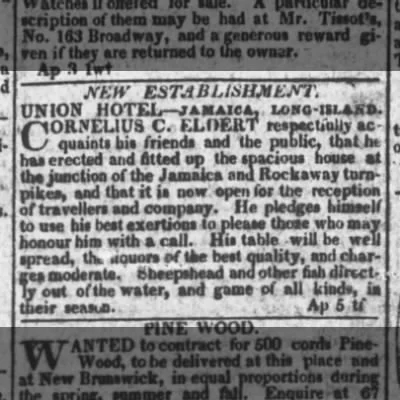
1817: The original Union Hotel advertisement. Cornelius C. Eldert established the "spacious house at the junction of the Jamaica and Rockaway turnpikes." Terrence O'Brien would later make this location his own.
By the time Terrence acquired the Union Hotel, it occupied a prime location in the heart of Jamaica village. The 1862 IRS Tax Assessment already shows him established as a Retail Liquor Dealer—earlier than previously known. He was building his empire even before Ann's death.
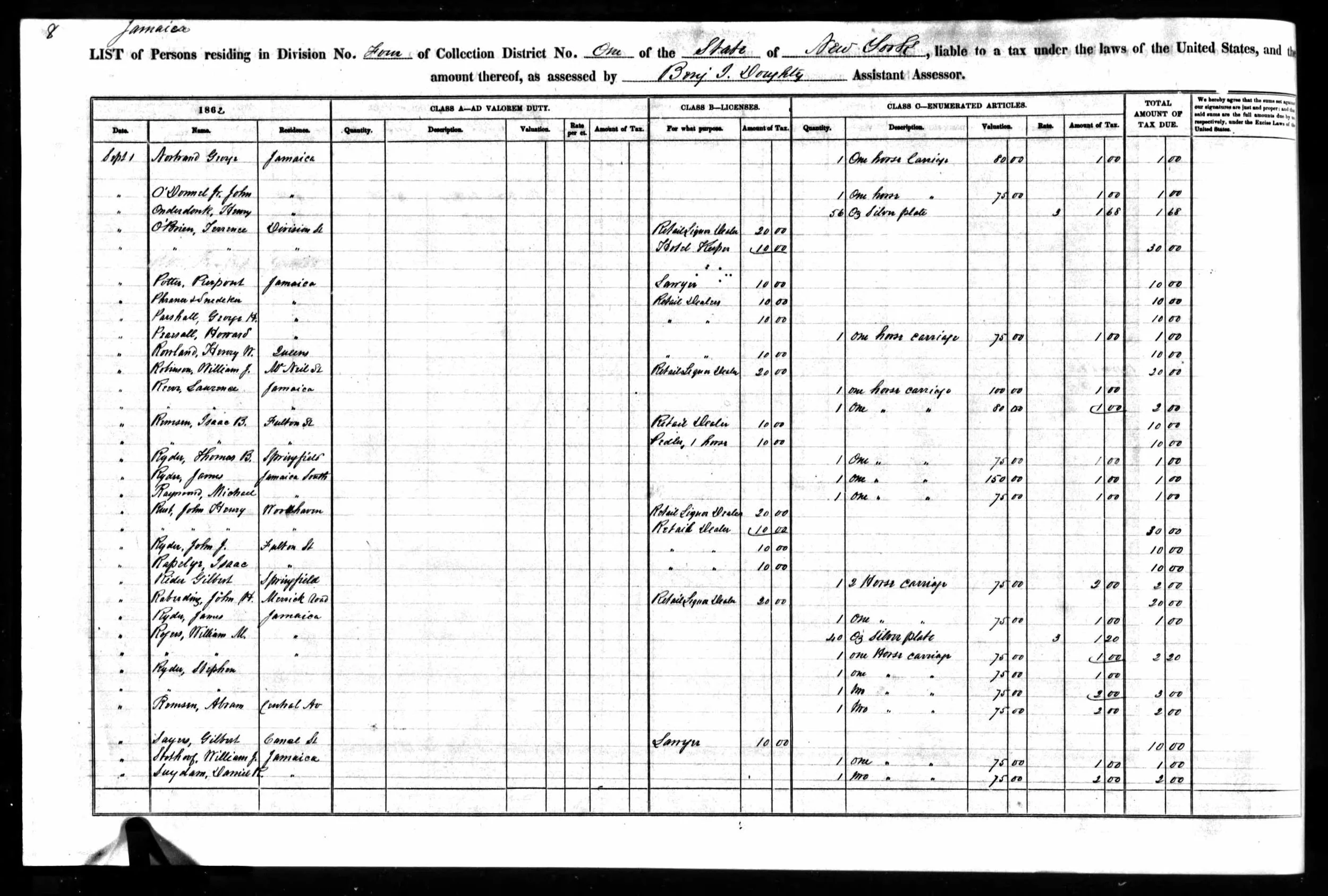
1862 IRS Tax Assessment: "O'Brien, Terrence" listed as a Retail Liquor Dealer in Jamaica, Division 4. He was already established in the liquor trade before the Civil War ended.
By 1865, the transformation from stable hand to hotel magnate was complete. The IRS Tax Assessment that year shows "O'Brien Terrence" paying $35 as a Retail Liquor Dealer and $20 for Hotel operations—a total of $55 in federal taxes. The widower with three children was firmly established as a Jamaica businessman.
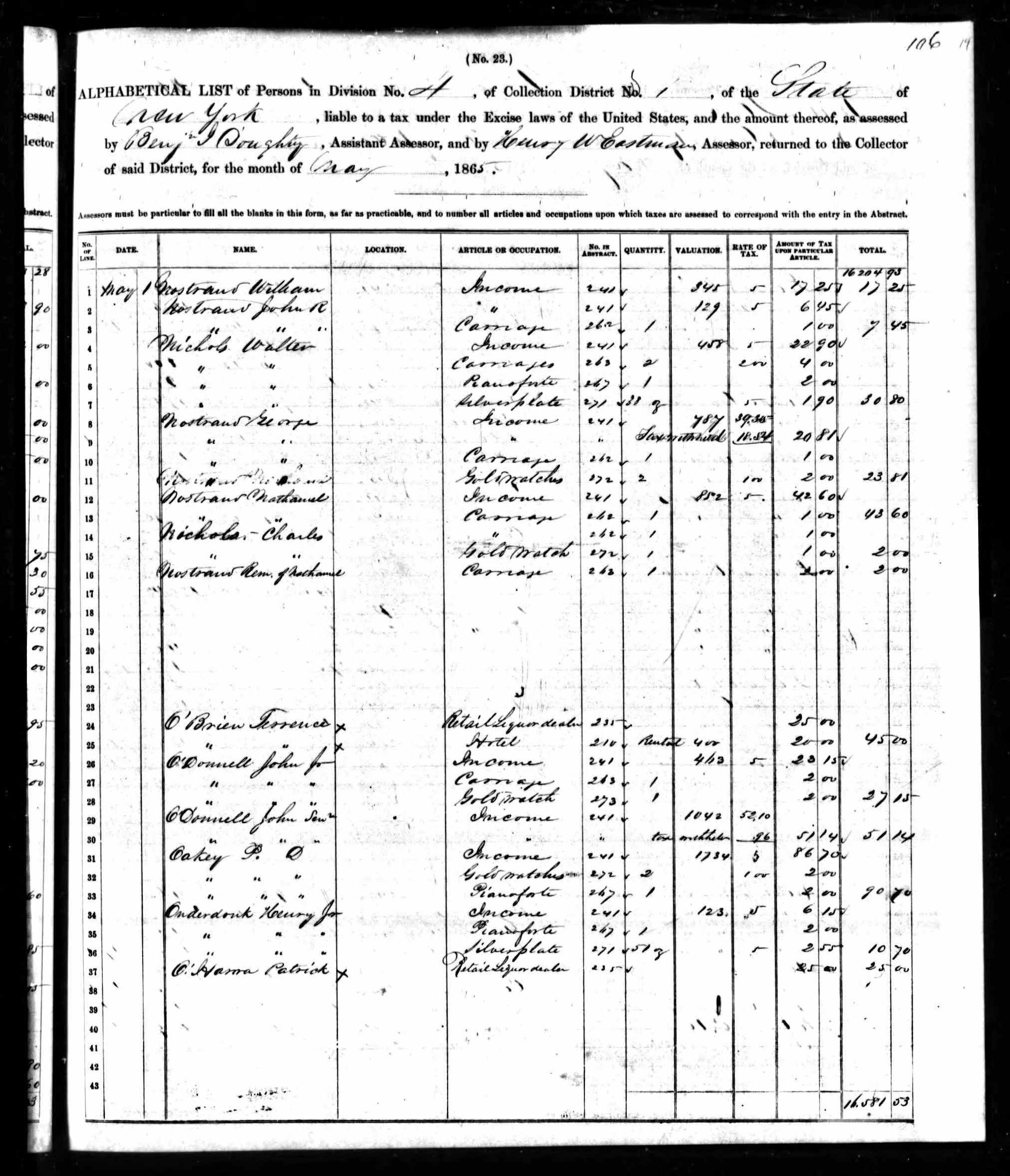
May 1865 IRS Tax Assessment. Lines 24-25 show "O'Brien Terrence" taxed as Retail Liquor Dealer ($35) and Hotel ($20, rental value $400).
The Corner of Fulton and Church
The Union Hotel occupied a prime location at the corner of Fulton Street (now Jamaica Avenue) and Church Street, in the heart of Jamaica village. The 1873 Beers Atlas of Long Island shows "T. O'Brien" clearly marked at this prominent intersection—visual proof of his standing in the community.

Beers Atlas of Long Island, 1873. "T. O'Brien" is clearly marked at the corner of Fulton Street and Church Street in Jamaica Village, Queens County. This prime location made the Union Hotel a natural gathering place for travelers, societies, and political groups.
On May 26, 1866, the Excise Commissioners granted Terrence a liquor license. The 1867 Jamaica Directory confirms his prominence: "O'Brien Terence, Union Hotel, Fulton n Church." He was now among the village's established businessmen—his hotel a gathering place for politicians, societies, and traveling companies.

Brooklyn Daily Eagle, May 26, 1866: "Terence O'Brien, Jamaica" among those granted liquor licenses by the Excise Commissioners.

1867 Jamaica Directory: "O'Brien Terence, Union Hotel, Fulton n Church." His establishment was now listed among Jamaica's prominent businesses.
Mrs. O'Brien, the Mother of the Landlord
In August 1866, fire broke out in the basement of the Union Hotel around half-past eleven at night. The liquor cellar was destroyed. The newspaper noted that "the fire seems to have been the work of design"—suspected arson.
But this account gives us something more valuable than fire damage details: our clearest glimpse of Bridget O'Brien's role in the household.

August 1866: Fire at the Union Hotel. The article describes "Mrs. O'Brien, the mother of the landlord" as "a very careful woman, having seen that all was safe before retiring."
Key Discovery
The newspaper's description of Bridget as "a very careful woman, having seen that all was safe before retiring" tells us she held a position of authority and trust within the household. She was responsible for securing the premises before bedtime—suggesting she played an active role in the day-to-day management of the Union Hotel.
In Irish-American families of this era, it was common for a widowed son to have his mother move in to help care for grandchildren and manage the household. After Ann Higgins' death in 1864, Bridget would have been essential—caring for three young children while Terrence ran his business. The respectful tone of the newspaper account suggests the family had standing in the Jamaica community.
O'Brien's loss on liquors was considerable; he had added a large quantity to his stock only the week before, and most of it was destroyed—uninsured. But this would not be his only trouble that year.
The Dark Side: The Valley Stream Distillery
Behind the respectable facade of the Union Hotel lay dangerous secrets.
Two months after the fire, in October 1866, an illegal distillery began operations at Valley Stream, near Hempstead, Long Island. The operation manufactured whiskey for months until federal authorities seized it on or about January 4, 1867. Deputy Collector Weeks of the First District testified that he "made a seizure of a distillery at Valley Stream, for which no license was taken out or taxes paid."
The evidence against Terrence was damning. At the distillery, investigators found "two hogsheads of molasses marked T. O'Brien" and "one empty cask marked Terry O'Brien." They also found Mr. Gilchrist on the premises, who "said he had nothing to do with it" and "would not tell who the proprietor was." Gilchrist had a bottle in his hand and said "he was going to draw some liquor for a neighboring farmer."

U.S. Commissioners' Court: "United States vs. O'Brien and Gilchrist." Deputy Collector Weeks testified about the seizure at Valley Stream and the casks marked with Terrence's name.
By April 1867, the case had expanded. The Brooklyn Eagle reported on "The Whiskey Frauds" before Commissioner Jones: "United States vs. Terence O'Brien, Francis McNeely and William Gilchrist—The defendants are charged with having been engaged in the distillery business at Hempstead, Long Island, without having paid the special tax."
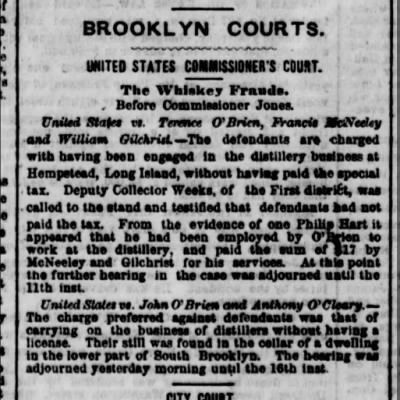
"The Whiskey Frauds": United States vs. Terence O'Brien, Francis McNeely and William Gilchrist. Philip Hart testified he had been "employed by O'Brien to work at the distillery" and paid $17 by McNeely and Gilchrist.
Witness Philip Hart testified that he "had been employed by O'Brien to work at the distillery" and was paid "$17 by McNeely and Gilchrist for his services." James Devlin testified he had transported five barrels of whiskey from the distillery to O'Brien's premises in Jamaica. The operation was sophisticated—and Terrence was clearly at the center of it.
More Legal Troubles
The distillery case wasn't Terrence's only brush with the law in 1867. In May, lightning destroyed his $200 liberty pole—perhaps divine commentary on his situation. Then in June, he was arrested again, this time for a different offense entirely.

May 1867: "A large flag-staff in front of the hotel of T. O'Brien, Jamaica, L.I. was struck by lightning... The staff was in two pieces and cost $200 to put it up."
The newspaper listed "the following persons" who "were arrested last Saturday at Jamaica, for violating the Excise Law, having sold liquor without a license." The list included James McLaughlin, Isaac Houseman, William Magee, and a dozen others—and Terrence O'Brien. This was a separate charge from the federal distillery case, suggesting Terrence was pushing legal boundaries on multiple fronts.

June 1867: "The following persons were arrested last Saturday at Jamaica, for violating the Excise Law, having sold liquor without a license"—including "Terrence O'Brien." A separate charge from the federal distillery prosecution.
A Gathering Place for Jamaica
Despite his legal troubles—or perhaps because of his colorful reputation—the Union Hotel remained a popular destination. Terrence knew how to throw a party, and various societies and military companies chose his establishment for their gatherings.
In 1867, a group called the "Rotten Corks" held their annual excursion to Jamaica. The society, composed of "liquor dealers of this city," took its name from a somewhat ironic motto: "Excise Law on Deck, Look out for rotten corks." They traveled in four stages drawn by six horses each, led by McCann's Fifty-sixth Regiment Band, "picking up a stray rotten cork here and there" as they proceeded "in gallant style along the Jamaica road, their inspiring music and jingling bells attracting the eyes and ears of everybody within sound."
Their destination? O'Brien's Hotel, "where a fine dinner was prepared, to which, appetized by the long ride, the company did excellent justice, and after a short time spent in social hilarity, the stages were brought forth, and the party took the road for home, evidently much pleased with the day's enjoyment."
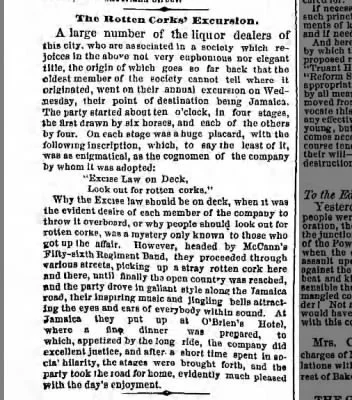
"The Rotten Corks' Excursion": A society of liquor dealers whose motto was "Excise Law on Deck, Look out for rotten corks" chose O'Brien's Hotel for their annual dinner. Given Terrence's legal troubles that same year, the irony is remarkable.
The following year, in October 1868, the John J. Scott Guards of Flatbush—numbering seventy-six members—came to Jamaica for their first annual excursion. "After shooting for a variety of prizes in the shape of gold pieces, greenbacks, silver ware, &c., and partaking of an elegant dinner at Mr. O'Brien's Hotel, they returned home in excellent order, marched through the village of Flatbush, waking up many of the residents of that Rip Van Winklish village by the enlivening strains of a brass band which escorted the Company on the excursion."
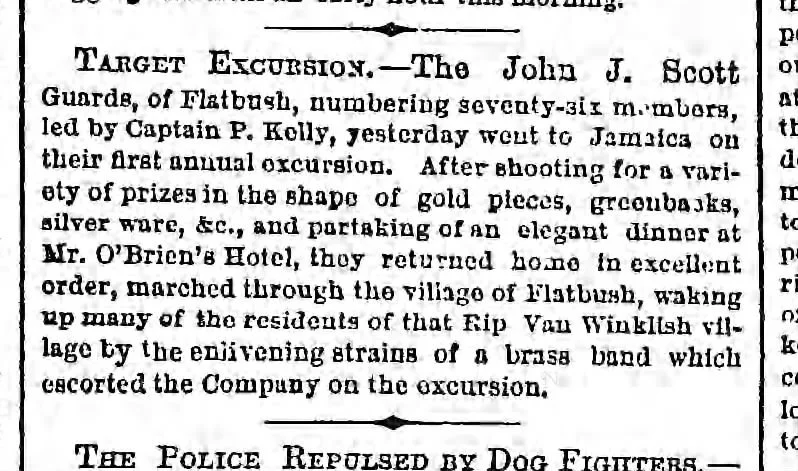
October 27, 1868: "The John J. Scott Guards, of Flatbush, numbering seventy-six members... partaking of an elegant dinner at Mr. O'Brien's Hotel." The Union Hotel was the place to celebrate.
The Union Hotel became more than a business—it was a Jamaica institution. Democratic Party meetings were held in its rooms, with fifty guns fired to celebrate national nominations. When Jamaica needed a landmark, Terrence erected a spectacular 148-foot liberty pole topped with a silhouette of Dexter, the champion racehorse who held the world trotting record.
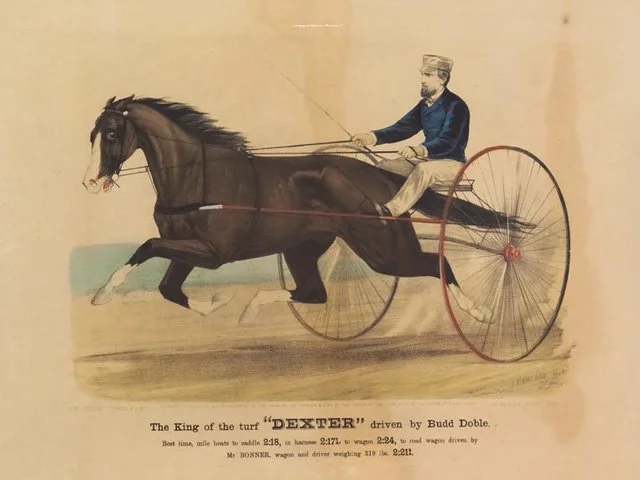
Currier & Ives print of Dexter, "The King of the Turf," driven by Budd Doble. In January 1869, Terrence erected a new 148-foot liberty pole topped with a Dexter silhouette—brilliant marketing that connected his Union Hotel to the racing mania sweeping Long Island.
The 1868 Jamaica Directory lists multiple O'Briens in the village: Henry (gardener), Timothy (laborer), William (clothier)—and "O'Brien Terence, Union Hotel, Fulton n Church." Whether any of these other O'Briens were relatives remains unknown, but Terrence was clearly the most prominent of the name in Jamaica.

1868 Jamaica Directory, page 179: Multiple O'Briens appear—Henry (gardener), Timothy (laborer), William (clothier)—and "O'Brien Terence, Union Hotel, Fulton n Church."
The Decline
Jamaica's fortunes changed, and Terrence's changed with them. As his obituary would later note, "The horse railroad, and the opening of other resorts, turned those who drove good horses in other directions." Direct railroad communication to the south side of Long Island meant travelers no longer stopped at Jamaica's halfway houses on their way to Rockaway. Business at the hotels decreased accordingly.
In October 1869, his mother Bridget died at age sixty-seven, her funeral held at the Union Hotel. The woman who had helped hold the family together through Ann's death and all the legal troubles was gone.
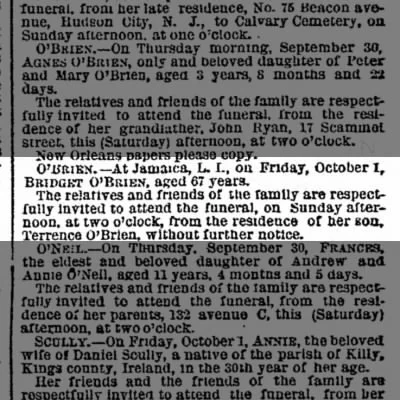
"O'BRIEN.—At Jamaica, L.I., on Friday, October 1, BRIDGET O'BRIEN, aged 67 years." Funeral held at "the residence of her son, Terrence O'Brien."
The Second Wife: Cornelia Bedell
With Bridget gone, Terrence needed help managing his household and three children. Sometime around 1869 or 1870, he remarried. His second wife was Cornelia A. Bedell, daughter of Anthony P. and Anastasia Bedell—a local family. Born around 1851, Cornelia was about eighteen or nineteen when she married the thirty-seven-year-old widower.
Together they would have one child: Miles Murtha Lawrence, born March 28, 1873. The unusual middle names—Murtha and Lawrence—may have honored family members on Cornelia's side, or perhaps carried meaning from Terrence's Irish past that has been lost to time.
His hotel property eventually passed into the hands of Bill Hastings for debts contracted in the purchase of liquors. According to newspaper accounts, Hastings was "badly fleeced"—there was a mortgage on the property, and O'Brien had received liquor equal to the full cash value of the premises. Even as his fortunes declined, Terrence remained a shrewd operator.
Then came 1874—the year that destroyed everything.
1874: The Year of Tragedy
On Wednesday, May 13, 1874, Cornelia A. O'Brien died at the Union Hotel. She was in her twenty-third year of life, leaving behind four children—the eldest just fourteen, the youngest barely a year old. Her son Miles was thirteen months old. He would never remember his mother's face.

"O'BRIEN.—At Jamaica, L.I., on Wednesday, May 13, CORNELIA A., wife of Terence O'Brien and daughter of Anthony P. and Anastasia Bedell, in the 23d year of her age."
Six months later, in November, Terrence himself fell suddenly ill. His condition was not supposed dangerous at all until the middle of the day before his death, when he began to sink rapidly. He sent for Father Farley, the pastor of St. Monica's Catholic Church, who came and gave him the consolation of the church.
According to newspaper accounts, Terrence imparted to Father Farley information that he had some valuables which he wished to place in his hands for the benefit of his children. It was arranged that the priest should return at a specified time to receive them.
But before the priest could return...

Terrence O'Brien's obituary detailed his rise from stable hand to hotel proprietor: "His knowledge of horses, and his attention to his business, made him many friends."
The Secret He Never Told
On Saturday, November 21, 1874, at approximately two o'clock in the morning, Terrence O'Brien sat up in bed and asked for a drink. When being restored to rest on the pillows, his life went out in an instant—without the nurse being aware of it.
He was forty-one years old. He had resided in the village of Jamaica for nearly forty years—since "almost his childhood days." He had risen from stable hand to hotel proprietor, married twice, fathered four children, faced federal prosecution, hosted military companies and political rallies, and built a 148-foot liberty pole topped with a racehorse.
And now he was dead.
Father Farley never returned in time to receive those valuables. Whatever Terrence had wanted to tell him—whatever secret he had intended to share for the benefit of his children—died with him in that instant, in that bed, in that hotel at the corner of Fulton and Church.
Four children were now completely orphaned. What would become of them? And what was the secret their father had tried to share?
"He imparted to Dr. Farley the information that he had some valuables which he wished to place in his hands for the benefit of his children, and it was arranged that the priest should return at a specified time and receive them. Before the time arrived... his life went out in an instant without the nurse being aware of it."
— Brooklyn Daily Eagle, January 27, 1876The Site Today
The Union Hotel at Fulton and Church Streets was demolished long ago. After Terrence's death, the property changed hands multiple times. By 1919, the Rialto Theatre was built on the site. The theatre was torn down by 1981.
Today, the lot where Terrence O'Brien hosted the Rotten Corks and the John J. Scott Guards, where he erected his 148-foot liberty pole, where he lived with two wives and raised four children, where his mother Bridget secured the premises each night—is now the Queens County Family Court.

Today: The Queens County Family Court now stands where Terrence O'Brien's Union Hotel once welcomed travelers, societies, and military companies to Jamaica, Queens.
Historical Echo
There is a certain poetry in this. The corner where four children were orphaned in 1874 now houses a court dedicated to family matters. The site where a father died with secrets untold now serves families navigating their own difficult transitions.
Fascinatingly, a 1997 archaeological assessment conducted for the Queens Family Court construction referenced the same 1873 Beers Atlas map, confirming that "T. O'Brien is printed as either the owner or proprietor in 1868 and 1873." Over 120 years later, the historical record still remembered the hotel keeper of Jamaica.
Evidence Analysis
PRIMARY SOURCE: 1873 Beers Atlas of Long Island
This atlas provides visual confirmation of Terrence O'Brien's prominence in Jamaica. "T. O'Brien" is clearly marked at the corner of Fulton Street and Church Street—the prime intersection in the village. The atlas was still being referenced over 120 years later in the 1997 archaeological assessment for the Queens Family Court construction.
PRIMARY SOURCE: 1862 & 1865 IRS Tax Assessments
These federal tax records establish Terrence's business timeline earlier than previously known. The 1862 record shows him already operating as a Retail Liquor Dealer before the Civil War ended. By 1865, he was taxed as both Liquor Dealer ($35) and Hotel proprietor ($20)—documenting his economic rise during the war years.
PRIMARY SOURCE: Federal Prosecution Records (1867)
Multiple newspaper accounts document the case of "United States vs. Terence O'Brien" for operating an illegal distillery at Valley Stream. The evidence was substantial: casks marked with his name, employees who testified he hired them, and whiskey transported to his Jamaica premises. This federal prosecution may explain why Terrence later took steps to hide his assets.
PRIMARY SOURCE: 1866 Fire Article
Beyond documenting the suspected arson, this article provides our clearest glimpse of Bridget O'Brien's role in the household. The description of "Mrs. O'Brien, the mother of the landlord" as "a very careful woman, having seen that all was safe before retiring" reveals she held a position of authority—managing the household and helping raise her grandchildren after Ann Higgins' death in 1864.
PRIMARY SOURCE: "Rotten Corks' Excursion" & "Target Excursion" Articles
These social columns reveal Terrence's hotel as a destination for societies and military companies. The "Rotten Corks"—a society of liquor dealers whose motto referenced the Excise Law—chose O'Brien's Hotel for their dinner the same year he was being prosecuted for excise violations. The irony was apparently lost on no one. The John J. Scott Guards' 1868 excursion shows the hotel remained popular despite Terrence's legal troubles.
Document Gallery
1864 — Ann Higgins
"aged 28 years and 7 months"
Death
1862 — IRS Tax
Retail Liquor Dealer
Tax
1863 — Harness Stolen
"from his stable"
Newspaper
1865 — IRS Tax
Liquor + Hotel
Tax
1866 — Liquor License
Excise Commissioners
License
1866 — Hotel Fire
"Mrs. O'Brien, the mother"
Newspaper
1867 — Federal Court
US vs. O'Brien
Court
1867 — Whiskey Frauds
Multiple defendants
Court
1867 — Directory
Fulton n Church
Directory
1867 — Rotten Corks
Dinner at O'Brien's
Newspaper
1868 — Target Excursion
Scott Guards
Newspaper
1869 — Bridget's Death
"aged 67 years"
Death
1873 — Beers Atlas
T. O'Brien location
Map
1874 — Cornelia's Death
"in the 23d year"
Death
1874 — Terrence's Obituary
"nearly forty years"
Death
Today — Family Court
Former hotel site
ModernContinue the Story
← Hidden Bonds: Series Overview Episode 1: The Irish Boy Who Built an Empire From famine Ireland to Jamaica, Queens Episode 3: Four Orphans and a Hidden Fortune → The scattering, the search, and the secret revealed Episode 8: The Kentucky Brother Patrick O'Bryan and the DNA reunionWant to Know When New Stories Are Published?
Subscribe to receive updates on new family history research—no spam, just meaningful stories when there's something worth sharing.
SUBSCRIBE TO OUR NEWSLETTEREvery Family Has a Story Worth Telling
Whether you're just beginning your research or ready to transform years of work into a narrative your family will treasure, I'd love to hear your story.
BEGIN YOUR RESEARCH INQUIRY