
The Chase
A Reflection on Memory, Motion, and the Stories We Carry Forward
A Companion Piece to One Egg, Two Lives
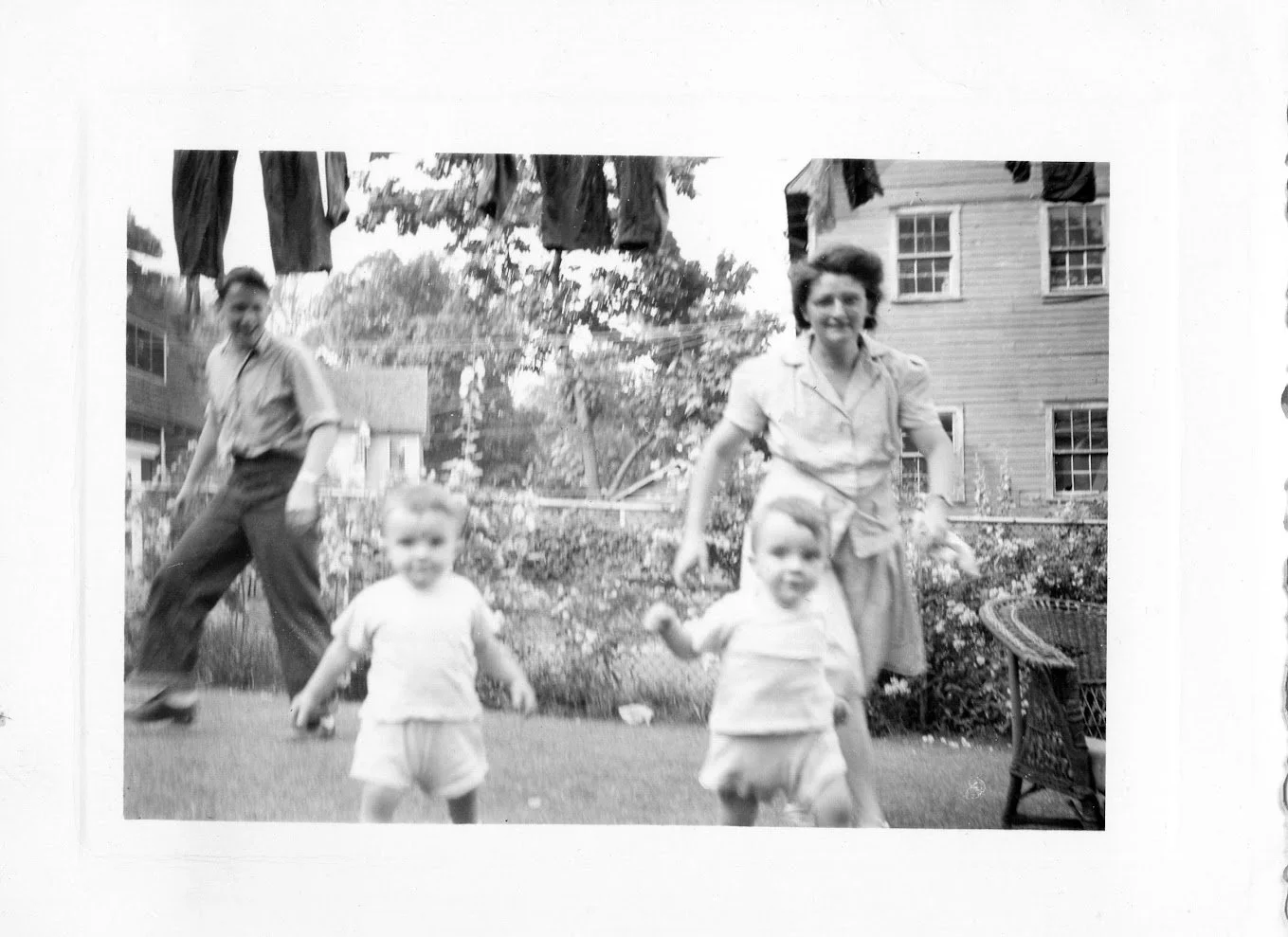
"The Chase" — circa 1947, Montclair , New Jersey
She is mid-stride, one hand slightly forward, her dress catching the summer air. Behind her, a young man — her brother-in-law — leans into the run with a grin on his face. And out front, blurred with motion, two small boys tear across the grass as fast as their bare legs will carry them.
Nobody is looking at the camera. Nobody is posing. The laundry hangs on the line behind them, the neighbor's clapboard house rises in the background, and a wicker chair sits abandoned at the edge of the frame. This is not a portrait. This is a moment — caught in motion, sometime around 1947, in a backyard in Montclair, New Jersey.
A mother chasing her twin sons.
I found this photograph while building the One Egg, Two Lives page — a project about these same twins, now grown men, and the DNA discovery that revealed they had been identical all along. I was deep in the documentation, sorting through decades of images and records, when this one stopped me cold.
Not because of what it showed. Because of what it felt like.
It felt like joy. Pure, uncomplicated, backyard joy. A young mother in her early forties, her boys barely past toddling, the whole afternoon stretching out ahead of them with nothing more urgent than the chase itself.
We begin our lives in the chase.
We chase the ball across the yard. We chase our siblings around the kitchen table. We chase lightning bugs at dusk and the ice cream truck down the block. The world is new and everything worth having is just ahead of us, just out of reach, just fast enough to make the catching thrilling.
Then the chase shifts. We chase grades and goals, careers and callings. We chase love. We chase the next paycheck, the next milestone, the next version of ourselves we hope to become. We chase our children — literally, at first, the way this mother chases her boys across the summer grass, and then figuratively, trying to keep up with the lives they're building beyond our reach.
And then, if we're lucky, if we live long enough and pay close enough attention, the chase shifts again.
We start chasing backward.
That's where genealogy lives — in the backward chase. We chase the names. We chase the dates. We chase the faded ink on a baptismal record or the penciled notation in a census ledger. We chase the story of who they were before we existed, before anyone thought to write it down, before the details slipped through the cracks of ordinary life.
We chase because we understand, finally, that the people who came before us were not just names on a chart. They were mid-stride, too. They had summer afternoons and laundry on the line and children they couldn't quite catch. They had joy that no document recorded and grief that no obituary fully captured.
We chase because someone has to. Because if we don't, the motion stops. The moment is lost. The photograph sits in a box, and nobody remembers who is running or why.
This mother — she didn't know, in this moment, what was coming. She didn't know that one day her twin boys would serve their country as officers in the United States Air Force. She didn't know that decades later, a DNA test would reveal what no doctor had told her at their birth — that these two boys, who came into the world together, were not just fraternal twins sharing a womb, but identical twins, split from a single beginning. One egg. Two lives.
She didn't know that nearly eighty years after this photograph was taken, someone would find it in a collection of family images and see in it everything that matters about why we preserve, why we research, why we write the stories down.
She was just chasing her boys.
And now those boys are approaching eighty.
The legs that blurred across that Montclair backyard have carried them through flight school and military service, through marriages and children and grandchildren of their own. The chase has changed for them, as it does for all of us. They are no longer running ahead of their mother's outstretched hand. They are looking back. Remembering. Wondering about the things they were too young to ask and the people who were gone before they thought to listen.
That is the gift of this work — not just the records and the evidence and the carefully sourced conclusions, but the recognition that every generation inherits the chase. We pick up where they left off. We carry their questions forward. And when we've done our work well, we leave behind not just answers but stories — so that the next generation, the ones who will someday chase our memories, will have something to hold onto.
We start out chasing.
We end up chasing the memories, the stories, and the documentation — so that someone new can begin the chase.
And maybe that's the point. Not the catching. The chasing. The beautiful, blurred, joyful act of running toward something that matters, with people who matter, in a moment that will never come again.
Except in a photograph. Except in a story.
Storyline Genealogy — From Research to Story
Read One Egg, Two Lives →