
The Storyline
"Real families.Real discoveries.Real stories."
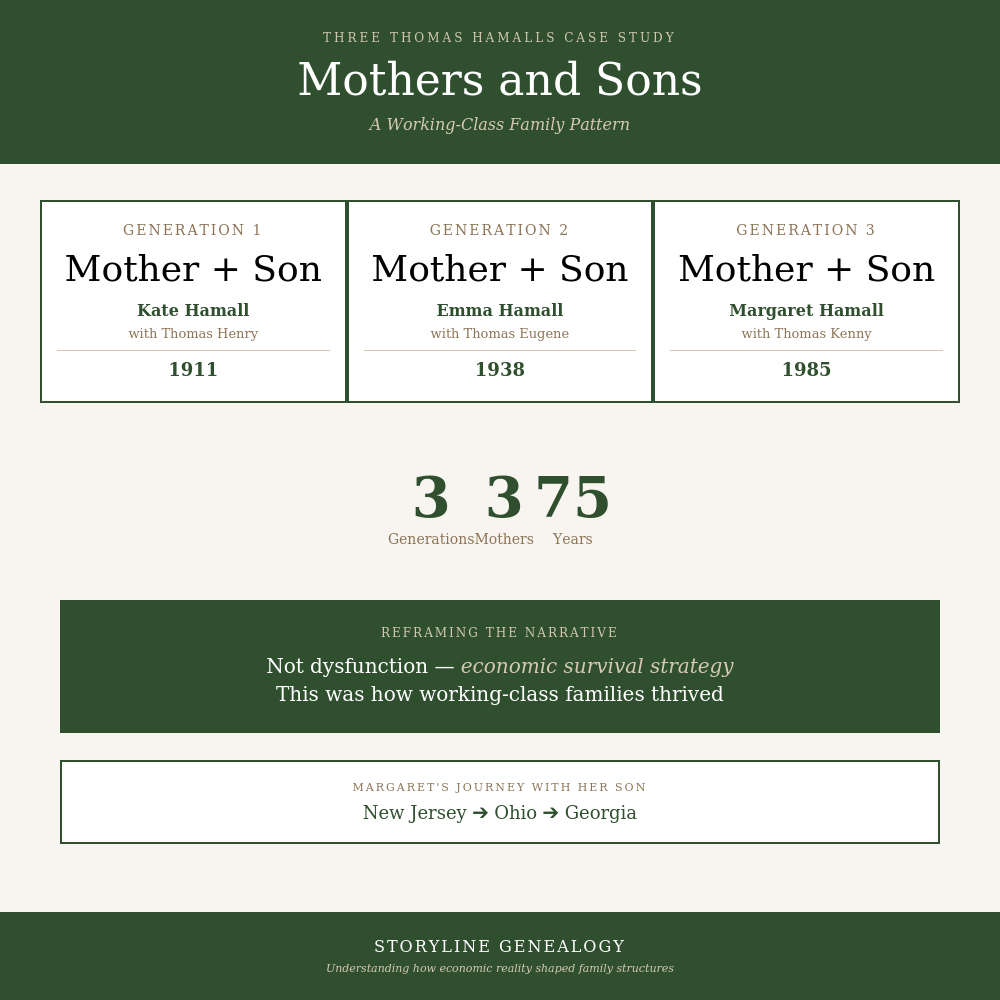
Mothers and Sons: A Working-Class Family Pattern
Three generations. Three mothers. Three sons. Three households built together. From Kate Hamall in 1911 to Margaret Kenny Hamall in 1985, a pattern repeated across 75 years—not because of dysfunction, but because this was how working-class families survived. Understanding multi-generational households as economic strategy, not pathology.
Part of the Storyline Genealogy Case Studies Series: Three Thomas Hamalls – Examining how economic reality shaped family structures across three generations of working-class Chicago families.
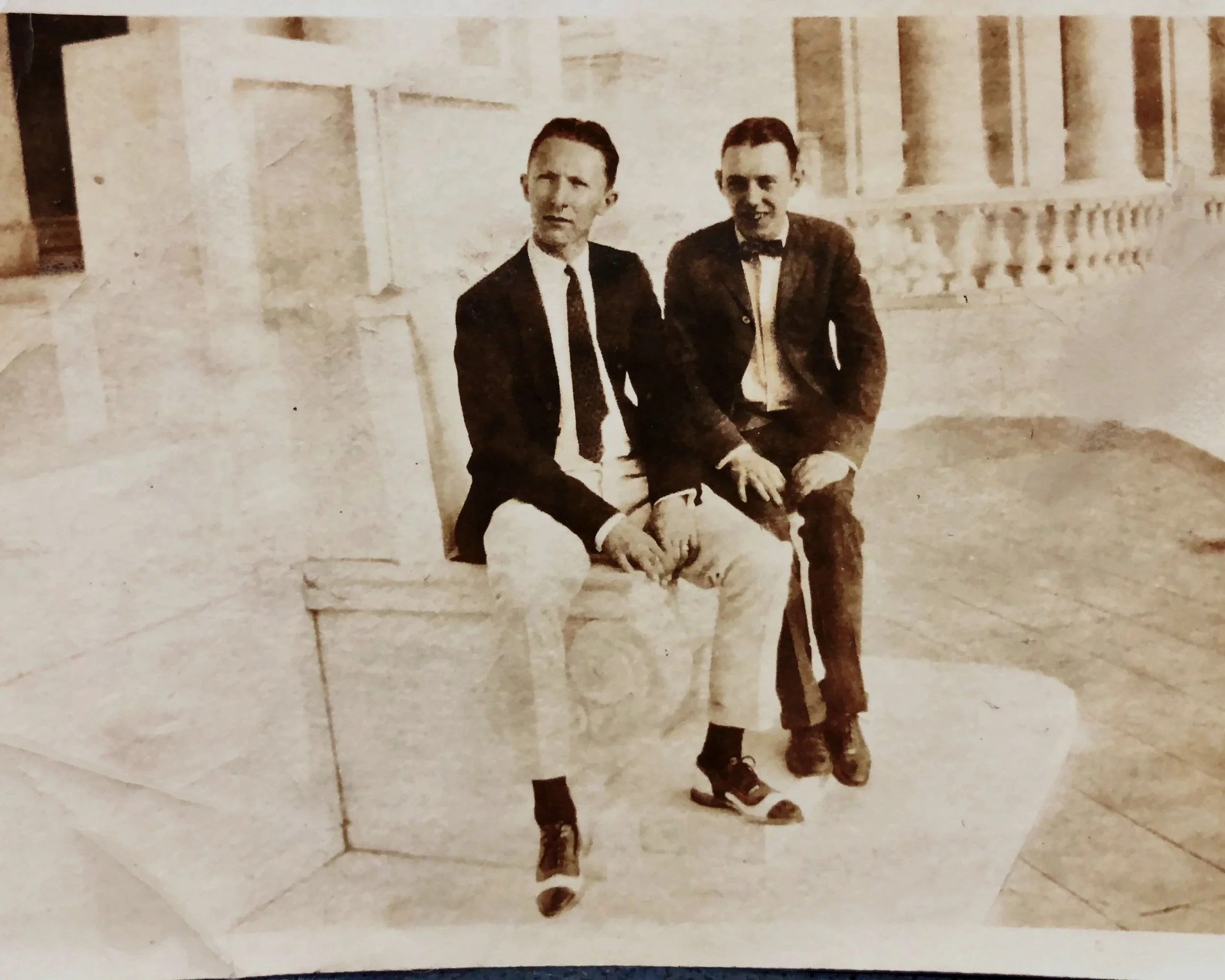
The Mystery Man :
In a 1947 photograph, two men sit together at the US Capitol—one is Thomas Eugene Hamall, age 43. The other remained unidentified for 75 years. Through forensic photo analysis, family tree reconstruction, and a 1968 high school yearbook, we finally discovered who he was—and uncovered a poignant story about family connections maintained across three fractured generations.
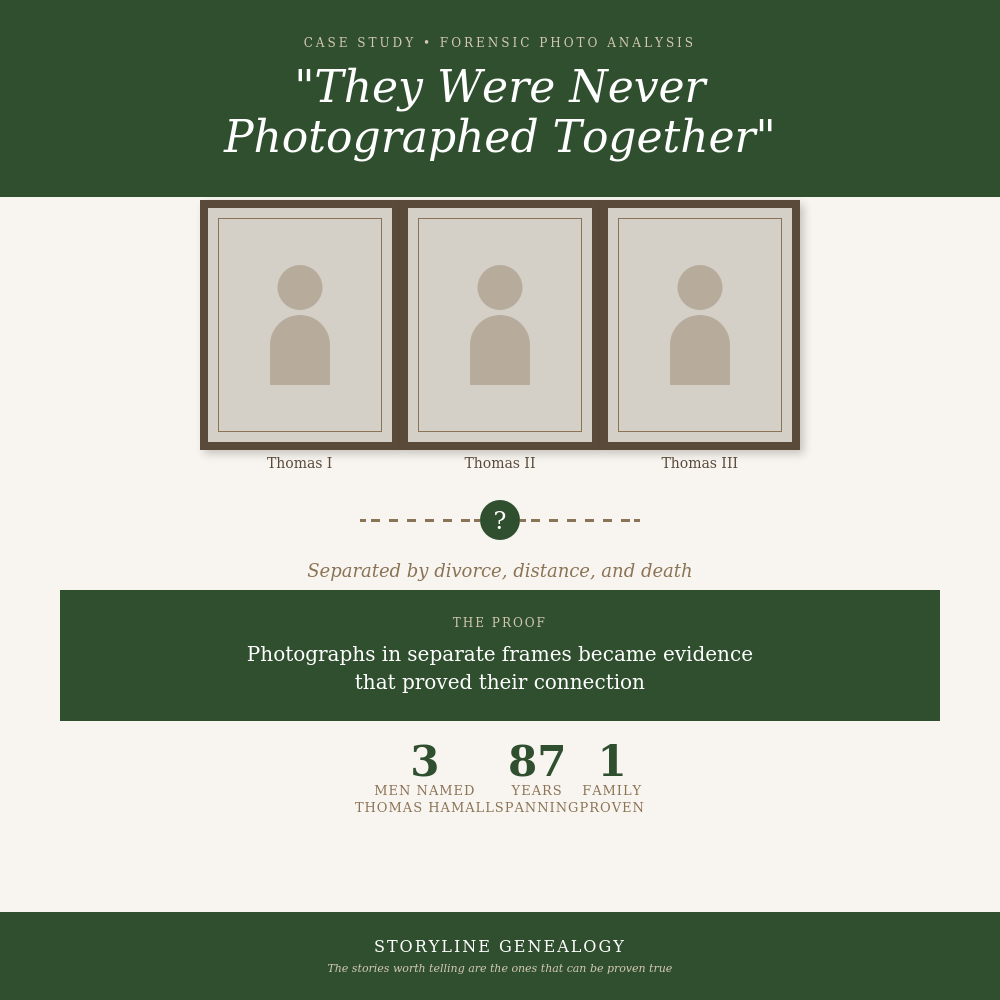
They Were Never Photographed Together
They were never photographed together—but forensic analysis proved they were there. When three men named Thomas Hamall were separated by divorce, distance, and death, photographs in separate frames became the evidence that proved their connection across 87 years.
Part of the Storyline Genealogy Series: proving that the stories worth telling are the ones that can be proven true.

The Property War: A Mill Worker's Legal Victory That Still Protects Families
Emma divorced Thomas on October 18, 1907. Five days later, she married another man in Indiana.
Five. Days.
She literally fled across state lines to remarry as quickly as possible, using Indiana's "quickie marriage" laws like a 1900s version of Las Vegas. Meanwhile, Thomas was left financially ruined, homeless, and owing $4 every week in child support – equivalent to $150 weekly in today's money.
But Thomas had a secret weapon: his mother Kate, who loaned him $400 in 1911 to buy a cottage in Riverside, Illinois. It seemed like a fresh start. Then came the deal that would change everything.
In 1914, Thomas and Emma thought they were being clever. He'd pay her $25 cash and deed his property to a friend "in trust" for their son Thomas Eugene. She'd give up all future child support claims. Everyone wins, right?
Wrong.
Ten years later, Emma filed a shocking lawsuit demanding $2,500 in "unpaid" child support – despite their agreement. She wanted to seize Thomas's cottage to satisfy the debt. What followed was a four-year legal war that went all the way to the Illinois Supreme Court, creating precedent that still protects homeowners today.
This isn't just another property dispute. This is the story of how one working-class father's promise to his son became a legal victory that would protect countless American families for generations...
Part of the Storyline Genealogy series: Uncovering the dramatic human stories behind legal history, one family at a time.

The Missing Brother Mystery
Sometimes the most puzzling genealogical mysteries hide in plain sight. One census entry proved particularly haunting: 'Thornton Hammil' listed as Owen Hamall's brother in 1880 Chicago—but no such person seemed to exist anywhere else in the historical record. The breakthrough came where it often does in immigrant family research: in the margins of church records, where community relationships revealed themselves through acts of faith and mutual support.
Part of the Storyline Genealogy series: When mysterious census entries unlock complex family stories that span continents and generations
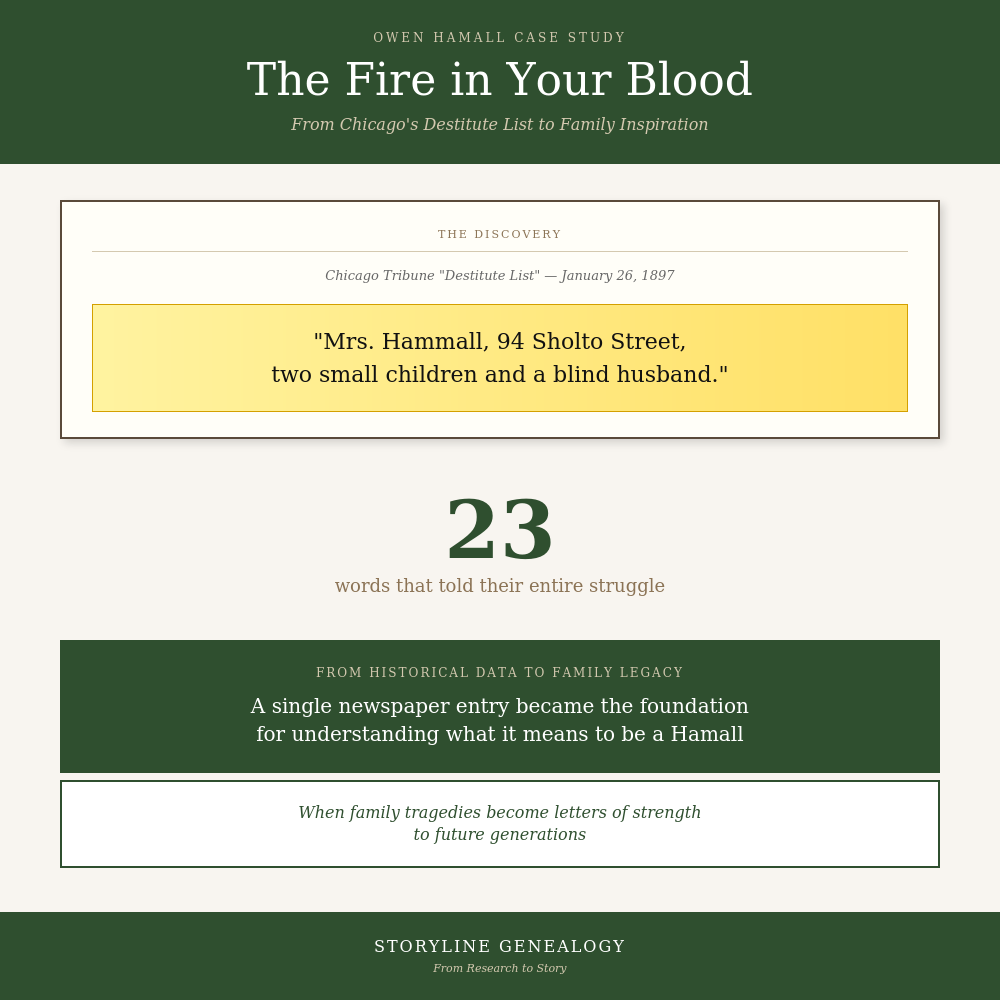
The Fire in Your Blood: From Chicago's Destitute List to Family Inspiration
When Owen Hamall died of meningitis in 1898, he left behind more than just a grieving family—he left behind a story of resilience that would echo through generations. This story was discovered not through grand family legends, but through a single newspaper clipping that reduced his family's struggle to twenty-three stark words: "Mrs. Hammall, 94 Sholto Street, two small children and a blind husband."
This entry in the Chicago Tribune's "Destitute List" from January 26, 1897, could have been just another piece of historical data. Instead, it became the foundation for understanding what it truly meant to be a Hamall descendant—and why some family stories deserve to be told as letters of strength to future generations.
Part of the Storyline Genealogy series: When family tragedies become letters of strength to future generations.

Legacy Letter: The Fire in Your Blood
A letter from Owen Hamall to his descendants — written in his voice, sharing what he wants them to know about courage, loss, and the fire that started burning in County Monaghan in 1847.
Part of the Storyline Genealogy series: When family tragedies become letters of strength to future generations.