
Royal Heritage
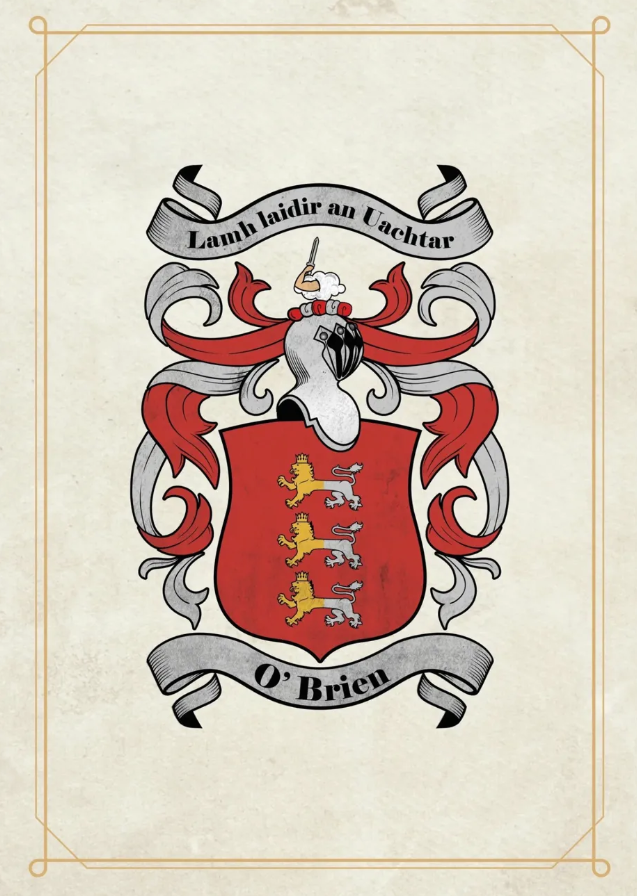
Lamh Laidir an Uachtar
The Strong Hand Uppermost — Motto of the O'Brien Clan, descendants of Brian Boru, High King of Ireland

Dromoland Castle, County Clare, Ireland. Built in the early 19th century for the O'Brien family on the site of their ancestral home, first mentioned in the will of Murrough O'Brien, Earl of Thomond, in 1551. The O'Briens are the principal Dalcassian family — descendants of Brian Boru.
As descendants of Brian Boru, the last great High King of Ireland, the O'Brien dynasty ruled the Kingdom of Thomond for centuries. Brian Bóramha mac Cennétig — known to history as Brian Boru — lived from 941 to 1014. He unified Ireland against Viking rule and died a hero's death at the Battle of Clontarf. From him sprang the Royal House of Thomond, and for five hundred years his descendants ruled as kings and princes from their strongholds in County Clare and Limerick.
To this day, the head of the O'Brien family carries the title Prince of Thomond and is recognized as the Chief of the Name. The current head of the dynasty is Sir Conor O'Brien, the 19th Baron Inchiquin.
In the 21st century, Y-DNA testing proved what no document could — that the O'Brien men of Caldwell, New Jersey carry the genetic signature of this royal line.
The O'Brien Coat of Arms
Heraldic symbols of a thousand-year dynasty
The O'Brien Family Crest
"Lamh Laidir an Uachtar" — The Strong Hand Uppermost
Three Lions
Gold and silver on a red shield, the three lions symbolize "deathless courage" — the magnanimity and military fortitude of family members in times of hardship.
The Red Shield
Dominated by "the Martyr's color," the rich red signifies military fortitude — representing the long-standing warrior history of the O'Briens in Ireland.
The Arm and Sword
A sword-wielding arm emerging from the crest — a connection to Nuadu, a mythical Irish king who reclaimed his throne with a false arm after being injured in battle. A faith shared by the O'Briens' founding family member.
White and Grey
The pale tones represent the peaceful and sincere nature of the O'Brien family in ordinary times.
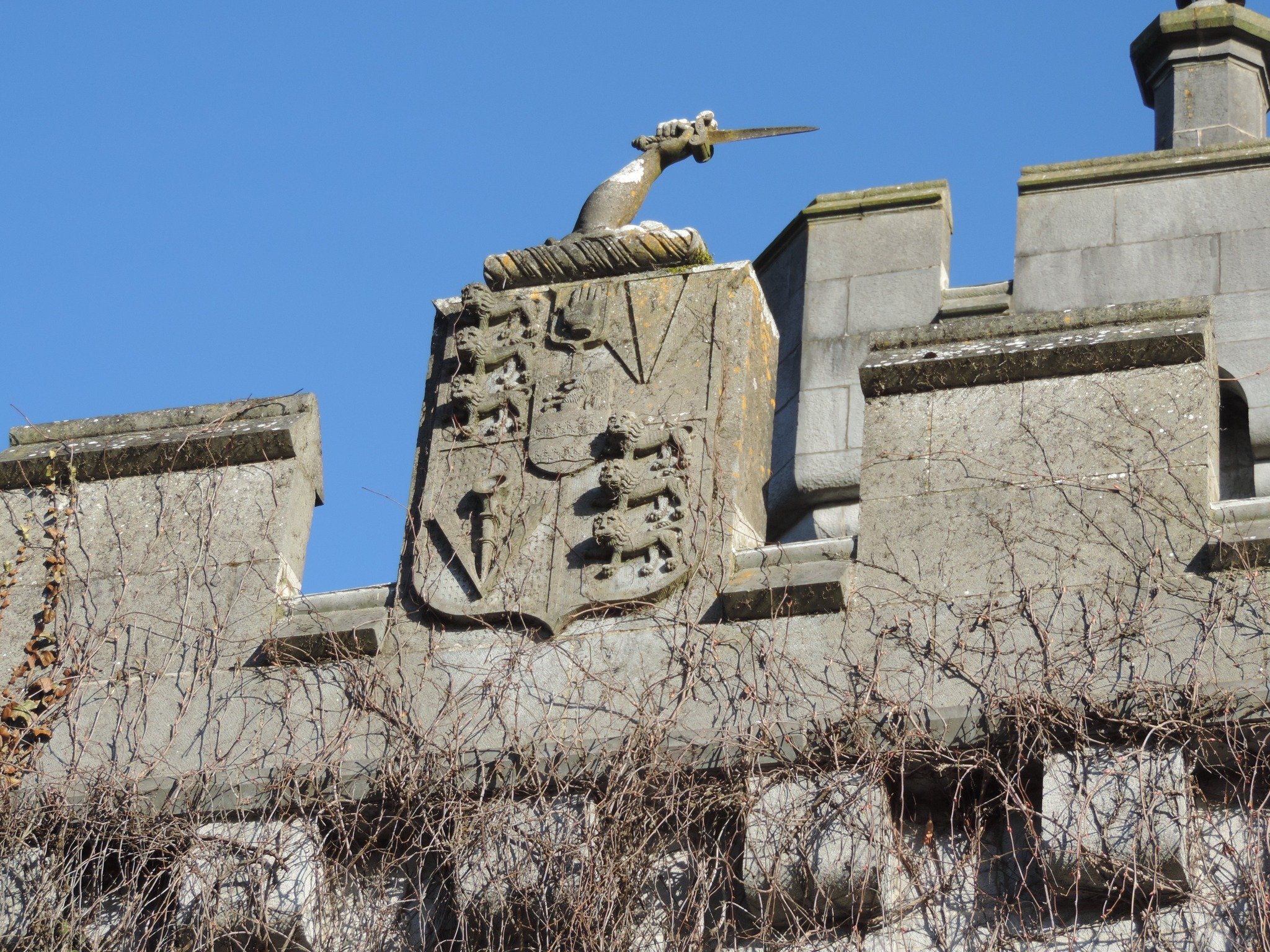
The O'Brien coat of arms carved in stone on the O'Brien family home in County Clare, Ireland. The three lions and the sword-wielding arm — still standing after centuries.
From Stone to Silver
The same crest, four centuries apart
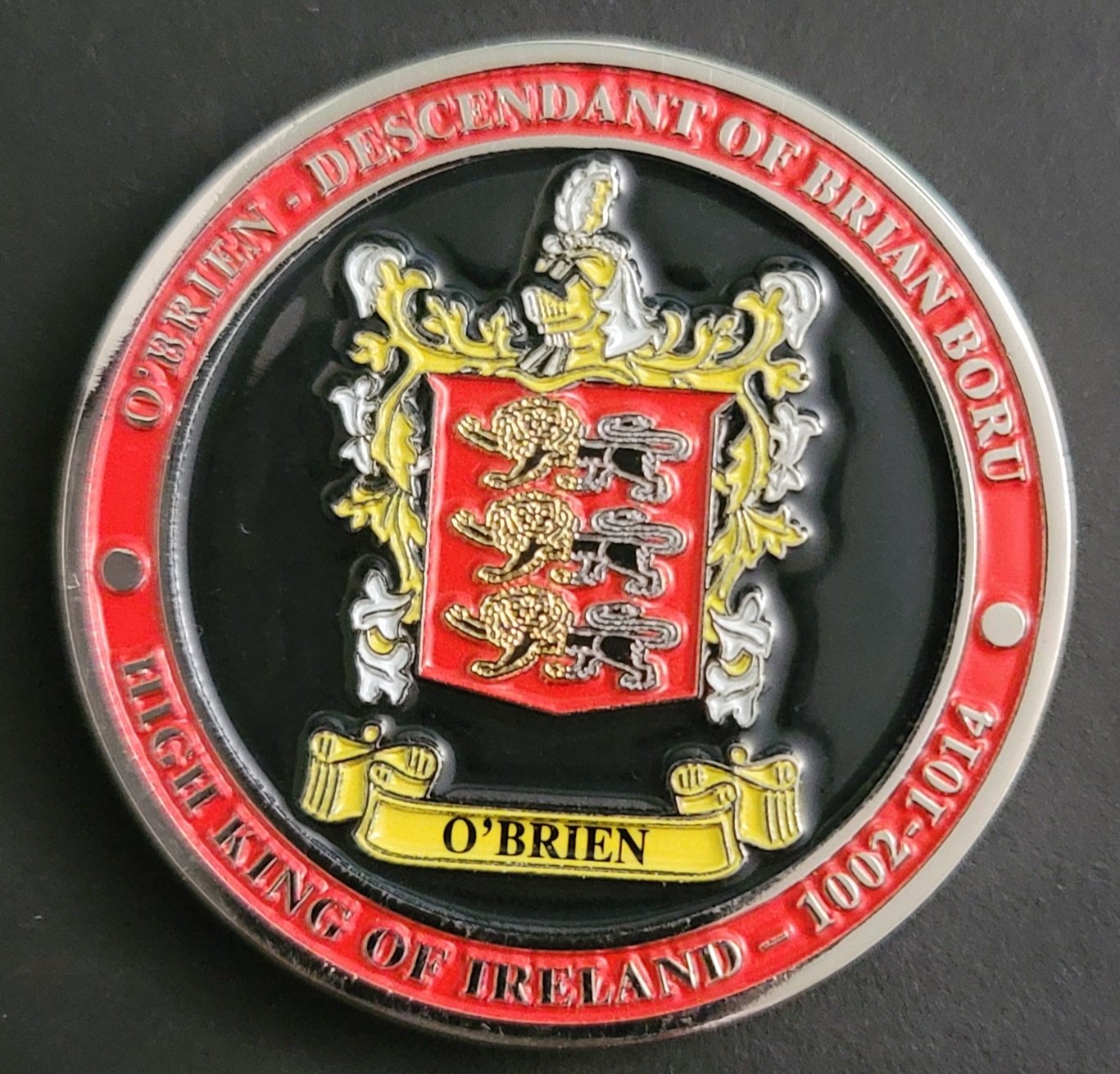
Obverse
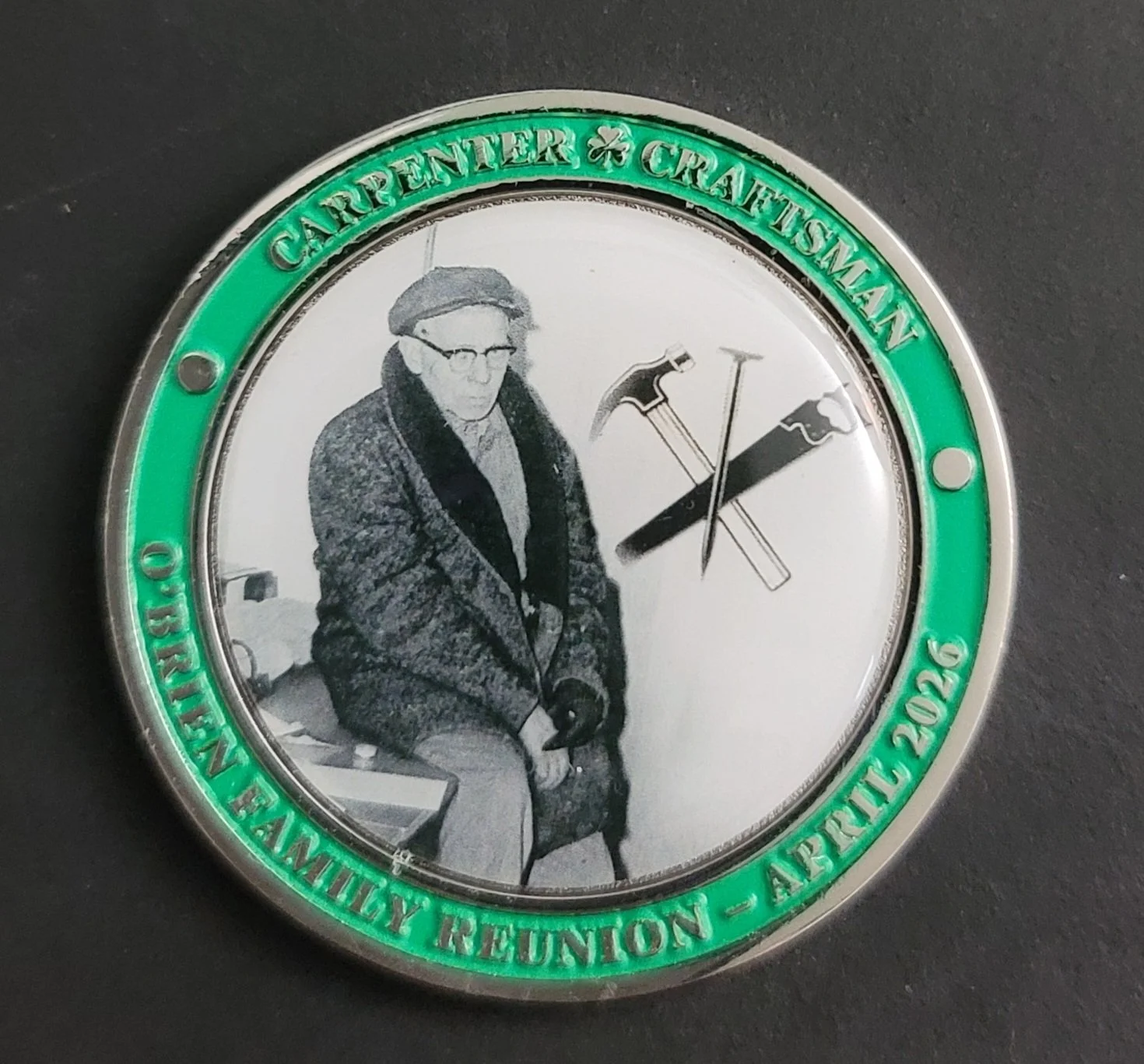
Reverse
In County Clare, our ancestors carved this crest in stone. In Georgia in 2026, the same three lions and the same crowned arm were struck again — this time in metal — and given to one hundred members of the family at the O'Brien reunion.
The obverse carries the heraldic claim: Descendant of Brian Boru, High King of Ireland · 1002–1014. The reverse carries our grandfather Miles Sr. at his workbench, with his hammer and his saw — Carpenter ☘ Craftsman. Royal blood and working hands, on a single coin.
The Inchiquin Vault
St. Mary's Cathedral, Limerick

The Inchiquin Vault in St. Mary's Cathedral, Limerick — resting place of the Barons Inchiquin, direct descendants of Brian Boru. The royal arms are displayed above the monument with effigies of the deceased.
The Genetic Signature of a King
The DNA haplogroup R-L226 dates back to the earliest times of Celtic Ireland. R-DC782, a downstream marker dating to approximately 900 CE, represents Brian Boru's own genetic signature. Our O'Brien family carries the R-DC768 marker, descending from King Turlough VI O'Brien (c. 1455–1528) — placing us within the Catholic Clare families of Ennis. Royal blood that survived three centuries of persecution.
Royal House of Thomond
Y-DNA Descendants' Tree

The Royal House of Thomond Y-DNA Descendants' Tree, from the O'Brien Surname Project. The R-L226 haplogroup traces from Brian Boru (941–1014) through subsequent genetic markers. Our O'Brien family carries the R-DC768 marker (right side), descending from King Turlough VI through an unnamed descendant — the Catholic Clare families of Ennis who were thought to have died out. DNA proved they did not.
Research & Resources
Published research, DNA projects, and further reading
Published Study
The O'Brien Irish Royal Line, R-DC782
The "Y" male line of descendants — by Dennis John O'Brien. Published in the Journal of Genetic Genealogy, documenting how a distinctive set of marker values defines the Y-STR signature for Gaelic Dalcassian families.
Read the Study (PDF) →DNA Project
O'Brien Surname Project
The surname project at Family Tree DNA, tracing the Y-DNA of males associated with O'Brien and related surnames — O'Brian, O'Bryan, Bryan, Brien, Bryant, and all reasonable spelling variations.
Visit the Project →DNA Project
R-L226 — Irish Type III Cluster Project
The SNP that defines the Irish Type III haplogroup. This project is open to all men who show the distinctive STR markers of the Dalcassian cluster — the genetic signature of Brian Boru's clan.
Visit the Project →Documentary Series
Hidden Bonds: The O'Brien Family of Jamaica, Queens
The full story of how two Famine brothers, four scattered orphans, and 21st-century DNA testing reunited a family — and proved their descent from the High King of Ireland.
Read the Series →