
A Welcome Confusion
The moment one egg became two lives
Newark College of Engineering · Circa 1964
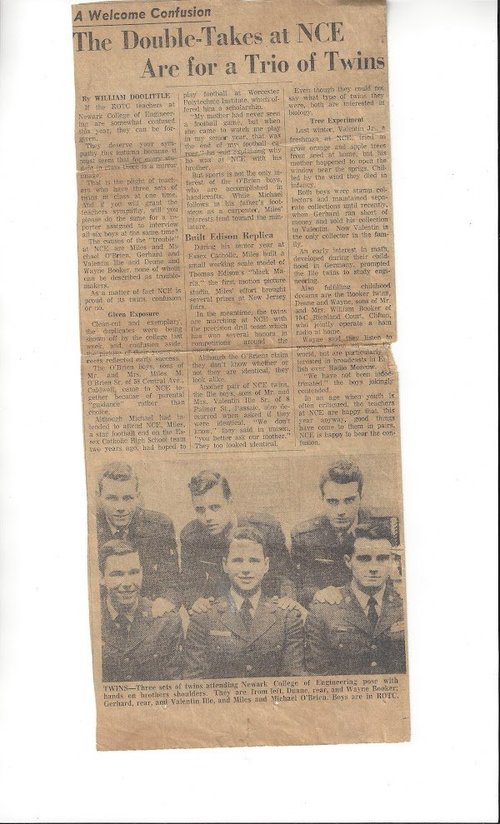
From a Newark College of Engineering publication, circa 1964. Three sets of twins in ROTC — including Miles and Michael O'Brien of Caldwell. Article courtesy of Judy Robertson Apicella.
A Welcome Confusion
The Double-Takes at NCE Are for a Trio of Twins
If the ROTC teachers at Newark College of Engineering are somewhat confused this year, they can be forgiven.
They deserve your sympathy this autumn because at least from that far-away distance in class there is a mirror image.
That is the plight of teachers who have three sets of twins in class at one time. And if you will grant the teachers sympathy, will you please do the same for a reporter assigned to interview all six boys at the same time.
The causes of the "trouble" at NCE are Miles and Michael O'Brien, Gerhard and Valentin Ilie, and Duane and Wayne Booker, none of whom can be described as troublemakers.
As a matter of fact NCE is proud of its twins, confusion or no.
Given Exposure
Clean-cut and exemplary, the "duplicates" were being shown off by the college last week, and confusion aside, the publicity department received early success.
The O'Brien boys, sons of Mr. and Mrs. Miles M. O'Brien Sr. of 88 Central Ave., Caldwell, came to NCE because of parental "guidance" rather than choice.
Although Michael had intended to attend NCE, Miles, a star football end on the Essex Catholic High School team two years ago, had hoped to play football at Worcester Polytechnic Institute, which offered him a scholarship.
"My mother had never seen a football game, but when she came to watch me play in my senior year, that was the end of my football career," he said resignedly. "She made sure he was at NCE with his brother."
But sports is not the only interest of the O'Brien boys, who are accomplished in handicrafts. While Michael follows in his father's footsteps as a carpenter, Miles' interest tend toward the miniature.
Built Edison Replica
During his senior year at Essex Catholic, Miles built a small working scale model of Thomas Edison's "Black Maria," the first motion picture studio. Miles' effort brought several prizes at New Jersey fairs.
In the meantime, the twins are marching at NCE with the precision drill team which has won several honors in competitions around the country.
Although the O'Briens claim they don't know whether or not they are identical, they look alike.
Another pair of NCE twins, the Ilie boys, sons of Mr. and Mrs. Valentin Ilie Sr. of 8 Palmer St., Passaic, also be-murmured when asked if they were identical. "We don't know," they said in unison, "you better ask our mother." They too looked identical.
Even though they could not say what type of twins they were, both are interested in biology.
Tree Experiment
Last winter, Valentin Jr., a freshman at NCE, tried to grow orange and apple trees from seed at home, but his mother happened to open a window near the sprigs, chilled by the wind they died in infancy.
Both boys were stamp collectors and maintained separate collections until recently, when Gerhard ran short of money and sold his collection. Now Valentin is the only collector in the family.
An early interest in math, developed during their childhood in Germany, prompted the Ilie twins to study engineering.
Also fulfilling childhood dreams are the Booker twins, Duane and Wayne, sons of Mr. and Mrs. William Booker of 140 Roseland Court, Clifton, who jointly operate a ham radio at home.
Wayne and, they hasten to amend, not are particularly interested in frequencies in English over Radio Moscow.
"We have not been indoctrinated," the boys jokingly contended.
In an age when youth is often criticized, the teachers at NCE are happy that, this year anyway, good things have come to them in pairs. NCE is happy to bear the confusion.
For eighteen years, they were interchangeable. Same house, same parish, same school, same ROTC uniform, same face looking back from every photograph. The world saw one thing repeated twice and called it a pair. Teachers confused them. Neighbors confused them. Even the boys themselves couldn't say for certain whether they were identical or fraternal — "you better ask our mother."
And then, buried in a college newspaper article about three sets of twins at Newark College of Engineering, a single paragraph says everything.
While Michael follows in his father's footsteps as a carpenter, Miles' interests tend toward the miniature.
There it is. The fork in the road. Not dramatic, not announced — just a quiet sentence in a lighthearted feature story about ROTC teachers doing double-takes. But it's the first time anyone wrote down what was already happening: one egg had become two lives.
Michael, the carpenter's son who became the carpenter. Hands like his father's — the same hands that renovated the Caldwell house, that built and fixed and shaped things from wood. He would go on to serve as a Lt. Colonel in the United States Air Force, but the instinct was already there at eighteen: build what you can touch.
Miles, the builder of miniatures. Precision at a different scale. He constructed a working replica of Thomas Edison's Black Maria — the world's first motion picture studio — and won prizes at New Jersey fairs for the craftsmanship. He would go on to serve as a Colonel in the Air Force, but the instinct was already there too: build what others can only imagine.
Two kinds of builders. Two kinds of vision. From the same fertilized egg that split in their mother's womb in early 1946.
There's a detail in the article that Miles probably never forgot. He had a football scholarship to Worcester Polytechnic Institute. He was a star end at Essex Catholic. He was going to play college football. And then his mother came to a game.
"My mother had never seen a football game, but when she came to watch me play in my senior year, that was the end of my football career. She made sure he was at NCE with his brother."
Lillian Robertson O'Brien — the orphan who became the matriarch — was not about to let her twins be separated. She had lost too much already. She knew what it meant when family scattered. So Miles went to NCE. With his brother. End of discussion.
The article calls it "a welcome confusion." The teachers couldn't tell them apart. The reporter couldn't tell them apart. The photograph shows six young men in ROTC uniforms, hands on brothers' shoulders, and you have to read the caption to know which is which.
But the words tell a different story than the faces. The words say: one follows his father into carpentry. The other builds miniatures and wins prizes. One wanted to stay close to home. The other wanted to play football across the state. Their mother made sure they stayed together — and then life, slowly, made sure they didn't.
That's what identical twins teach us, if we pay attention. You can start from the same cell, share the same DNA, grow up in the same house with the same parents and the same checkered tie on picture day — and still become two completely different people. Not because the biology diverged. Because the lives did.
The ROTC teachers at Newark College of Engineering saw a mirror image. William Doolittle saw a feature story. But eighty years later, reading this yellowed clipping, we see something else entirely.
We see the exact moment one egg became two lives.
A welcome confusion.
A father's trade and a son's miniatures. A mother's refusal to let her twins be separated. An article that captured the fork in the road before anyone knew the road would lead to two Air Force careers, two retirements, and a DNA test that proved what the teachers always suspected.
They were identical all along. And they were never the same.
Storyline Genealogy — From Research to Story
Read One Egg, Two Lives →