
Proving a Donation No One Could Find
The case study argues that Marie Chapelier defended an inheritance settlement her stepdaughter tried to undo. This page shows the work behind that claim — document by document, phrase by phrase — including how a conclusion holds when the one deed that would state it plainly is searched for in every place it could be, and found in none.
When a court file records who won but never states what was fought over, can the subject of the dispute — and the reason one party kept losing — be recovered from the surrounding record?
The litigation records name Marie Chapelier and Romain Trépagny, recite dismissals and fines, and refer back to still-earlier judgments — but not one of them states, in the body of the order, what the two families were actually disputing. The subject had to be reconstructed from a single naming phrase, then confirmed against the records that framed it. This page reconstructs that work, and is honest about its one persistent gap: the 1656 deed at the center of the case has never been located, and the conclusion about it rests on convergence rather than on the document itself. Where the seventeenth-century hand can be read with confidence, the phrase is given in French and English. Where it cannot yet be read faithfully, that is marked plainly rather than filled in.
One Sovereign Council record, of 13 February 1696, does what none of the others do: it names the donation. It is also where a date error entered the story — and where reading the manuscript, not the transcription, corrected it.

The Judgment That Names the Donation
The record dismisses the Trépagnys’ appeal of the 16 January 1694 provost sentence, compensates costs, and — in a single recital of what the lower court had confirmed — states the subject that every other order withholds: a donation made by Trépagny and his wife to Robert Drouin and Marie Chapelier. The case was never about a debt Marie owed. It was about a gift the Trépagnys had made and, after Robert’s death, wanted back.
The two phrases above were read directly from the manuscript leaf at magnification. The intervening procedural recital is not yet given a faithful word-for-word reading and is marked accordingly.
The archive’s modernized transcription renders the Beaupré sentence as “27 avril 1698” — impossible, since it postdates both the December 1696 final judgment and Marie’s death in March 1697. The original leaf plainly reads 1693; the third digit is unambiguous. The error is in the transcription, not the record. Register matter of the same period, independently dated 1693, confirms the reading.
Appel de la sentence du 16 janvier 1694 par Romain Trépagny (Trépanier) et Geneviève Drouin, sa femme, contre Marie Chapellier, veuve de Robert Drouin, rejeté, dépens compensés, 13 février 1696; Archives nationales à Québec, Fonds Conseil souverain (03Q,TP1,S28,P5891; copie de registre P7202).
The subject of the dispute (a donation to Robert Drouin and Marie Chapelier, not a debt owed by Marie); the two-tier lower-court structure beneath the appeal (Beaupré bailiff, then provost); and — read from the manuscript — the true date of the underlying Beaupré sentence, 27 April 1693.
The naming phrase tells us a donation existed. It does not tell us what the donation was. The case study argues it settled Geneviève’s inheritance from her mother, Anne Cloutier. Her 1656 marriage contract has since been retrieved and read — and it does not contain the donation. So the reading is established not by one document but by five, converging from independent directions.

A Court-Ordered Division, c. 1650
Governor d’Ailleboust, asked to set down what he recalled of an earlier dispute, describes how — when Robert Drouin wished to move his children by the late Anne Cloutier to Trois-Rivières with his new wife — Zacharie Cloutier objected, and a division of the Rivière-aux-Chiens concession was ordered so the children would hold what came to them from their mother’s estate. This is the “succession de la défunte Anne Cloutier” that the 1695 Council records name, traced to its origin a generation earlier.
Read from the certified 1667 copy (typed and manuscript both present in the source image). The declaration is a recollection set down under a governor’s hand, not a contemporaneous 1650 court act; it is weighed as strong corroborating testimony of the settlement, not as the settlement instrument itself.
Déclaration d’un certificat de M. d’Ailleboust à Robert Drouin du 29 juin 1656, copie collationnée par Duquet, notaire royal, 22 novembre 1667; “Trois-Rivières, Quebec, Canada records,” images, FamilySearch, image 469 of 2546; BAnQ, Image Group 100626718.
That Anne Cloutier’s children — Geneviève among them — held a court-recognized claim to a share of the very Rivière-aux-Chiens property, from their mother’s succession, as early as c. 1650. The material foundation of the later donation, established without the 1656 deed.
The Council Names the Succession, Twice
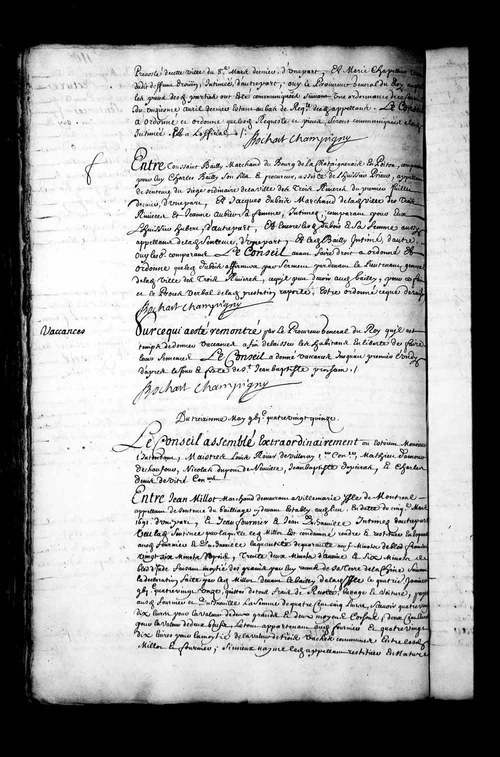
Two orders in the litigation itself state the dispute’s subject in the court’s own language. The 2 May 1695 order styles Geneviève the héritière of Robert Drouin and Anne Cloutier, her father and mother. The 29 August 1695 order, granting Trépagny more time to file, describes the pending matter as concerning the succession of the late Anne Cloutier, mother of his wife. Neither is an inference: the Council names the maternal inheritance as the thing at issue.
First phrase read from the 2 May 1695 order (P5815); second from the 29 August 1695 order (P7152). Both are archival modernized transcriptions cross-checked against the manuscript headings.
Ordre que les documents de Trépagny soient communiqués à Chapelier et à l’official, 2 mai 1695 (03Q,TP1,S28,P5815); et Romain Trépagny reçoit un mois pour fournir ses griefs d’appel, 29 août 1695 (03Q,TP1,S28,P7152); Archives nationales à Québec, Fonds Conseil souverain.
In the court’s own words, twice: the dispute concerns Geneviève’s inheritance from her mother, Anne Cloutier. This converts the maternal-inheritance basis from inference to document-stated fact.
The Same Father, the Same Pattern
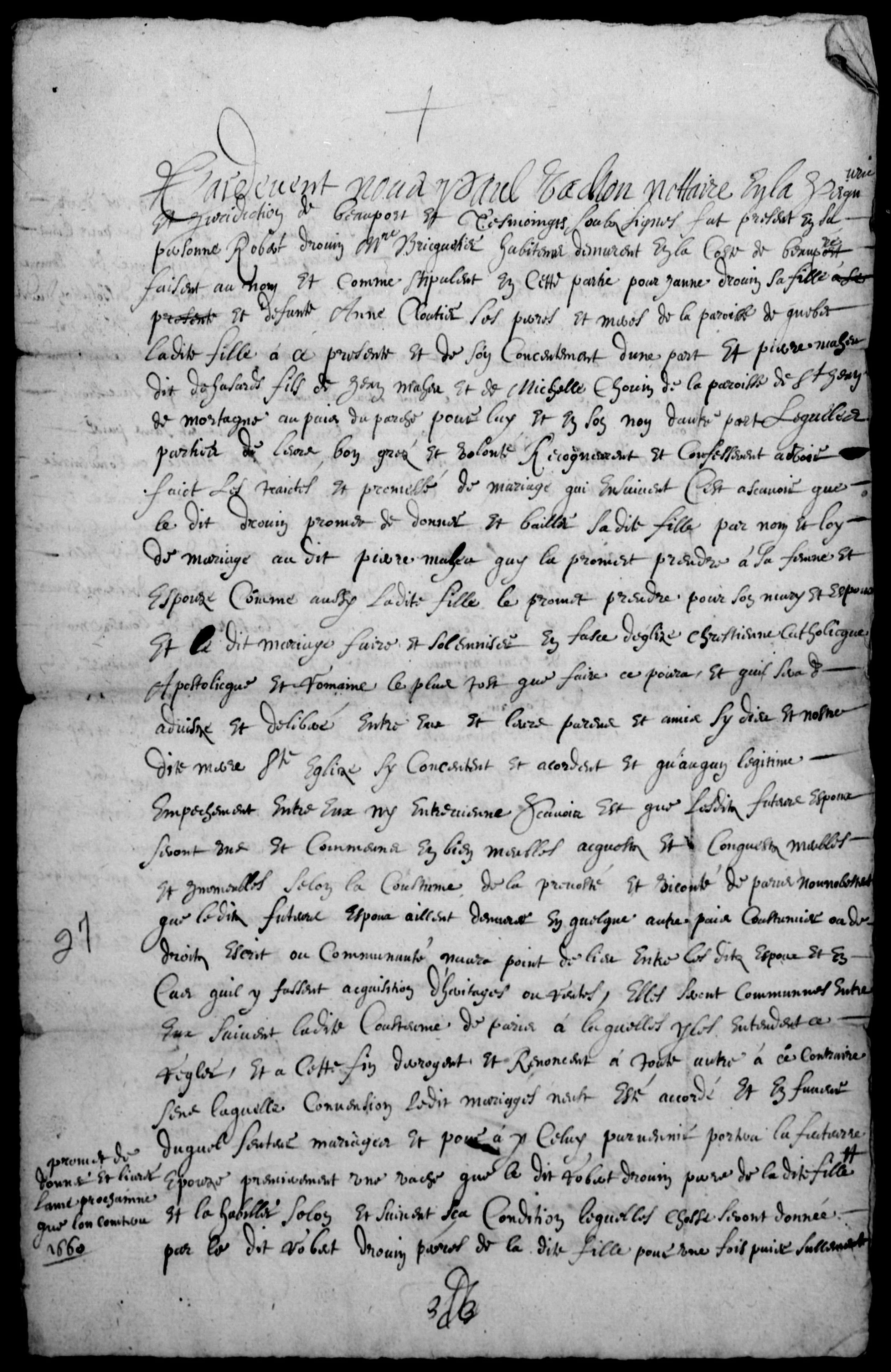
Three years after Geneviève married, her full sister Jeanne — also a daughter of Robert Drouin and the late Anne Cloutier — married Pierre Maheu. With both contracts now in hand, the two can be read against each other rather than one inferred from the other. In each, Robert stipulates in his own name for a daughter of his first marriage; in each, the maternal Cloutier kin stand as witnesses. Geneviève and Romain themselves appear among the witnesses to Jeanne’s.
What the pair shows is a settled family practice: Robert established each of Anne Cloutier’s daughters at marriage, before the same circle of maternal relatives, on terms drawn from the estate their mother left. That practice is the frame within which the litigation’s donation has to be read.
Read from the greffe leaf and its dorse. This is Jeanne’s contract, not Geneviève’s; it is cited as collateral (sibling-cluster) evidence of the family’s settlement practice. With Geneviève’s own 1656 contract now retrieved, the two are compared directly rather than one standing in for the other.
Contrat de mariage de Jeanne Drouin et Pierre Maheu, greffe Paul Vachon, Beauport, 8 [septembre] 1659; “District Judiciaire de Québec…,” images, FamilySearch, image 58 of 1175; BAnQ, Image Group 106136181.
A settled family practice, now demonstrable across two surviving contracts three years apart: Robert established each of Anne Cloutier’s daughters at marriage, before the same circle of maternal kin, on terms drawn from their mother’s estate.
Two further records place the dispute in its material context: what Marie and Robert were worth, and what the Trépagnys were — which together bear on why the fight happened when it did.

500 Livres, and a Signature
Robert and Marie sell a roughly sixty-arpent concession for 500 livres tournois — several years of a habitant’s income. It shows a couple managing property with sophistication, not scraping subsistence, and it carries Marie’s own signature, “Marie chapelié” — the second independent instance of her literacy, the trait that underlies her later navigation of the courts.
Vente d’une concession de ~60 arpents à Notre-Dame-des-Anges par Robert Drouin et Marie Chapelier à René Chevalier, 500 livres, 12 septembre 1655; Archives nationales à Québec, Fonds Ministère des Terres et Forêts (03Q,E21,S64,SS5,SSS5,D56).
Substantial means (the 500-livre figure, read from the act); and Marie’s literacy, confirmed by her signature — a second instance beyond the 1649 marriage contract.

The Blended Family, Enumerated
The census fixes the household that produced the dispute: Robert, Marie, and the children of two marriages under one roof — Geneviève and Jeanne from Anne Cloutier, and the younger children, including Étienne, from Marie. It is the roster against which the 1696 alliance is read: Étienne, Marie’s son, siding with his mother against his half-sister Geneviève.
Recensement de la Nouvelle-France, 1666, ménage de Robert Drouin, côte de Beaupré; Archives des Colonies, Série G1, vol. 460, 1re partie.
The blended-family structure — the roster identifying which children were Anne Cloutier’s and which were Marie’s, and so making the half-sibling alignment of 1696 legible.
The Genealogical Proof Standard asks for a reasonably exhaustive search and an honest account of what was — and was not — found. Negative results are evidence too.
What the search covered
- The full litigation sequence located across the Conseil souverain registers (TP1,S28), with duplicate register copies identified rather than double-counted.
- The subject of the dispute recovered from the 13 February 1696 naming phrase and the true Beaupré date read from the manuscript, correcting the archive’s “1698.”
- The maternal-inheritance basis established by convergence — the d’Ailleboust declaration, two 1695 Council orders, Jeanne’s 1659 sibling contract, and the 1668 Cloutier family settlement.
- The 1656 marriage contract of Geneviève Drouin and Romain Trépagny located and read, against both the original minute and the archival typed transcription.
- The economic frame assembled — the 1655 sale read from the original notarial minute (means, payment terms, and Marie’s signature) and the 1666 census (household structure).
- Marie’s death date confirmed as 18 March 1697 (Hôtel-Dieu de Québec) via PRDH.
- The donation deed is absent from the notary’s greffe. Badeau drew both the family’s 1655 sale and the 1656 marriage contract; his register was searched page by page from before the sale through March 1657 — a full year past the marriage, the window in which a follow-on donation would sit. Those two instruments are the only Drouin–Chapelier acts in it.
- The donation is not in the marriage contract. Read against manuscript and transcription, the single occurrence of the word is the standard formula “par succession donnation et autrement” — defining what may come to Geneviève during the marriage as her own, free of community debts. Protective boilerplate running toward the bride, not a gift from the couple.
- The donation cannot be in the insinuations. Donations were registered there to bind third parties, but the surviving Québec series opens in October 1668 — twelve years too late to hold a 1656 act. The lead is closed for structural reasons, not for want of looking.
- The 27 April 1693 Beaupré bailiff sentence and the 16 January 1694 provost sentence are recited in later records but not yet retrieved as standalone documents.
- A faithful word-for-word transcription of the connective passages of the cited Council orders remains to be completed from the originals; only anchored phrases are transcribed here.
The claim the case study makes — that Marie defended an inheritance settlement her stepdaughter tried to undo, and that the courts upheld it at every level — rests on directly-read records: the naming of the donation, the Council’s own styling of Geneviève as her mother’s heir, and the sequence of dismissals. The deed itself was searched for in the three places it could reasonably be, and is in none of them. That is not a hole in the argument; it is the argument working as intended. Five independent records establish what the missing deed would have stated, which is precisely why a conclusion built on convergence survives the loss of any single document.
Go to the Source
Every claim on this page can be checked against the original. The Conseil souverain registers are digitized and open at BAnQ; the 13 February 1696 judgment that names the donation is the place to begin.
View the Judgment at BAnQ → Back to the Case Study →