
Documentary Evidence & Sources
The records foundation underlying the Donaghmoyne genetic network — Irish parish registers, Griffith’s Valuation, migration documents, American vital records, and the citation apparatus that grounds the case study’s documentary claims.
This page is the documentary parallel to the case study’s Chromosome 2 Triangulation Analysis. Where the chromosome 2 page asks what does the genetic evidence show about the Donaghmoyne network, this page asks what does the documentary evidence show about the four founding couples and their American descendants.
Together with the DNA Evidence Analysis page (cluster matrices and cross-network patterns) and the Y-DNA Analysis page (paternal-line haplogroup), these four analytical components form the evidentiary core of the case study. Each component is designed to be readable on its own. Read together, they demonstrate the Genealogical Proof Standard’s requirement that evidence of different types from different sources be analyzed independently and then correlated to support, refute, or refine specific genealogical claims.
The page is organized in eleven sections. Sections 1 through 3 establish the documentary anchor — the four marriage records that proved four families lived alongside each other in one parish in pre-Famine County Monaghan. Sections 4 and 5 set those marriages in geographic context and acknowledge the documentary gaps honestly. Sections 6 through 8 trace the families’ migration to North America and surface the single most important document the case study has located. Section 9 synthesizes the documentary and genetic evidence within the case study’s five-tier evidence framework. Section 10 is the citation apparatus.
A reader who works straight through the page will leave with a clear answer to a precise question: what kind of documentary footing does the Donaghmoyne genetic network actually rest on, and where does that footing become uncertain?
The Four Founding Couples: Documentary Anchors
Four marriages, one parish, seventeen years. Why these four records carry the documentary weight of the case study.
The Donaghmoyne genetic network rests on a documentary spine of four marriage records, all from the Roman Catholic parish register of Donaghmoyne, County Monaghan. The earliest is dated 1841; the latest, 1858. Within those seventeen years, four couples whose surnames recur throughout the case study’s DNA cluster matrix — Hamall, Hamill, Hammel, King, McKenna (also recorded as McCanna), and Gartlan — appear in the same priest’s register, married in the same parish.
| Couple | Year | Parish | Register reference |
|---|---|---|---|
| Henry Hamill & Mary McMahon | 1841 | Donaghmoyne, Co. Monaghan | Donaghmoyne RC marriage register, ref. 91 |
| Owen Hamill & Ann King | 1846 | Donaghmoyne, Co. Monaghan | Donaghmoyne RC marriage register, ref. 398 |
| Charles McKenna & Susan Hamill | 1857 | Donaghmoyne, Co. Monaghan | Donaghmoyne RC marriage register, ref. 811 |
| James Hamill & Ann Gartlan | 1858 | Donaghmoyne, Co. Monaghan | Donaghmoyne RC marriage register, ref. 841 |
Why these four marriages
These are not the only marriages in the Donaghmoyne register that mention any of these surnames. They are the four marriages whose descendants have tested into the case study’s DNA cluster matrix at thresholds that survive scrutiny — and whose documented marriage location, the same parish in the same generation, eliminates the most obvious alternative explanation for the genetic clustering. Geographic co-location in pre-Famine County Monaghan is the precondition; the genetic evidence is what raises the bar from plausibly related to biologically related.
Together, the four records establish four propositions. First, that each of the four couples existed and married. Second, that all four marriages occurred in the same Roman Catholic parish. Third, that the four marriages span a single generational window — seventeen years between the earliest and latest, with the spouses likely born within a roughly thirty-year band beginning in the late 1810s. Fourth, that the surname cluster appearing repeatedly in the case study’s genetic-match data is documented as geographically and temporally co-resident in pre-Famine Donaghmoyne.
Geographic co-location is not biological relatedness. The four marriage entries do not, by themselves, prove that any of these couples are related to any other. They do not name parents (the index fields for husband’s and wife’s parents are empty). They do not name witnesses (those fields are also empty in the available index). They do not give townland-level addresses beyond “Donaghmoyne.” They do not name occupations, ages, or denominations. They establish presence, parish, and year — nothing more.
The case study’s claim that these four couples are biologically related rests on the convergence of documentary evidence (these four records) with genetic evidence (the cluster matrix and chromosome 2 segment data). Neither evidence stream proves the relationship alone. The convergence is what carries the proof.
From the four marriages, the documentary evidence base extends outward in four directions. Backward: into Griffith’s Valuation (1861) and the surviving pre-Famine records (Section 4 and Section 5), where the same surnames appear in adjacent townlands. Forward: into the Canadian and American records that document each family’s emigration and settlement (Section 6 and Section 7). Inward: into the few baptismal records from the same Donaghmoyne register that name children of the founding couples (treated as supporting evidence in Section 3). Outward: into the death certificates, census entries, and probate records of second-generation descendants whose own children and grandchildren are the DNA-tested matches whose chromosomes carry the Donaghmoyne signal forward into the present.
The Donaghmoyne Parish Registers
What the registers contain, what they don’t, and how to read what survives.
The Roman Catholic parish of Donaghmoyne sits in southern County Monaghan, in the Poor Law Union of Carrickmacross and the Civil Registrar’s District of the same name. The surviving Donaghmoyne RC registers begin in the early 1840s — baptisms from 1841, marriages from 1840 — and run through 1880 at the parish level, with the period after 1864 also covered by Irish civil registration. There are no surviving Roman Catholic baptismal or marriage registers for the parish before 1840.
- Roman Catholic baptisms, Donaghmoyne 1841–1880 (online; consulted via Monaghan Genealogy / rootsireland.ie indexed transcripts).
- Roman Catholic marriages, Donaghmoyne 1840–1880 (online; consulted via Monaghan Genealogy / rootsireland.ie indexed transcripts). The four founding-couple marriages all fall within this window.
- Aughnamullen West and Donaghmoyne (combined) marriages 1864–1891. A separately maintained register that overlaps the later period.
- Raferagh (parishes of Donaghmoyne, Aughnamullen West and Latton) marriages 1864–1891.
- Civil registration, Donaghmoyne registrar’s district marriages from 1845; births and deaths from 1864. Indexed at IrishGenealogy.ie with linked record images for marriages from 1870 and deaths from 1871.
A late-starting register: constraint and opportunity
The 1840s start date is the single most consequential structural fact about the Donaghmoyne registers for this case study. It is a constraint because the parents of the four founding couples — men and women born roughly between 1790 and 1815 — almost certainly married before the register began. Their own marriages, baptisms, and burials are not in this register because the register did not yet exist. This is the documentary gap discussed in Section 5: it is real, it is specific, and it applies to a particular generation.
It is also an opportunity because the four founding-couple marriages fall in the register’s earliest years — among the first hundreds of entries the parish ever recorded in this systematic form. The fact that all four couples chose to marry in this parish, in this register, in this seventeen-year window, is itself evidence of community presence. People do not appear in a parish register by accident; they appear because they lived there or because they had relatives there willing to host the wedding.
How to read what the index transcripts give you
The four marriage records in Section 3 are presented in the form available through the rootsireland.ie indexed transcripts maintained by Monaghan Genealogy. The transcripts are second-generation evidence: a transcriber working from the original priest’s manuscript captured certain fields and not others. Several conventions of these transcripts deserve explanation before the records themselves.
Each of the four marriage records displays a date of 1-Jan-YYYY. None of these is the actual date of marriage. The notes field on each record reads “Exact date not given. Priest’s name not given.” In the early Donaghmoyne register, the priest frequently recorded the year of marriage but not the day. Where the day is missing from the original manuscript, the rootsireland index defaults to 1-Jan as a sortable placeholder. A reader unfamiliar with this convention might infer a New Year’s Day wedding; the convention itself forbids that inference.
What the records establish, then, is the year of each marriage. Not the month, not the day, not the season. This is a real constraint on the analysis, and it is honored throughout this page.
The transcripts also leave most ancillary fields empty — denomination, occupation, age, status, husband’s parents, wife’s parents, witness names. Two explanations are possible: the original priest did not record those details (most likely for the earliest entries, when many parish priests recorded only minimum canonical requirements), or the transcriber chose not to capture them. The practical consequence is the same: the case study cannot rely on these fields for parental identification or witness analysis without consulting the original register pages directly. That consultation is among the case study’s identified next-step research priorities.
One additional convention appears on the Mary Hamill 1847 baptismal record presented in Section 3a. The notes field reads “in marriage book.” This indicates that the baptism was entered in the marriage register rather than a separate baptismal register — a common practice in Irish parishes during the registers’ earliest years, when separate volumes for the different sacraments had not yet been established or when an entry was added in a blank space. The notation does not affect the entry’s evidentiary value; it identifies where the original page sits.
The Four Marriage Records Analyzed
Each of the four records, presented in chronological order, with transcription and analytical close-reading.
The four records appear in the order they were entered in the register. Each is shown in the format available through rootsireland.ie, transcribed faithfully, and analyzed for what it does and does not establish. All four marriages have accompanying baptismal records in the same register — supporting evidence that connects parents to children, the move that turns marriage into lineage. The first three couples are each represented by a single child’s baptism: Henry Hamill and Mary McMahon’s daughter Mary (1847), Owen Hamill and Ann King’s daughter Mary (1846), and Charles McKenna and Susan Hamill’s son Pat (1858). The fourth couple, James Hamill and Ann Gartlan, have left a far more extensive trail: seven of their children appear in the same register over fourteen years (1864–1878), making them by some distance the most extensively documented of the four founding couples. The evidentiary asymmetry is not coincidental — the three emigrant families left for Canada, Wisconsin, and Joliet shortly after marrying, while the Hamill / Gartlan family stayed and raised children in Dian townland. Section 3d explores that asymmetry in detail.
Henry Hamill & Mary McMahon, 1841

Indexed transcription
- Date of marriage:
- 1841 (year only; exact date not given)
- Parish / district:
- Donaghmoyne
- County:
- Co. Monaghan
- Husband:
- Henry Hamill, of Donaghmoyne
- Wife:
- Mary McMahon, of Donaghmoyne
- Witnesses:
- not transcribed
- Reference:
- 91
- Notes:
- “Exact date not given. Priest’s name not given.”
What this record establishes
Henry Hamill and Mary McMahon married in the Roman Catholic parish of Donaghmoyne, County Monaghan, in 1841. Both gave their address as Donaghmoyne. The marriage took place in the register’s second year of operation, making it among the earliest entries the parish recorded in this systematic form.
Within the case study, this record is the documentary foundation for the direct ancestral line — Henry and Mary are the parents of Owen Hamall (b. 1847), whose Chicago descendants are the case study’s principal subjects. The marriage establishes that Owen’s parents were married in Donaghmoyne six years before his birth and that the family’s documented Irish residence was in this specific parish.
Supporting evidence: Mary Hamill baptism, 1847
A second record from the same register names the same parents. Mary Hamill, daughter of Henry Hamill and Mary McMahon, was baptized in Donaghmoyne with a recorded year of birth of 1847. The notes field on the baptismal record reads “in marriage book” — the entry was inscribed in the marriage register rather than a separate baptismal register, the convention discussed in Section 2.

The 1847 baptism is doubly significant. It confirms the marriage record by naming the same couple as parents of a child six years later. And it places a Hamill child in Donaghmoyne in 1847 — Black ’47, the deadliest year of the Great Famine in Ireland. Mary Hamill is recorded in the case study’s family reconstruction as Owen’s older sister, who survived birth during the Famine but did not survive long after the family’s emigration; a four-year-old Mary Hamill is recorded as having died in Montreal in 1851. The Donaghmoyne baptism is the earliest direct documentary trace of her life.
What this record does not establish
The marriage record names neither party’s parents. It does not name the officiating priest or the witnesses. It does not give a townland-level address within Donaghmoyne parish. It does not record either party’s age or occupation. The case study’s reconstruction of Henry’s likely birth year, occupational background, and townland of origin therefore rests on other evidence streams — chiefly Griffith’s Valuation (Section 4), the pre-Famine Tithe Applotment Books (Section 5), and the Montreal Catholic parish records that document the family’s post-Famine arrival (Section 6).
The 1847 baptism similarly names only parents and child. It does not record the day of birth or baptism, godparents (the sponsor fields are empty), or address beyond the parish.
Evidence tier: Confirmed for the marriage and for the parental identification of Mary Hamill (1847).
Owen Hamill & Ann King, 1846

Indexed transcription
- Date of marriage:
- 1846 (year only; exact date not given)
- Parish / district:
- Donaghmoyne
- County:
- Co. Monaghan
- Husband:
- Owen Hamill, of Donaghmoyne
- Wife:
- Ann King, of Donaghmoyne
- Witnesses:
- not transcribed
- Reference:
- 398
- Notes:
- “Exact date not given. Priest’s name not given.”
What this record establishes
Owen Hamill and Ann King married in Donaghmoyne RC parish in 1846, five years after Henry Hamill and Mary McMahon. Both gave their address as Donaghmoyne. The marriage falls in the same priest’s register, in the same parish, in the same generation as the 1841 marriage in Section 3a.
This Owen Hamill is not Owen Hamall (b. 1847 Donaghmoyne, d. 1898 Chicago), who is the case study’s direct subject and a son of Henry Hamill and Mary McMahon. The Owen who married Ann King in 1846 is a distinct individual who emigrated with his family directly to Wisconsin and died there in 1858. The two Owens are contemporaries from the same parish, with similar surname spellings (Hamill / Hamall / Hammel are documented variants of the same family name in this cluster), and have been conflated in earlier published genealogies. The case study treats them as separate people throughout, supported by two distinct documentary trails: this 1846 Donaghmoyne marriage and 1858 Wisconsin death for one Owen; an 1847 birth, 1879 Chicago marriage, and 1898 Chicago death for the other. Ann (King) Hamill, after Owen’s 1858 death, continued the family’s westward migration: she is documented in Nebraska by 1880 and lived there until her death in 1888.
Supporting evidence: Mary Hamill baptism, 1846
A baptismal record from the same Donaghmoyne register names a Mary Hamill, daughter of Owen Hamill and Anne King, with a recorded year of birth of 1846 — the same year as the parents’ marriage. The notes field reads simply “Hamil” (a surname-spelling variant the transcriber preserved). The baptism record connects the marriage record to a child whose own life can be traced into the family’s subsequent emigration to Wisconsin.

The 1846 baptism does important corroborative work. It names the same couple as parents of a child within the same calendar year as their marriage — Owen Hamill and Anne King, of Donaghmoyne — confirming the marriage record by independent reference. Mary Hamill is the earliest documented descendant of this founding couple, the first Hamill child recorded for this branch in Donaghmoyne and the first traceable link in the chain that would lead to Wisconsin a decade later. As with the 1847 baptism in 3a, the entry names only the parents and child; the sponsor fields are empty, no day of birth or baptism is given within the year, and no address beyond the parish is recorded.
What this record does not establish
As with the 1841 record, no parents, witnesses, occupations, ages, or townland-level addresses are transcribed. The record establishes that Owen Hamill and Ann King married in Donaghmoyne in 1846 — nothing more. The case study’s claim that this Owen is biologically related to the other three founding-couple lines rests on the genetic evidence presented elsewhere in the case study, not on this record alone.
Evidence tier: Confirmed for the marriage and the parental identification of Mary Hamill (1846). Biological relatedness to the other founding couples: Proven through convergence with the chromosome 2 cluster evidence (see DNA Evidence Analysis page).
Charles McKenna & Susan Hamill, 1857

Indexed transcription
- Date of marriage:
- 1857 (year only; exact date not given)
- Parish / district:
- Donaghmoyne
- County:
- Co. Monaghan
- Husband:
- Charles McKenna, of Donaghmoyne
- Wife:
- Susan Hamill, of Donaghmoyne
- Witnesses:
- not transcribed
- Reference:
- 811
- Notes:
- “Exact date not given. Priest’s name not given.”
A surname variant requiring research, not resolution
The rootsireland indexed transcript records the husband’s surname as McKenna. Earlier case study materials and DNA-match correspondence consistently use McCanna, the form the family appears to have carried into Joliet, Illinois, in the second half of the nineteenth century. McKenna and McCanna are documented variants of the same Irish surname — the same kind of spelling drift the case study addresses with Hamall / Hamill / Hammel. The Donaghmoyne record cannot, on its own, settle which form the priest actually wrote in the original manuscript or which form the family preferred. The original register page is one of the case study’s next-step research priorities; the Joliet vital records (Section 7) carry the American form.
For now, both forms are presented openly, and the case study uses McKenna (also recorded as McCanna) when referring to this couple in documentary contexts.
What this record establishes
Charles McKenna and Susan Hamill married in Donaghmoyne RC parish in 1857, sixteen years after Henry Hamill and Mary McMahon. Both gave their address as Donaghmoyne. The marriage falls late in the founding-couple window — after the worst years of the Great Famine, after Henry Hamill had already died in Montreal (1854), and three years before James Hamill and Ann Gartlan would marry in the same parish. Susan’s presence in Donaghmoyne in 1857, marrying into a family with the McKenna / McCanna surname, places another Hamill of marriageable age in the parish at a time when much of the population had already emigrated.
Significance for the case study
This couple’s descendants form one of the four documented branches whose DNA tests anchor the chromosome 2 cluster evidence. The American settlement was in Joliet, Illinois, where the family is documented in census, vital, and burial records under the McCanna spelling (Section 7). The Joliet line is the geographical bridge between the Donaghmoyne origins and the Chicago Hamall line of Mary’s direct ancestry: Joliet sits roughly forty miles southwest of Chicago, and several DNA matches in the case study’s cluster matrix descend from Susan Hamill McCanna’s American children.
Supporting evidence: Pat McKenna baptism, 1858
A baptismal record from the same Donaghmoyne register names a Pat McKenna, son of Charles McKenna and Susan Hamill, with a recorded year of birth of 1858 — the year after the parents’ marriage. The names match the marriage record exactly, including the surname spelling: this baptism, like the marriage, records the form McKenna, not McCanna.

The 1858 baptism does double analytical work. It links the marriage record to a continuing family — the move from couple to lineage — and it documents the McKenna spelling a second time in the same parish register, in the same priest’s hand, one year after the marriage. The McCanna form that surfaces in the Joliet records (Section 7) is therefore most plausibly an American shift in spelling rather than the form the family carried out of Donaghmoyne. The case study marks that interpretation as suggestive rather than settled until the original parish-register pages are consulted directly — two index transcripts in the same database might share transcription conventions — but the consistency across two record types one year apart strengthens the case considerably. Pat McKenna is the earliest documented child of this founding couple and a candidate for tracing into the family’s American records.
What this record does not establish
As with the other three records, parents, witnesses, occupations, ages, and townland addresses are absent. The record does not establish that Susan Hamill is related to Henry Hamill, Owen Hamill, or James Hamill — the fact that the surname recurs four times in this register is striking, but recurrence is not relatedness. The case study’s claim that the four Hamill spouses in these records share common ancestry rests on the genetic evidence; this record establishes only Susan’s presence and her marriage.
Evidence tier: Confirmed for the marriage. Surname-form question (McKenna vs. McCanna): Exploring — resolution requires consultation of the original parish-register page.
James Hamill & Ann Gartlan, 1858

Indexed transcription
- Date of marriage:
- 1858 (year only; exact date not given)
- Parish / district:
- Donaghmoyne
- County:
- Co. Monaghan
- Husband:
- James Hamill, of Donaghmoyne
- Wife:
- Ann Gartlan, of Donaghmoyne
- Witnesses:
- not transcribed
- Reference:
- 841
- Notes:
- “Exact date not given. Priest’s name not given.”
What this record establishes
James Hamill and Ann Gartlan married in Donaghmoyne RC parish in 1858, the latest of the four founding-couple marriages and the closing entry of the founding-couple window. Both gave their address as Donaghmoyne. Within the case study, this is the marriage that brings the surname Gartlan into the cluster — a connection that proved consequential when DNA matches with Gartlan ancestry began to appear in the case study’s cluster matrix.
Why the Gartlan surname matters
For some time, the appearance of Gartlan-line matches in the chromosome 2 cluster data raised the question of whether the connection traveled through the Hamill side or through Mary’s Chicago Griffith line (her great-grandmother Kate Griffith had documented connections elsewhere). The 1858 Donaghmoyne marriage of James Hamill to Ann Gartlan resolved that question. The Gartlan line enters the cluster through Hamill, in the same parish as the other three founding couples, in the same priest’s register, in the same generation. The Gartlan connection is a Donaghmoyne connection — and this record is the documentary anchor that shows it.
James Hamill appears more than once in mid-century Monaghan records. The case study identifies the James Hamill of this 1858 marriage with the James Hamill of Dian (b. 1827, d. 1914), whose son Peter Hamill’s 1949 death certificate names James Hamill and Ann Gartlan as parents — the cornerstone document discussed in Section 8. The Dian identification is supported by Griffith’s Valuation 1861 (treated in Section 4), which places James Hamill in Dian townland, and by the 1864 civil birth registration of the couple’s daughter Anne (presented immediately below), which records the father as “James Hamill, of Dien, Farmer.” Other Donaghmoyne-area James Hamills appearing in the same records are not yet definitively distinguished and remain a research lead.
Supporting evidence: the most extensively documented founding couple
Of the four founding couples, James Hamill and Ann Gartlan have left by some distance the most extensive same-register documentary trail. Seven of their children appear in the Donaghmoyne baptismal register between 1864 and 1878 — Anne (1864), Hugh (1865), Daniel (1867), Henry (1868), James (1873), John (1875), and Martha (1878). An eighth child, Bridget (1872), is documented through civil registration at Beagh townland and falls outside the Donaghmoyne register. Three further children — Patrick (c. 1862), Peter (1864), and Margaret “Maggie” (c. 1880) — are documented through American or family records but have no baptism yet located in the home parish; Patrick and Peter both emigrated to Missouri without a known ecclesiastical trace in Donaghmoyne, and locating their baptisms remains a research priority for the case study.
The volume of documentation is itself analytically meaningful. The three other founding couples emigrated within a few years of marrying — Henry Hamill and Mary McMahon to Montreal by c. 1850, Owen Hamill and Ann King to Wisconsin shortly after their 1846 wedding, Charles McKenna and Susan Hamill to Joliet shortly after Pat’s 1858 baptism. Only James Hamill and Ann Gartlan stayed in the parish, and only their family is therefore documented at this depth in Donaghmoyne’s own register. Three of the seven baptisms are presented in detail below: the earliest (Anne, 1864) with its civil-registration corroboration, and a representative Latin entry (Hugh, 1865) showing how the priest’s original record looked. The full inventory closes the subsection.
Anne Hamill, baptized 25 January 1864 — the earliest of seven
Anne is the earliest documented child of James Hamill and Ann Gartlan in the Donaghmoyne register. Her baptismal entry is unusual for this period in giving an explicit calendar day — most early Donaghmoyne entries default to the year-only “1-Jan” convention discussed in Section 2, but Anne’s notes field reads “born 25 January, Rev. Thomas Smollen.” The baptism is therefore precisely datable, and the officiating priest is named.

The same baptism is preserved in the original Donaghmoyne parish register page in Rev. Smollen’s hand. The Latin entry, set among other entries from January and February 1864, follows the standard ecclesiastical formula and preserves the place-of-residence and sponsor details:
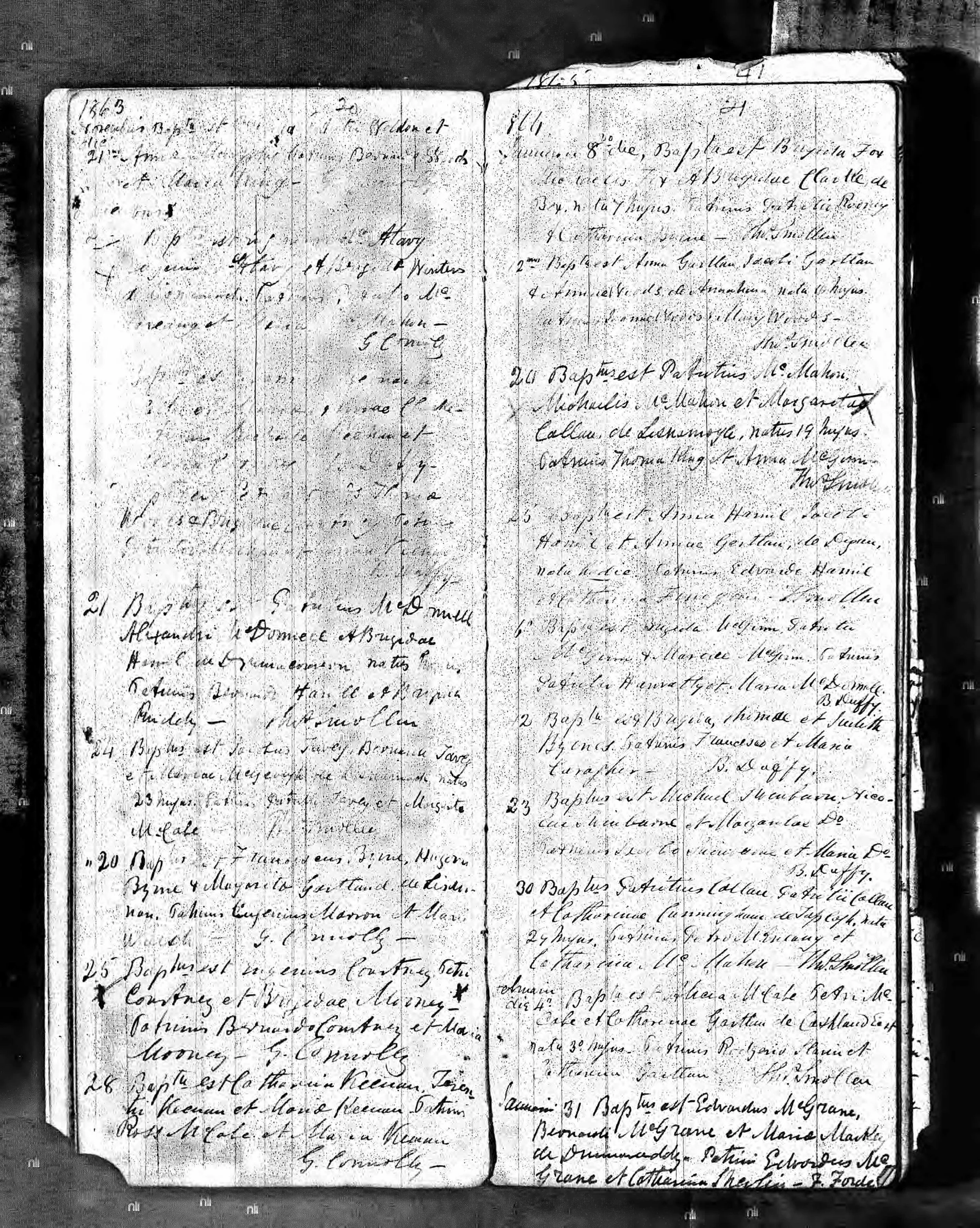
Anne’s birth was also registered civilly under the new Irish civil registration system, which had begun on 1 January 1864 — making her among the first generation of Irish births recorded in both ecclesiastical and civil systems. The civil entry adds details the parish register did not capture:

The 1864 civil registration identifies the father as “James Hamill, of Dien, Farmer” and the mother as “Anne Hamill, formerly Gartlan.” This is the documentary anchor that places this James Hamill in Dian townland by name, occupation, and government-registered residence — a piece of evidence the parish register entries, with their bare townland address, cannot supply alone. The civil record corroborates the parish records (same parents, same townland, same year) and adds the occupational identification that distinguishes this James Hamill from other men of the same name in the parish.
Combined with Griffith’s Valuation 1861 (Section 4), which independently records only one James Hamill in Dian townland, and with Peter Hamill’s 1949 death certificate (Section 8), which retrospectively names James and Ann as Peter’s parents, the 1864 civil registration completes a four-source documentary identification of James Hamill of Dian. Marriage record, parish baptism, civil birth registration, Griffith’s Valuation, and testamentary record all point to the same individual at the same townland across more than ninety years — precisely the kind of independent multi-source convergence the BCG Genealogical Proof Standard requires.
Hugh Hamill, baptized 18 December 1865 — Latin in the priest’s hand
The 1865 baptism of Hugh Hamill provides a representative example of how the original Latin entries appeared in the Donaghmoyne register. The officiating priest in this case was Rev. James Forde, who recorded the entry in the standard Catholic Latin formula. The detail below shows the entry as it appears in the register itself:
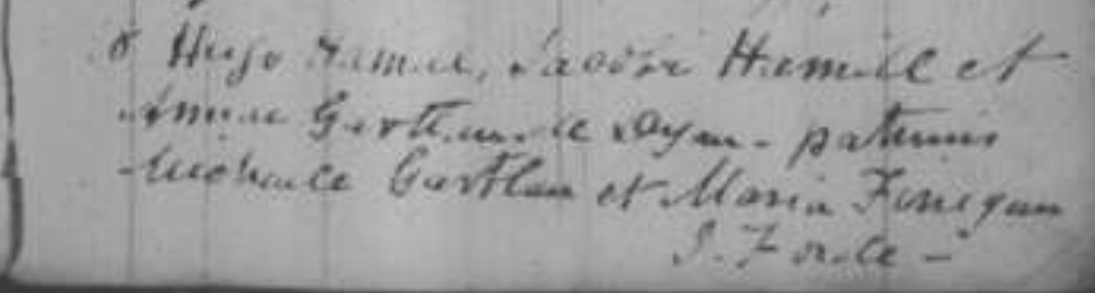
Three details of this entry repay close attention. First, the spelling of the townland is “Dyan” in this 1865 Latin entry, where the rootsireland.ie indexed transcripts and modern records render the same place as “Dian.” Variability in townland spelling across the register is documented and ordinary, not corrupting; the place is identifiable across the variation. Second, the Sponsor 1 named here, Michael Gartlan, is most plausibly the maternal uncle — Ann Gartlan’s brother — reflecting the close-family sponsorship pattern that runs through the seven baptisms (Edward Hamill, very likely a paternal uncle, sponsored Anne in 1864; Hugh Gartlan and Owen Gartlan sponsor later children). Third, the Latin form “Jacobi Hamill et Annae Gartlan” preserves the wife’s maiden surname even after marriage — a Catholic recording convention that is invaluable for family reconstitution and that the case study leans on heavily throughout.
The same entry appears on the full December 1865 register page, where it sits among other baptisms recorded by Rev. Forde and his contemporaries during that month:

James Hamill, 1873 — a second original register page
The 1873 baptism of James Hamill — named for his father — illustrates how the family’s register entries evolved across the documented decade. The rootsireland.ie indexed transcript records the date, parents, address (now given as “Donaghmoyne Parish” rather than “Dian”), and sponsors, but does not name the officiating priest:

The corresponding original register page survives and shows the entry in its contemporaneous setting:
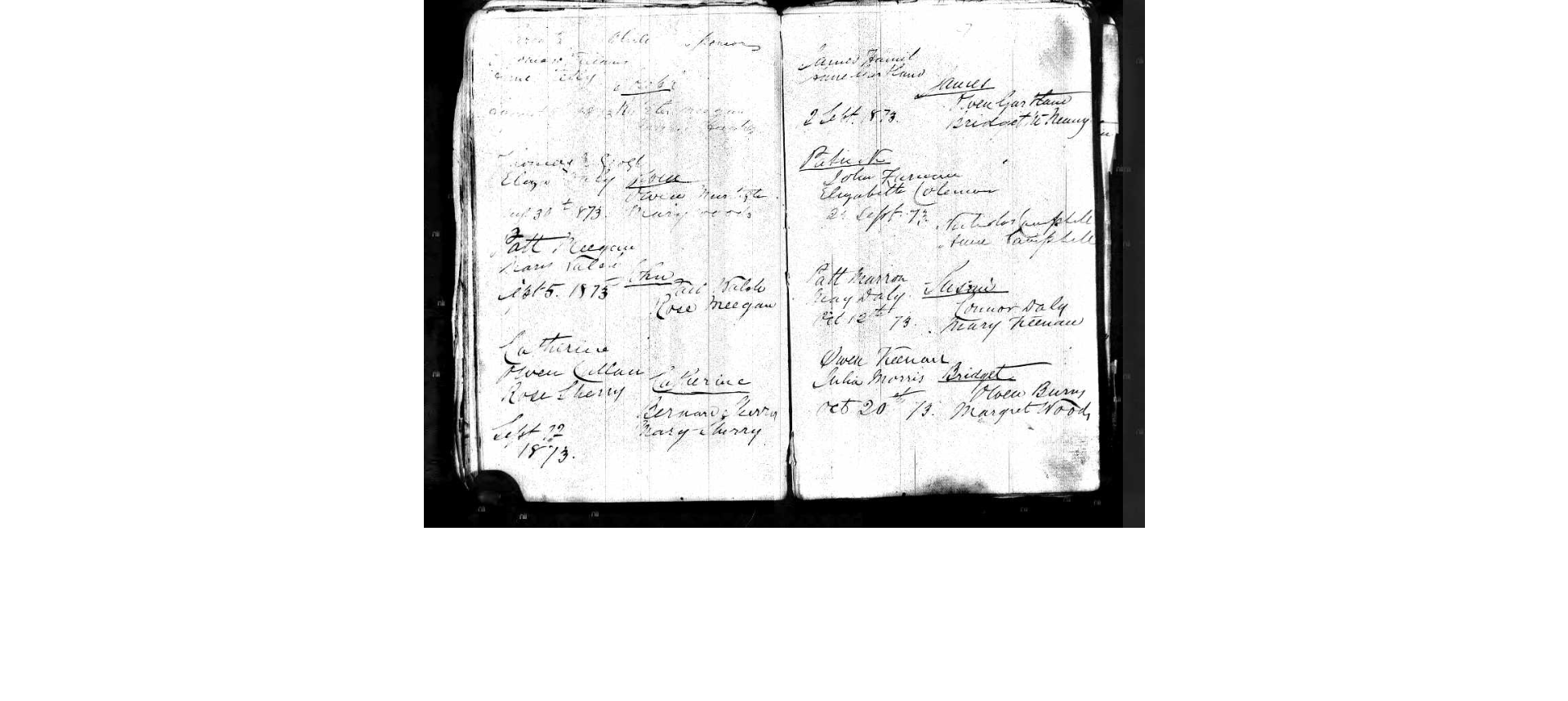
The 1873 register page differs visibly from the 1864 page. Anne’s 1864 entry was made by Rev. Thomas Smollen; Hugh’s 1865 entry by Rev. James Forde; the 1873 entry’s officiant is not transcribed in the index. The same family appears in three different priests’ hands across nine years, in three slightly different renderings of the same townland (Dian, Dyan, Donaghmoyne Parish), and in three different visual styles. The continuity of the parental names — “James Hamill and Anne Gartlan” — is what makes the documentary chain hold across the handwriting and spelling variation.
The full inventory: seven baptisms, fourteen years
The seven Donaghmoyne baptismal records for children of James Hamill and Ann Gartlan, in chronological order:
| Child | Baptism | Sponsors | Officiant |
|---|---|---|---|
| Anne Hamill | 25 Jan 1864 | Edward Hamil, Catherine Finegan | Rev. Thomas Smollen |
| Hugh Hamill | 18 Dec 1865 | Michael Gartlan, Mary Finegan | Rev. James Forde |
| Daniel Hamill | 2 Mar 1867 | John Hammil, Mary Martin | Rev. Thomas Smollen |
| Henry Hamill | 7 Jun 1868 | Hugh Gartlan, Catherine Finegan | Rev. Thomas Smollen |
| James Hamill | 2 Sep 1873 | Owen Gartlan, Bridget McNeany | not listed |
| John Hamill | 28 Nov 1875 | Owen McGinn, Catherine McNeany | not listed |
| Martha Hamill | 25 Mar 1878 | James Finegan, Anne King | not listed |
Bridget Hamill (b. 1872) is documented through civil registration at Beagh townland and is not represented in the Donaghmoyne baptismal register; her baptism is presumed to have been recorded in an adjacent parish’s register.
The pattern of sponsors is itself analytically useful. Gartlan sponsors recur across the seven baptisms — Michael Gartlan (Hugh, 1865), Hugh Gartlan (Henry, 1868), Owen Gartlan (James, 1873) — a pattern most consistent with three Gartlan brothers serving as godparents in turn for their sister Ann’s children. Finegan and McNeany sponsors appear repeatedly as well (Catherine Finegan twice, Mary Finegan once, Catherine McNeany, Bridget McNeany), suggesting a tight neighbor-network in Dian and adjacent townlands. Most intriguingly, the sponsor named at Martha’s 1878 baptism is “Anne King” — the same name as the woman who married Owen Hamill in 1846 (Section 3b). The same-person identification is geographically improbable: Ann (King) Hamill emigrated with Owen to Wisconsin shortly after their marriage, was widowed there in 1858, and is documented in Nebraska by 1880, where she remained until her death in 1888. A return visit to Donaghmoyne in 1878 is therefore unlikely though not categorically impossible. The Anne King at Martha’s 1878 baptism is most plausibly a different woman of the same name — perhaps a sister, niece, or unrelated parishioner — but the surname overlap is striking enough to warrant pursuit, particularly given the broader question of whether the King family contributed multiple women to the founding-couple network.
The fourteen-year span of these baptisms (1864–1878), all in the same register, all naming the same parents, all giving Dian or Donaghmoyne Parish as the address, establishes James Hamill and Ann Gartlan’s continuous documented presence in the parish across the entire generation in which their children were born. No similar continuity is documented for the other three founding couples in the Donaghmoyne register itself, for the simple reason that they were not there to be documented — they had emigrated. Only James Hamill and Ann Gartlan stayed and built a family in the parish, and only their documented descendants therefore form the second-generation cohort whose own emigration to Missouri, Montana, and adjacent destinations creates the mid-American DNA-match population the case study draws on. The asymmetry is structural: documentation of the staying family, oral tradition and reconstructed records of the leaving families.
What this record does not establish
Even with the richest documentary trail of the four founding couples, the 1858 marriage record itself remains a sparse index entry. It does not name parents, witnesses, occupations, ages, or townland-level addresses; the Dian identification rests on the supporting evidence assembled above and on Griffith’s Valuation 1861 (Section 4), not on this record alone. The seven children’s baptisms, in turn, establish those children as offspring of James Hamill and Ann Gartlan but do not by themselves prove biological relatedness between this couple and the other three founding couples. The connection across founding couples is what the case study’s genetic evidence is for; the documentary evidence establishes the where and the when within which the genetic evidence does its work.
Evidence tier: Confirmed for the marriage and for each of the seven children’s baptisms. Identification of this James Hamill as James Hamill of Dian: Proven through convergence of the 1858 marriage record, the 1864 civil birth registration of Anne Hamill (which names the father as “James Hamill, of Dien, Farmer”), Griffith’s Valuation 1861 (Section 4), and Peter Hamill’s 1949 death certificate (Section 8) — four independent record types from four separate source systems naming the same individual at the same townland across more than ninety years.
What the four records, taken together, allow us to claim
Read individually, each of the four records establishes one couple, one parish, one year. Read together — and only read together — the four records establish a documented network of geographically and temporally co-resident families in pre-Famine Donaghmoyne, with a recurring core surname (Hamill, in four documented spellings) appearing four times across seventeen years and three marriages bringing in connecting surnames (King, McKenna / McCanna, Gartlan) that themselves recur in the case study’s genetic-match data. The accompanying baptismal records — one for each of the three emigrant couples plus seven for the family that stayed — extend the same-register documentary footing across a further two decades and ten children, anchoring each founding couple in Donaghmoyne by both marriage and lineage.
That is what the documentary evidence, on its own, will support. It is a strong claim but a contained one: geographic and temporal co-residence, not biological relatedness. The biological claim is what the genetic evidence carries — and what the four marriage records make legible by establishing where the genetic signal is documented to have originated.
The remaining sections of this page extend the documentary footing outward. Section 4 places these families in the geography of Griffith’s Valuation. Section 5 addresses what the registers cannot tell us — the parental generation, born before the registers began. Section 6 traces each couple’s migration. Section 7 picks up the story in America. Section 8 returns to one document — Peter Hamill’s 1949 death certificate — that does in a single page what these four records cannot do at all: name parents, by name.