
Joseph Ménard: The Winter He Was Away
The Winter He Was Away
On the fourth of February 1820, in a notary's office in Montréal, a forty-six-year-old farmer from the Lac des Deux-Montagnes signed on to paddle into the North-West for two winters. Two months later he married for the third time. By the end of that year he was somewhere beyond Lake Superior, and the parish priest at Rigaud was writing two words beside his name that every family of a voyageur came to know: Voyageur Hivernant — the man who winters away.
A widower twice over
Joseph Ménard had been baptized at Montréal in 1773 and married at the Oka mission in 1798, to Marie Hélène Charlebois. As a young man he had probably made the summer run to Lac la Pluie and back; two engagements of a Joseph Ménard of Les Éboulis survive from 1802 and 1803. Then he farmed. Marie Hélène bore him at least six children and died in July 1813, aged thirty-two.
In January 1815 he married again, at Rigaud — Angélique, the daughter of Gabriel Guilbault and his Ojibwe wife, Marie Josephte. Angélique's father and two of her brothers stood in the church that day, and a week later Joseph stood, and signed, at Gabriel's own second marriage. Angélique gave him a daughter, Anastasie, in November 1815, and a son, Gabriel, in July 1817. She was buried at Rigaud in April 1819, aged twenty-six.
That left Joseph, at forty-five, a widower for the second time with a houseful of children. In 1817 he had already sold, as their guardian, the children's share of a timber lot on the Rivière Rouge that lay too far from home to work.
Two contracts, six weeks apart
The records do not say why a man of his age, with children at home, chose that winter to go. They say only what he agreed to. Before the notary John Gerbrand Beek he engaged to the North West Company as a devant — the bowman, who stood in the front of the canoe and read the water — to winter two years in the North-West. The wage was 1,200 livres, with a hundred piastres paid in advance and his equipment to be issued at Fort William.
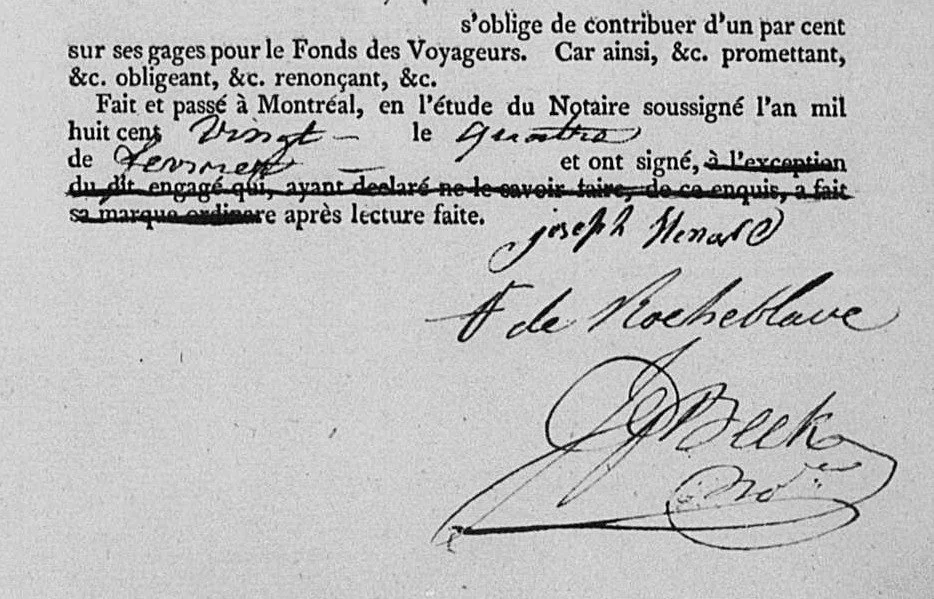
Most voyageurs made a mark. Joseph signed — as he had at his marriages in 1798 and 1815 — and that signature is how he can be told apart from the other Joseph Ménards of his neighbourhood. One of them had come to the same notary six weeks before: a Joseph Ménard of St-Benoît, engaging as a middleman for three winters at 700 livres. That man made his mark. He was very probably Joseph's own son, born in 1799 and then twenty years old.
A wedding before the brigades left
On the tenth of April 1820, at St-Benoît, Joseph married Suzanne Boyer. She was a widow, and her first husband, Ignace Charlebois, had been the brother of Joseph's first wife: the two were already in-laws. The priest described the groom as veuf en dernière noce d'angélique Guilbeau. Among the witnesses were Suzanne's father, Paul Boyer, a François Ménard, and a Gabriel Guilbeau. L'Époux a signé avec nous.

He married knowing he would be gone within weeks, and gone for two years. Whatever else the marriage was, it put a wife in the house he was leaving.
Fort William, fall 1820
The North West Company's general ledger picks up both men. The younger Joseph's account, headed "Junr," is charged with his Montréal engagement and a three-point blanket from the Fort William book. It ends with a note in a lighter hand: Deserted Fall 1820 from Fort William. He had come as far as the lake and gone no further in the company's service. The son, if it was he, was at Rigaud in 1825, when he married and his father stood beside him and signed.
The elder Joseph — "Senr" in the ledger — went on into the interior. The book does not say which department he wintered in.
What happened at home
On the twenty-second of December 1820, Suzanne gave birth to a daughter. She was baptized the next day at Rigaud as Marie Clotilde. Where a priest would write le père présent, this one wrote instead that the father was Voyageur Hivernant.
Two months later Suzanne was dead. She died on the twentieth of February 1821 and was buried at Rigaud two days after, épouse en secondes noces de Joseph Ménard Voyageur Hivernant. Her husband is not among those named at the grave. He was somewhere in the North-West, in the middle of the winter.
The words are the priest's. It was Suzanne's second marriage; it was Joseph's third.
Paid off
He had engaged for two winters. He served one. In the summer of 1821 the North West Company was merged into the Hudson's Bay Company, and the ledger closes his account after a single year's wages.
| 1820 Dr | To sundries, Montreal Engagement Book fo. 261 | 499.5 |
| 1821 Cr | By wages | 600 |
| Closed | To amount of pay list | 133.15 |
The company kept its books in a livre worth half the Montréal livre, so the 1,200 of his contract is the 600 of the ledger. And the 133 livres 15 sols left on the pay list, doubled back into Montréal currency, is 267 livres 10 sols — the sum paid in cash to a Joseph Menard about the eleventh of August 1821, as the brigades came down.
He came home with that money in the late summer of 1821. Suzanne had been in the ground for nearly six months. The daughter he had never seen was almost eight months old.
Afterwards
No later engagement of his has been found. He lived on for more than a quarter of a century. In 1837, at Bytown, he married a fourth time, to Ursule Ladouceur, and he ended his life up the Ottawa, where some of his children had settled. In April 1848, at Pointe-Gatineau, he stood godfather beside Ursule at the baptism of her granddaughter. He was seventy-four. His own burial has not yet been found.
The daughter born while he was away appears next under another name. By 1844 she was living at St-Polycarpe in Soulanges, where she married as Marie Delphine Ménard, fille de Joseph Ménard et de Suzanne Boyer. She went west with her husband to Upper Canada, and she died at Bothwell, Ontario, on Christmas Eve 1906, two days after her eighty-sixth birthday — as Mary Cartier.
Read the baptisms and burials at home for the years he was away. A priest who usually wrote le père présent sometimes wrote voyageur hivernant instead. Those entries are evidence of absence in a way that silence is not.
Line up the contract with the family calendar. A marriage, a birth or a death in the weeks around an engagement can explain the decision — or tell you what the man came home to.
Follow the money to the end of the account. The pay list and the cash book can show when a winterer came home, even when no parish record names him.
The full documentary case — how four Joseph Ménards were told apart, and every record behind this story — is in the case study.
Joseph Ménard, Voyageur → · Fort William: Where the Voyageur's Year Turned →
Sources
- Greffe de John Gerbrand Beek, CN601,S29, BAnQ Vieux-Montréal: engagements of 20 December 1819 (Joseph Menard of St-Benoît) and 4 February 1820 (Joseph Menard des Éboulis).
- Hudson's Bay Company Archives, Archives of Manitoba: F.4/32, North West Company General Ledger, fos. 671–672; F.4/43, p. 55, and F.4/45, p. 69, cash paid, August 1821.
- Registres paroissiaux: L'Annonciation d'Oka (marriage, 5 Feb 1798); Ste-Madeleine-de-Rigaud (burial, 3 Jul 1813; marriages, 30 Jan and 6 Feb 1815; baptism, 7 Nov 1815; burial, 16 Apr 1819; baptism, 23 Dec 1820; burial, 22 Feb 1821; marriage, 17 Oct 1825); St-Benoît (marriage, 10 Apr 1820); Notre-Dame de Bytown (marriage, 30 Nov 1837); St-François-de-Sales, Pointe-Gatineau (baptism, 28 Apr 1848); St-Polycarpe (marriage, 26 Aug 1844).
- Bothwell, Ontario: civil death registration, 1906, no. 014045, and burial register, 26 December 1906 (Mary Cartier).
- Full citations and analysis: Four Joseph Ménards — Full Methodology.
