
The Abitakijikokwe Discovery
How systematic parish searching, tribal identifiers, and full-text search recovered the name, nation, and stated homeland of a woman remembered only as "Sauvagesse."
Research Strategy & Documentation Process
Initial Research Phase
Starting Point
Subject: Gabriel Guilbault, d. 1833, St-Benoit, Quebec
Initial Problem: First wife listed only as "unknown Indigenous woman" or "Sauvagesse"
Available Data: Gabriel's death record, second marriage at Rigaud to Josephe Josette Clausier dit Lapensée (1815)
Reverse Chronological Search
- Located Gabriel's burial record (April 8, 1833; died April 6) — register states age about 93, against age 70 from his 1762 baptism; conflict logged, not resolved
- Found 1815 marriage identifying him as "widower of Josette Sauvagesse"
- Bracketed the first wife's death to 1813–1814, then closed it: her burial was located in the same Rigaud register, 25 June 1813
- Identified Gabriel's birthplace: L'Assomption (1762)
The Breakthrough
The 1798 baptism of three children at St-Paul-de-Lavaltrie identified the mother as "Josephte Sauvagesse, de la nation des Sauteux"—the nation specified: Ojibwe/Saulteaux. This tribal identification was the key that unlocked everything.
Geographic Clustering Strategy
Parishes searched along the Quebec-Ontario border, following the fur trade routes
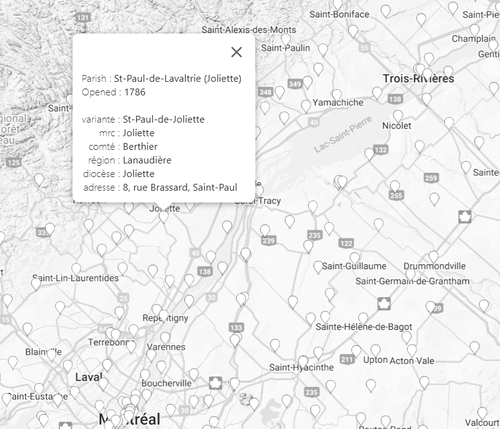
1795-1805: St-Paul-de-Lavaltrie
(baptisms found)

1799-1803: L'Annonciation, Oka
(her baptism, marriage, and two children)

1806-1827: Ste-Madeleine-de-Rigaud(six entries: baptism, marriages, burials)

1830-1835: St-Benoit
(Gabriel's death)
Breakthrough Discovery Phase
The 1798 Mass Baptism
Search Parameters: St-Paul-de-Lavaltrie (filmed as St-Paul-de-Joliette), 1795-1800, surname variations
Finding: October 10, 1798 — three children baptized together at St-Paul-de-Lavaltrie
Critical Details Extracted
Mother: "Josephte Sauvagesse, de la nation des Sauteux"
Children's ages: Indicated births from 1790-1797
Nation: des Sauteux = Ojibwe/Saulteaux
This tribal specification was the key that unlocked everything.
Pattern Recognition Applied
Identified search terms:
- "Sauvagesse" (generic Indigenous woman)
- "Sauteuse/Sauteux" (Ojibwe/Saulteaux)
- "de nation" (tribal member)
- Spelling variants: Guilbault/Guilbeau/Guilbeault
The Marriage Record Discovery
January 27, 1801 — L'Annonciation, Oka
Full Indigenous Name Preserved
Bride: "marie josephte abitakijikok8e," of the Sauteux nation
Children legitimized: Four — Gabriel, Angélique, Joseph and François
Witnesses: Included individuals with Indigenous names
Significance: The record preserves her Indigenous name and formalizes a relationship of some eleven years' standing.
The Entry Above the Marriage
One entry earlier on the same register page, dated 26 January 1801, stands her adult baptism — the prerequisite performed the day before the wedding. It records her "de la nation Sauteuse sur le lac supérieur, âgée de quarante ans" — not merely a nation but a homeland, some seven hundred miles west of the parish where she would be buried. Her godparents were Iroquois of the Oka mission. No other document names her this fully, and it had been passed over in favour of the marriage directly beneath it.
Technology Note: FamilySearch Full Text Search
Critical to this discovery was the Full Text Search capability on FamilySearch, which allows searching within the actual handwritten content of documents rather than just indexed fields. This tool enabled the discovery of records that weren't indexed under the Guilbault name variations but contained references to "Sauvagesse" and "Sauteuse" within the document text.
Primary Source Documents
The original register entries naming Marie Josephte Abitakijikokwe, 1798 to 1827

10 Oct 1798 — Gabriel Jr. Gabriel Jr.'s baptism identifying his mother as "Josephte Sauvagesse, de la nation des Sauteux" — the first record of her nation.

10 Oct 1798 — Angelique. Same-day baptism of Angelique and Joseph Claude, October 10, 1798.

10 Oct 1798 — Joseph Claude. Same-day baptism with godparents named, October 10, 1798.

27 Jan 1801 — Marriage Record. The breakthrough document — Marriage record preserving "Abitakijikok8e"

1801 Marriage Record (detail). Close-up showing the Anishinaabe name "Abitakijikok8e" written by the priest.

1801 Marriage Record (detail/close-up). Detail showing the Anishinaabe name "Abitakijikok8e" written by the priest.

26–27 Jan 1801 — Oka. The original greffe register page, her adult baptism and marriage recorded one after the other. The transcription volume consulted first proved accurate, but only the register shows the two entries as a single sequence.

28 Jun 1806 — Louis. Her youngest, baptized at Rigaud with his sixteen-year-old brother Gabriel standing as godfather. Their father is recorded here as maçon, no longer voyageur.

25 Jan 1802 — Marie Louise. Born and baptized the same day at Oka, "née aujourd'hui," her mother named as Marie Josephte Tabitakijokok8e de cette mission — the family resident at Oka. The word maçon is interlined above her father's name and validated by the priest at the close of the entry: his change of trade falls within the twelve months since the marriage, where he was still recorded as voyageur.

27 May 1803 — Marie Louise. Buried at Oka aged sixteen months, died the previous day — arithmetic that reconciles exactly with her stated birth date. Her mother is named in full: Marie Josette Abitakijikok8e. Her father was present and could not sign. Eleven entries above on the same opening lies the burial of another infant, daughter of a different Marie Josette — of the Nipissing nation, wife of another man — the near-match against which this identity was tested.

25 Jun 1813 — Her Burial. "Marie Josette Sauvagesse de nation," died the evening of the 23rd, aged about fifty, lawful wife of Gabriel Guilbeault, mason, of the Seigneurie d'Argenteuil. Among those present the priest names “gabriel guilbeault Mari de la defunte” — her husband, written out as such — with Ignace Poiriault père and François Beaudry; none could sign.

1815 Second Marriage. Gabriel's remarriage at Rigaud, 6 February 1815, to Josephe Josette Clausier dit Lapensée, daughter of François Clausier dit Lapensée and Marie Anne Desforges dit St-Maurice, identifying him as "widower of Josette Sauvagesse." Present: Joseph Ménard, gendre de l'Époux, and Joseph Guilbeault, son fils. Labroquerie ptre.

30 Jan 1815 — Angélique. The eldest daughter marries Joseph Ménard, widower of the late Hélène Charlebois, agriculteur in the Seigneurie d'Argenteuil — she a minor, married on a single ban with the other two dispensed by the Vicar General three days earlier. Her filiation continues past the foot of the captured folio; PRDH-IGD marriage no. 5742434 supplies it, naming the bride's mother Marie Josette and marking her deceased. Seven days later, in this same church, her father married again.

16 Apr 1819 — Angélique. Buried aged twenty-six, munie des secours de l'Église, died the previous morning, wife of Joseph Ménard. Present: “Gabriel Guilbeault, père de la défunte” and Théodore Duplanty, neither able to sign. This is the most explicit statement of a parent-child relationship anywhere in the family — the priest naming the father as father, not merely as a man of the same name standing by. It matches the 1813 entry, where the same priest wrote Gabriel down as Mari de la defunte: Labroquerie wrote relationships out. Her stated age puts her birth about 1793, agreeing with the age of six recorded at her baptism in 1798.

1 Oct 1827 — Marie Louise. The last daughter, born about 1807 and given the name of the sister buried in 1803, marries Louis Labre — “fille mineure de Gabriel Guilbeau (consentant) et de Marie Josephte, du Township d'Hawkesbury.” Two things sit in that line. Her father is present and consenting, seventy years old and six years from his own grave. And her mother is named — simply Marie Josephte, no surname, fourteen years after the priest at this same altar had buried her as sauvagesse de nation. The name outlasted the woman by fourteen years and the last four of her children by rather longer. PRDH-IGD marriage no. 13549846.
Verification Phase
Cross-Reference Validation
Each child traced forward to establish complete family documentation:
Children Documented
Gabriel Jr. (b. June 1790): FamilySearch Film #100437666, Image 683 — Mother identified as "de la nation des Sauteux" (Ojibwe/Saulteaux). Traced to adulthood with confirmed parentage.
Angelique (b. ~1792): FamilySearch Film #100437666, Image 682 — Age at baptism: 6 years. Death: April 15, 1819.
Joseph Claude (b. June 1797): Same baptism record as siblings — Age at baptism: 16 months. Traced to adulthood.
François (b. Sept 10, 1799): FamilySearch Film #100437666, Image 707 — Died: April 3, 1801. Complete birth-death cycle documented.
Marie Louise (b. Jan 25, 1802): Oka register — born and baptized the same day, mother recorded as "Marie Josephte Tabitakijokok8e de cette mission." Buried at Oka 27 May 1803, aged sixteen months, her father present and unable to sign. Corroborated independently by PRDH-IGD, individual no. 2075071.
Louis (b. June 24, 1806): Ste-Madeleine-de-Rigaud register, baptized 28 June 1806 — godfather his brother Gabriel Jr. The entry reads "Louis né du vingt quatre du courant, fils de Gabriel Gilbeau maçon en la Seigneurie d'Argenteuil et de Marie" at the foot of the page; the mother's name continues on the next page, where it is hard to read but appears to be "Josephe." No death record located.
Marie Louise, second of the name (b. c. 1807): Not yet located in any baptismal register. Documented by her marriage to Louis Labre at Ste-Madeleine-de-Rigaud, 1 October 1827 — "fille mineure de Gabriel Guilbeau (consentant) et de Marie Josephte, du Township d'Hawkesbury." Buried at St-Michel-de-Vaudreuil on 28 December 1844 as “Louise Guilbeault, épouse de Louis Labre, journalier en cette paroisse,” died two days earlier, aged about thirty-seven — an age that agrees with a birth about 1807. Corroborated by PRDH-IGD marriage no. 13549846 and family no. 161970. Naming a later child for one who died is ordinary practice and is not, by itself, evidence of anything beyond the death having been accepted as final.
Name Analysis
The Name: Abitakijikokwe, Mid-Sky Woman
- Her name, Abitakijikokwe, is a primary Anishinaabe name: abitakijik, the sky at its midpoint — the sun at midday — and -okwe, woman. Mid-Sky Woman. (The reading is Deliris López Tiwari's, who explained it and gave permission to cite her.)
- Register variants — Abitakijikok8e, Tabitakijokok8e — are period hands rendering a spoken Ojibwe name in French orthography
- The ecclesiastical "8" ligature defeats modern indexers, who render it variously as 8, ou, v, w, or 3. Anyone searching for her must try all of them; this is a principal reason she stayed hidden
- Conflation guard: the same Oka register records a Marie Josette of the Nipissing nation whose name carries the same element, burying a daughter of similar age within the same month of 1803. The two are distinguished by nation and by husband and are not the same woman
Historical Context
Fur Trade Society
Marie Josephte's union with Gabriel Guilbault represents a typical fur trade marriage pattern:
- Initial Union (c.1789-1790): Relationship began "à la façon du pays" (according to the custom of the country)
- Children Born (1790-1799): Four children born before Catholic marriage
- Church Marriage (1801): Formalization of existing relationship
- Legitimization: Children recognized and legitimized by the Church
A Family Between Two Worlds
A French-Canadian voyageur father and a Saulteaux mother, children born in the interior and baptized on the family’s return, and a family that settled in the parishes of the lower Ottawa. The registers record the mother’s name and nation; they do not record how her children understood their own heritage, and this study does not assume it.
Geographic Context
The Oka/Deux-Montagnes region was home to established Indigenous communities. The location along the Ottawa River was traditional Ojibwe/Algonquin territory and a major fur trade route, connecting Gabriel's work as voyageur with Indigenous trading networks.
Research Tools & Techniques
FamilySearch
- Quebec Catholic Parish Records
- Film #100437666 (St-Paul-de-Lavaltrie baptisms)
- Film #008130869 (L'Annonciation marriage record)
- Full Text Search Feature (critical breakthrough)
Ancestry.com
- Drouin Collection
- Quebec Vital Records
Original Registers
- Greffe copies photographed for St-Jérôme (Oka) and Montréal (Rigaud)
- PRDH-IGD, as independent corroboration of register readings
Language Considerations
- French paleography skills required
- Understanding of Latin sacramental formulas
- Recognition of Ojibwe linguistic patterns
- Historical French-Canadian spelling variations
Critical Success Factors
What Made This Case Solvable
- Priests who recorded rather than erased Indigenous identity — Unlike many colonial records that omitted Indigenous names entirely, the priests in these parishes chose to preserve Marie Josephte's Ojibwe name and tribal affiliation
- Mass baptism creating clustered records — The October 10, 1798 baptism of three children together provided concentrated information and established the family unit
- Preservation of Indigenous name in marriage record — Despite an 11-year gap between the relationship's start (~1789-1790) and the 1801 Catholic marriage, the priest recorded her full Ojibwe name
- Consistent geographic area — The family remained within the Quebec-Ontario border region, allowing systematic parish-by-parish searches
- A complete sacramental arc — her own baptism, her marriage, five of her children's baptisms, two of their burials, and her own burial all survive, letting each statement be tested against the others
Obstacles Overcome
- Multiple spelling variations of the surname (Guilbault/Guilbeau/Guilbeault)
- A death record initially thought lost, later located in the Rigaud register
- Language barriers (French/Latin/Ojibwe)
- Geographic spread across multiple parishes
- Time gap between relationship start (1790) and marriage (1801)
Evidence Assessment
Evidence Status
Her identity, her nation, and her stated homeland rest on entries examined in the original registers of three parishes, 1798 to 1827, each naming her as the wife of the same man and the mother of the same children. Two age statements taken twelve years apart by different priests agree within two years, and a daughter's stated age at burial reconciles exactly with her stated birth date sixteen months earlier. No evidence conflicting with the identification has been found. Three matters remain open and are not treated as settled: the mother's name in the 1806 baptism of Louis, which begins "Marie" at the foot of the page and continues on the next, where it is hard to read but appears to be "Josephe"; the baptism of the last daughter, born about 1807 and documented so far by her 1827 marriage and her 1844 burial; and the age recorded at her husband's burial in 1833, which conflicts with his own baptism by twenty-three years and is logged as an informant error rather than reconciled.
Lessons Learned
Key Takeaways
- Indigenous ancestors can be documented in colonial records when priests chose to record rather than erase identity
- Persistence through spelling variations essential — both for surnames and Indigenous names
- Understanding historical context crucial — knowledge of fur trade customs and "à la façon du pays" marriages
- Multiple record types provide fuller picture
- A name can outlive the person in the record — hers is still being written into parish entries fourteen years after her burial, as her children married and were buried in turn
Reproducible Strategies
- Start with known fur trade communities (Oka, Deux-Montagnes, along Ottawa River)
- Search for cultural identifiers, not just names (Sauvagesse, Sauteuse, "de nation")
- Check witnesses/godparents for community networks
- Review all children's records, not just direct line
- Read the entries immediately above and below your target — adjacent entries carry the sacraments that made the target possible
- Use Full Text Search features when available
Final Assessment
Fourteen original register entries, 1798 to 1827, document Marie Josephte Abitakijikokwe and her family. Six records state her nation — the three 1798 baptisms, François's in 1799, and her own baptism and marriage at Oka. One states her homeland. Two, taken twelve years apart by different priests, agree on her age within two years. She was born about 1760–1763, was baptized at forty at Oka, married the following morning, bore at least seven children of whom two died in infancy, and was buried at Rigaud in June 1813. Her husband stood at the grave, named by the priest as Mari de la defunte, and could not sign.
What made her recoverable was not that the records were unusual but that they were read closely: the entry above the marriage, the interlined word validated at the foot of a baptism, the near-name in the same register belonging to a different woman.
The methodology employed—combining systematic searching, pattern recognition, linguistic analysis, and historical context—can be applied to other challenging Indigenous ancestry cases, though results this comprehensive remain rare.

L'Annonciation Church at Oka today—This sacred place, at the confluence of Indigenous and French cultures, holds the register where her baptism and marriage were recorded on January 26 and 27, 1801.