
Irish & Irish-American Research›The Three Thomas Hamalls›Document Gallery
Document Gallery & Photo Archive
Three Generations, One Cottage: Primary Source Evidence
A curated collection of the primary sources behind three generations of Thomas Hamalls and one cottage at 291 Lionel Road, Riverside, Illinois
ABOUT THIS ARCHIVE
This gallery presents the complete documentary, photographic, and testimonial evidence used to prove the three-generation connection. Each item includes:
- Provenance: Where the document is located and how we accessed it
- What It Proves: Direct and indirect evidence provided
- Significance: Why this document matters to the overall case
- Evidence Analysis: Evidence type and information quality
Organization: Documents are presented chronologically by generation, then by evidence type (legal, government, private).
GENERATION I: THOMAS HENRY HAMALL (1880-1938)
LEGAL RECORDS
ITEM 001: Illinois Supreme Court Decision - Hamall v. Petru (1928)

Illinois Supreme Court Reports, Volume 331, Page 465 (1928)
Date: October 25, 1928
Case Citation: Hamall v. Petru, No. 18255, 331 Ill. 465, 163 N.E. 338 (1928); on appeal from the Circuit Court of Cook County
What It Contains:
- Thomas Hamall purchased property at 291 Lionel Road, Riverside, Illinois on February 20, 1911 for $300
- Property described as "a one-room cottage, twenty-four by twenty-four feet"
- Cottage built with $400 borrowed from his mother, Kate Hamall, and $250 from others ($950 in all); finished August 1911
- 15 October 1914: property deeded to Frank J. Petru in trust for son Thomas Eugene, Thomas keeping a life estate
- 13 November 1924: Emma petitioned in the divorce case; $2,500 found due for support; Petru directed to convey the property back to Thomas
- Thomas sued to cancel the 1914 deed; the circuit court ruled for him and Emma appealed
- Supreme Court affirmed: the property, worth no more than $1,000 before 11 October 1922, was his homestead and beyond the reach of the judgment
What It Proves:
- DIRECT: Ownership, purchase date, price, property description
- DIRECT: Relationship to Emma (ex-wife) and Thomas Eugene (son)
- INDIRECT: Thomas Henry's determination to protect property he purchased for himself and his mother
- INDIRECT: Financial relationship with mother Kate (four-generation connection)
Significance: This is the foundational document of the entire case study. Because county property records from 1911-1920 are incomplete, this Supreme Court decision provides the only validated evidence of the exact purchase date, original price, property description, and Thomas Henry's motivations through his four-year legal battle to protect it.
Evidence Analysis:
- Evidence Type: Direct evidence of ownership, purchase, and relationships
- Information Quality: Facts found by the court from the trial record
- Reliability: High for the facts found and affirmed; the court declined to decide the question of law argued
- Corroboration: Residence confirmed by the 1918 draft card
→ See the Full Methodology: The Court Case
GOVERNMENT RECORDS - MILITARY
ITEM 002: World War I Draft Registration Card (1918)

Thomas Henry Hamall, WWI Draft Registration, 1918
Date: 1918
Registrant: Thomas Henry Hamall, age 38
What It Contains:
- Full name: Thomas Henry Hamall
- Age: 38 (born 1880)
- Residence: 291 Lionel Road, Riverside, Illinois
- Occupation and employer information
- Physical description
- Signature
What It Proves:
- DIRECT: Residence at 291 Lionel Road seven years after purchase
- DIRECT: Thomas Henry lived at the property (not just owned it)
- INDIRECT: Continuous occupation from 1911-1918
Significance: This document bridges the gap between the 1911 purchase and the 1928 Supreme Court case, proving Thomas Henry actually lived at the cottage (not just owned it as investment property). Self-reported address on official government document carries high evidentiary weight.
Evidence Analysis:
- Evidence Type: Direct evidence of residence
- Information Quality: Primary information; Thomas Henry provided his own address
- Reliability: High; legal consequences for false information on draft cards
- Corroboration: Agrees with the 1928 opinion that the cottage was his home
→ See the Full Methodology: The Address Trail
PRIVATE RECORDS - PHOTOGRAPHS
ITEM 003: Photographs at the Olmsted Bridge (early 1920s)


Thomas Henry and Thomas Eugene, each photographed at the Olmsted-designed bridge in Riverside, early 1920s
Date: Early 1920s (paper stock and print style); attributed by the family to the 1922 wedding
Location: Riverside, Illinois (Olmsted-designed bridge)
What It Contains:
- Visual evidence of both father and son in Riverside
- Distinctive Olmsted landscape architecture (identifiable location)
- Formal wedding occasion (documents family event)
- Reverse of one print marked “Thomas E Hamall”
What It Proves:
- DIRECT: Thomas Henry and Thomas Eugene each photographed at the same bridge in Riverside
- INDIRECT: Thomas Eugene knew Riverside as a young man
- NOT ESTABLISHED: That the two were there on the same day, or that the son attended his father's 1922 wedding
Significance: These photographs place Thomas Eugene in Riverside as a young man, years before he gave the cottage as his address in 1940, and are consistent with his attending his father's 1922 wedding. They do not show the two men together, so his attendance is suggestive rather than proved. The 1922 Cook County marriage return, which names the witnesses, would settle it.
Location Verification: Olmsted-designed landscapes in Riverside are distinctive and documented in historic preservation records. Bridge pillars visible in photos match archival photographs of Riverside from the 1920s.
Evidence Analysis:
- Evidence Type: Direct evidence of each man at the bridge; no evidence of shared presence
- Information Quality: Primary information; contemporary photographs
- Reliability: Moderate to High; location verified, subjects identified by family markings
- Corroboration: The 1928 opinion confirms Thomas Henry's 1922 marriage
→ See the Full Methodology: The Photographs
NEWSPAPERS
ITEM 016: Riverside Building Permit (April 1929)
Date: Permits issued during April 1929
Entry: “Thomas H. Hamall, alterations at 291 Lionel road.”
What It Proves:
- DIRECT: The village issued Thomas H. Hamall a permit for alterations at 291 Lionel Road in April 1929
- INDIRECT: He still held the cottage, and was improving it, the spring after the Supreme Court decision
Evidence Analysis:
- Evidence Type: Direct evidence of a permit; indirect evidence of ownership
- Information Quality: The village’s permit record, as printed by the local paper
- Reliability: High for the permit; it does not show whether the work was done or who lived there
→ See the Full Methodology: The Address Trail
GENERATION II: THOMAS EUGENE HAMALL (1904-1967)
GOVERNMENT RECORDS - MILITARY
ITEM 004: World War II Draft Registration Card THE SMOKING GUN
October 16, 1940
⚠️ CRITICAL DOCUMENT - THIS IS THE SMOKING GUN
This single draft card proves Thomas Eugene actually lived at the inherited cottage (not just owned it), establishes the exact timeline of family separation, and shows his choice—when the marriage ended, he went to the cottage his father had protected.

WWII Draft Registration Card captures Thomas Eugene Hamall in transition showing a change of address from 4869 N Ashland to 291 Lionel Rd, Riverside
Date: October 16, 1940
Registrant: Thomas Eugene Hamall, age 36
Critical Information:
- Original address (CROSSED OUT): 4869 N Ashland Avenue, Chicago
- Corrected address (TYPED OVER): 291 Lionel Road, Riverside, Illinois
- Emergency contact: Margaret Catherine Hamall, 4869 N Ashland Avenue (NOT crossed out)
- Date: October 16, 1940
What This Proves:
- DIRECT: His Ashland address was struck out and 291 Lionel Road typed over it
- DIRECT: He claimed 291 Lionel Road as legal residence to federal government
- INDIRECT: Marriage separated (different addresses for husband and wife)
- INDIRECT: Thomas Eugene moved to his father's cottage after separation
- DIRECT: Precise timeline—separation occurred between April 1940 (census) and October 1940
Why This Is Critical:
- Proves Thomas Eugene actually lived at his father's cottage
- Establishes exact timeline of family separation (April-October 1940)
- Shows Thomas Eugene's choice—when marriage ended, he went to the cottage his father had protected
- Provides primary evidence (self-reported) of residence claim
The Visible Correction: The correction captures a moment of decision. Thomas Eugene started to write his wife's parents' address (where he'd been staying?), then crossed it out and the cottage address is typed over. The emergency contact still lists Margaret at Ashland—she stayed with her parents while he moved to the cottage.
Timeline Correlation:
- April 1, 1940: Census shows intact family at 33 N Menard
- April-October 1940: Separation occurs (evidence: addresses diverge)
- October 16, 1940: Thomas Eugene claims 291 Lionel Road as legal residence
- c. 1941: Divorce
- 1942: Margaret takes Thomas Kenny to her parents in Miami
Evidence Analysis:
- Evidence Type: Direct evidence of residence and marital separation
- Information Quality: Primary information, supplied by the registrant in person
- Reliability: Very High; federal document with legal consequences for false statements
- Corroboration: Confirmed by "Riverside House" photographs showing Thomas Eugene at cottage (1940-41)
→ See the Full Methodology: The Address Trail
GOVERNMENT RECORDS - CENSUS
ITEM 005: 1940 U.S. Federal Census (April 1, 1940)

Last census record of intact family - April 1, 1940
Date: April 1, 1940 (official enumeration date)
Household Head: Thomas Eugene Hamall
What It Contains:
- Thomas Eugene Hamall (head, age 36)
- Margaret Hamall (wife)
- Thomas Kenny Hamall (son, age 7)
- Address: 33 N Menard Avenue, Chicago
What It Proves:
- DIRECT: Last census record of intact family
- DIRECT: All three living together at 33 N Menard, April 1940
- INDIRECT: Family still together six months before draft card shows separation
Significance: This census provides the "before" snapshot. Combined with October 1940 draft card (showing separation), it establishes a six-month window when the marriage ended and Thomas Eugene moved to 291 Lionel Road. Critical for timeline precision.
Evidence Analysis:
- Evidence Type: Direct evidence of family composition and residence
- Information Quality: Primary information from household members
- Reliability: High; official government enumeration
- Corroboration: Confirmed by First Communion keepsake (1939) showing same address
→ See the Full Methodology: The Address Trail
ITEM 006: 1920 U.S. Federal Census (Thomas Eugene as "Thomas Hepp")

Thomas Eugene listed as 'Thomas Hepp' (stepfather's surname), 1920
Date: January 1920
Listed As: Thomas Hepp (stepfather's surname)
What It Proves:
- DIRECT: Thomas Eugene's location in 1920
- INDIRECT: Name variation explained (mother's remarriage)
- INDIRECT: Living with mother, not father (parents divorced)
Name Tracking: Thomas Hepp (1920) → Thomas Eugene Hamall (1930 and after)
→ See the Full Methodology: Conflicts
ITEM 007 & 008: 1930 and 1950 Census Records


1930 and 1950 US Census Records
→ See the Full Methodology: The Address Trail
PRIVATE RECORDS - PHOTOGRAPHS
ITEM 009: "Riverside House" Envelope Collection (1940-1941) CRITICAL VISUAL EVIDENCE

Front View of the Cottage at 291 Lionel Rd, Riverside, Illinois

Thomas Eugene with the dog in a lawn chair in the rear yard of the cottage

From Thomas Kenny's photos: the same dog, same chair, same yard
Date: Circa 1940-1941 (based on Thomas Kenny's age)
Location: 291 Lionel Road, Riverside, Illinois
Collection Includes Three Photographs:
Photo 1: The Cottage Itself
- Exterior view of 291 Lionel Road
- Architectural details visible
- Rear yard of cottage with lawn chairs
Photo 2: Thomas Eugene Hamall with Dog
- Thomas Eugene (age 36-37) on lawn chair rear cottage yard
- Dog prominently featured (distinctive markings)
Photo 3: From Thomas Kenny's images: the same dog perched in the lawn chair
- Photo dating to 1940-1941
- Same dog as Photo 2 (verified by distinctive markings)
- Same rear yard of cottage with lawn chairs
What These Prove:
- DIRECT: Thomas Eugene physically present at the cottage with the dog
- DIRECT: The same dog, chair and yard in Thomas Eugene's print and in a print from Thomas Kenny's own collection
- NOT ESTABLISHED: Thomas Kenny appears in neither print, so the photographs do not by themselves place him at the cottage
- INDIRECT: Consistent with Thomas Kenny's memory of "Saturday visits"
- INDIRECT: Consistent with his memory of a dog "left behind"
Significance: These three photographs together provide visual support for the oral history testimony. Thomas Kenny remembered:
- "Saturday visits" to cottage → consistent with Photo 3, from his own collection
- "Had to leave the dog behind when we moved to Miami" → consistent with Photos 2 & 3, which show the same dog
The contemporary envelope labeling ("Riverside House") shows these photos were recognized as important at the time, not just in retrospect decades later.
Photographic Analysis:
- Same dog verified by: Distinctive markings, size, coloring
- Same location verified by: Porch columns, window placement, architectural details
- Date verified by: Thomas Kenny's age (8-9 = 1940-1941), correlates with draft card timeline
Evidence Analysis:
- Evidence Type: Direct evidence of Thomas Eugene and the dog at the property
- Information Quality: Primary information; contemporary photographs
- Reliability: High; physical visual evidence at specific location
- Corroboration: Supports the October 1940 draft card; consistent with the oral history
→ See the Full Methodology: The Photographs
ITEM 010: Washington DC Capitol Photographs (1947)
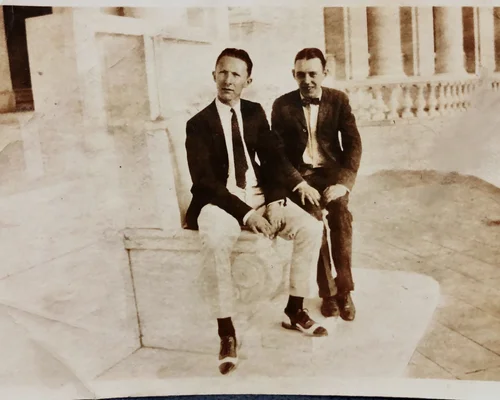

Thomas Eugene and Thomas Kenny both photographed at the US Capitol Building in 1947
Date: 1947 (dated on reverse of photographs)
Location: U.S. Capitol Building, Washington DC
What These Prove:
- DIRECT: Thomas Eugene and Thomas Kenny met in Washington DC in 1947
- DIRECT: Both at the same place, from the same angle; light and coats suggest the same season and time of day
- INDIRECT: Father travelled from the Chicago area, roughly 700 miles, to visit his son
- INDIRECT: Father-son relationship maintained six years post-divorce despite geographic separation
Significance: Some five years after Margaret took Thomas Kenny to Miami, Thomas Eugene travelled from Illinois to Washington DC to visit his son during seminary years. This demonstrates:
- Continued father-son relationship despite distance
- Thomas Eugene's commitment (a 700-mile trip in 1947 was a significant undertaking)
- Oral history verification—Thomas Kenny called this visit "pivotal"
→ See the Full Methodology: The Photographs
NEWSPAPERS
ITEM 017: Riverside Assessment Roll (1949)
Section: S 36 T 39 R 12, Block 1, Riverside 2nd Division
Entry: Emma E Hamall, w½ Lot 212, size 40x217, land 1191, improvements 1136
What It Proves:
- DIRECT: Emma E. Hamall, Thomas Eugene's mother, was assessed on the west half of Lot 212 in 1949
- INDIRECT: The cottage lot was still in the family's hands in 1949, the year before Thomas Eugene and Emma appear in Miami
Significance: The last record of the cottage in the family. The lot description agrees with the property's current legal description. How the cottage came to Emma after Thomas Henry's death in 1938 is not yet documented.
Evidence Analysis:
- Evidence Type: Direct evidence of who was taxed on the parcel
- Information Quality: The village assessor's roll, as printed
- Reliability: High for the assessment; it does not show residence, and the plat dates for Lot 212 still need checking
→ See the Full Methodology: The Address Trail
GENERATION III: THOMAS KENNY HAMALL (1932-2010)
GOVERNMENT RECORDS - VITAL
ITEM 011: Birth Certificate (July 21, 1932)
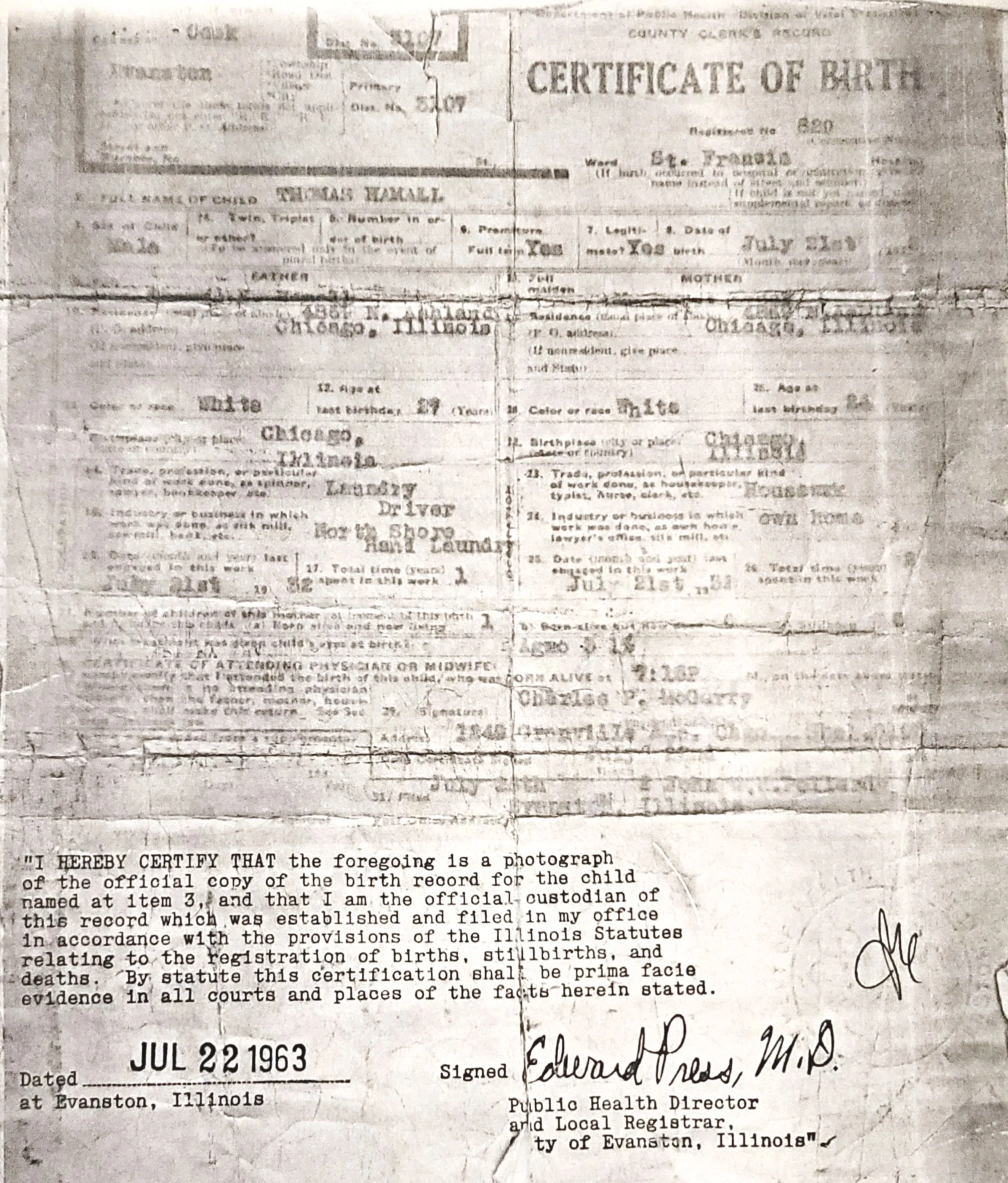
Birth certificate establishing Generation III identity and parentage
Date Filed: July 1932 (birth July 21, 1932)
Birth Place: Evanston, Illinois
What It Proves:
- DIRECT: Identity of Thomas Kenny (Generation III)
- DIRECT: Parentage (son of Thomas Eugene)
- DIRECT: Parents living at 4869 N Ashland (Margaret's parents' home)
- INDIRECT: Newlywed couple living with in-laws (married 1930, baby 1932)
Significance: Establishes Thomas Kenny as biological son of Thomas Eugene, creating the documented three-generation lineage. Also explains the recurring Ashland Avenue address—this was Margaret's parents' home where the young couple lived after marriage.
→ See the Full Methodology: The Address Trail
GOVERNMENT RECORDS - CENSUS
ITEM 012: 1945 Florida State Census

Post-divorce custody - Thomas Kenny in Miami with mother, 1945
Timeline:
- 1940: Age 7, living with both parents at N Menard Avenue
- 1940-1941: "Saturday visits" to cottage with father
- 1942: Move to Miami with mother
- 1945: Still in Miami (this census)
→ See the Full Methodology: The Address Trail
PRIVATE RECORDS - DOCUMENTS
ITEM 013: First Communion Keepsake (1939)

First Communion Keepsake confirms 33 N Menard address from 1940 Census
Date: 1939 (First Communion typically age 7)
What It Contains:
- Thomas Kenny Hamall name
- First Communion date (1939)
- Address correction visible: "Ashland" crossed out, replaced with "33 N. Menard"
- Contemporary handwriting (corrected at time, not retroactively)
Significance: This small personal document establishes the address progression:
- 1932: 4869 N Ashland (Margaret's parents—newlyweds with in-laws)
- 1939: 33 N Menard (own home—shows family independence)
- 1940: Same Menard address (confirmed by April census)
- 1940: Separation (October draft card shows Thomas Eugene at 291 Lionel)
→ See the Full Methodology: The Address Trail
PRIVATE RECORDS - PHOTOGRAPHS
ITEM 014: Four Generations Photograph (1932)
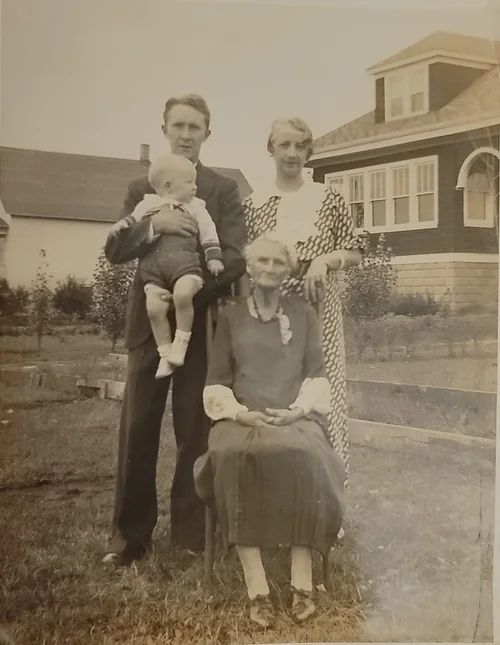
Four Generations - 1932: Marie Marguerite Louise Souliere, Emma Gilbert (Guilbault) Hamall, Thomas Eugene Hamall, to infant Thomas Kenny
Date: 1932 (based on infant Thomas Kenny)
Location: Unknown (likely Chicago area)
Photograph Shows:
- Marie Louise Souliere (great-grandmother, 1850s birth)
- Emma (grandmother, Thomas Eugene's mother)
- Thomas Eugene Hamall (father, age 28)
- Thomas Kenny Hamall (infant, age 0-1 year)
What This Proves:
- DIRECT: Four-generation lineage showing strong maternal support network from Marie Louise to Thomas Kenny
- DIRECT: Visual confirmation of family relationships
- INDIRECT: Marie Louise lived to see great-grandson
- INDIRECT: Family continuity across generations
Significance: This photograph creates a visual link from Thomas Eugene's mother and grandmother to the man who would eventually return to relive those memories in 1998 (Thomas Kenny as infant). It documents the four-generation chain and proof of contact with his father's family:
- Marie Louise (Thomas Kenny has vivid memories of "fishing with his great-grandmother in Florida") →
- Emma (Marie Louise's daughter, Thomas Eugene's mother) →
- Thomas Eugene (inherited and lived at cottage) →
- Thomas Kenny (visited cottage, returned in 1998)
Historical Context: Four-generation photographs were rare in 1932 due to shorter life expectancies. Marie Louise's survival to see her great-grandson was notable.
→ See the Full Methodology: The Research Question
ORAL HISTORY
ITEM 015: Oral History Testimony (1998-2010) TESTED AGAINST THE RECORDS

From the Kennesaw State Archives: Interview with Thomas K Hamall by Hugh L Gordon covers his early life and professional career
Interviewee: Thomas Kenny Hamall (1932-2010)
Interviewer: Mary Hamall Morales (daughter) and Hugh L Gordon (Kennesaw State Archives)
Date Range: 1998-2010 (multiple interviews over 12 years)
Recording Method: Notes and audio recordings
Key Testimony:
CLAIM 1: "Saturday Visits" to Cottage (1938-1941)
"After my grandfather died, my father would take me to the cottage for Saturday visits. I remember the porch, the dog, spending time with Dad there."
Verification Status: SUPPORTED
- Death certificate: Thomas Henry died January 28, 1938
- Draft card: Thomas Eugene at 291 Lionel Road, October 1940
- Photographs: the same dog in the cottage yard in Thomas Eugene's print and in Thomas Kenny's own (1940-1941)
CLAIM 2: "Had to Leave the Dog Behind" (1941)
"When Mother decided to move us to Miami, we had to leave the dog behind at the cottage. I remember that hurt."
Verification Status: CONSISTENT
- Photographs: The same dog in Thomas Eugene's print (Photo 2) and in Thomas Kenny's (Photo 3)
- 1945 Florida census: Thomas Kenny in Miami with mother
- Timeline: Move occurred in 1942
CLAIM 3: "Pivotal" Washington DC Visit (1947)
"My father came to visit me in Washington when I was in seminary. That trip meant everything—he traveled all that way just to see me. It was pivotal for our relationship."
Verification Status: ✓ CONFIRMED
- Photographs: Dated 1947, showing Thomas Eugene and Thomas Kenny at U.S. Capitol
- Geographic analysis: Thomas Eugene travelled from the Chicago area, roughly 700 miles
- Date: 1947 confirmed by photo dating
CLAIM 4: 1998 Return to Riverside
"I wanted to return to Riverside to honor the memories and show Barbara this special place"
Verification Status: FAMILY ACCOUNT
- Site visit: Researcher verified that cottage at 291 Lionel Road is no longer there. Photos and the memories of Thomas Kenny are all we have.
- 2025 verification: Property still exists but the house on that property was built in 1989
- Envelope evidence: "Riverside House" photos from 1940 preserved by Thomas Kenny
How the Claims Stand: none contradicted
Significance: Every factual claim Thomas Kenny made was tested against documentary or photographic evidence, and none was contradicted. The Washington visit is confirmed by dated photographs. The Saturday visits and the dog are supported by his father's 1940 residence and the envelope prints, which cannot by themselves show the son was there. The 1998 return is a family account.
Emotional/Interpretive Content:
- Description of "Saturday visits" as meaningful time with father
- Memory of leaving dog as painful separation
- Characterization of DC visit as "pivotal"
- Need to return in 1998 to relive those memories and share with his wife Barbara.
Genealogical Methodology: While feelings and interpretations cannot be "proven," the fact that no verifiable claim was contradicted gives weight to Thomas Kenny's emotional interpretations. Where his facts could be checked, they held, and his assessment of their emotional significance deserves respect.
Evidence Analysis:
- Evidence Type: Direct evidence of personal experience
- Information Quality: Primary information (firsthand witness)
- Reliability: Moderate to high: firsthand, recalled decades later, and not contradicted where it could be checked
- Corroboration: Every factual claim tested; none contradicted; interpretive content supported by the pattern of evidence
→ See the Full Methodology: How the Records Were Weighed
EVIDENCE SUMMARY
Primary Sources by Type
By Evidence Type:
Legal Records: 1
- Illinois Supreme Court case (highest reliability)
Government Records - Federal: 7
- WWI draft card (1918)
- WWII draft card (1940) ← SMOKING GUN
- Four census records (1920, 1930, 1940, 1950)
Government Records - State/Local: 2
- Birth certificate (1932)
- Florida state census (1945)
Newspapers: 2
- Riverside News permit list (1929)
- Riverside News assessment roll (1949)
Private Records - Photographs: 5 Photo Sets
- 1922 wedding photos (2 photos)
- 1932 four generations photo
- 1940-41 "Riverside House" collection (3 photos) ← CRITICAL
- 1947 Washington DC photos (2 photos)
Private Records - Documents: 1
- 1939 First Communion keepsake
Oral History: 1
- Thomas Kenny Hamall interviews (tested against the records)
EVIDENCE QUALITY ASSESSMENT
Highest Quality (Conclusive)
- Illinois Supreme Court decision
- Birth certificates
- Draft registration cards
- Census records
High Quality (Strong)
- Death certificates
- Contemporary photographs with verified locations
- Marriage records
- Newspaper permit lists and assessment rolls
Moderate Quality (Supporting)
- Personal documents with contemporary corrections
- Oral history tested against the records
HOW TO USE THIS GALLERY
For Genealogists: Each item includes an evidence analysis (evidence type, information quality, reliability) suitable for Genealogical Proof Standard evaluation.
For Researchers: Full repository citations enable you to request copies of these documents for your own verification or to pursue related research.
For Family Members: Photographs and personal documents tell the human story behind the legal and government records. View them together to understand the complete narrative.
For Students: This archive demonstrates how multiple source types (legal, government, private, oral) work together to prove complex genealogical questions.
ARCHIVAL NOTES
Digitization: All photographs professionally scanned at 600 DPI, color-corrected, stored in archival-quality formats (TIFF originals, JPEG derivatives)
Storage: Original documents stored in acid-free folders, archival boxes, climate-controlled environment
Backup: Digital files backed up to three separate locations (cloud, external drive, institutional repository)
Access: Family retains originals; digital copies available for research and publication
Copyright: Family photographs © Thomas Kenny Hamall estate; available for non-commercial use with attribution
Citation: When citing these sources, use format: "[Item Number], Document Gallery, Three Generations One Cottage Case Study, Storyline Genealogy, 2025"