
The Card Said La Rochelle
Every genealogist knows the rule: go to the original. It is a good rule and it is only half a rule, because it answers the question of where to look without answering the question that actually decides cases—what to do when the sources you have reached disagree with each other.
The file of one woman supplies four demonstrations. Marie Riton was born in Poitou about 1623, bore an illegitimate child on the Île de Ré in 1644, abjured the Roman Church at La Rochelle in 1645, crossed to New France, married a mason at Beauport in 1650, raised seven children and died there in 1674. Her documentary trail is ordinary in size—perhaps thirty records across two countries—and it contains a database field that contradicts a register, a register that contradicts arithmetic, two documents that look like corroboration and are not, and a surname that is simply wrong in the only act that uses it.
None of these is exotic. That is the point. They are the four most common ways a file misleads a researcher, and each one calls for a different test.
| Marie Riton | b. about 1623, Le Bourg-sous-la-Roche, near La Roche-sur-Yon, Poitou; d. between 16 April and 4 November 1674, Beauport, New France |
| Parents | Robert Riton and Marguerite Guyon |
| Husband | Léonard Leblanc, maistre masson, m. 23 August 1650, at the house of Robert Giffard, Beauport |
| Children | Seven, born 1651 to 1662; all lived to marry |
| Status | Fille à marier — emigrated before the crown-sponsored programme of 1663 |
Her full documentary biography is published separately. This study concerns only the points at which her sources disagree.
The four conflicts, in summary
| The record | The conflict | The test |
|---|---|---|
| 1. Confirmation, 1660 PRDH-IGD no. 403669 against the register |
The card gives her origin as the diocese of La Rochelle. The register says Luçon. Four of the six entries above hers are La Rochelle. | Cite the register, not the index. Names may come from a card; ages, origins, occupations and relationships may not. |
| 2. Confirmation, 1660 the register against the rest of the file |
The register gives her age as 22, implying a birth about 1638 — impossible against a child borne in 1644 and a marriage in 1650. | Reaching the original begins the enquiry. Test every datum against the whole file, and record a conflict as a conflict. |
| 3. Conseil souverain, 1702 two volumes, two piece numbers |
One decision catalogued twice looks like corroboration. One volume is also misdated 1701; both headings say Lundy. | Count witnesses by source string. Test internal dates against something outside the document — a weekday will not defer to a clerk. |
| 4. Inventaire, 1674 a recital, not a search |
No marriage contract survives for Léonard Leblanc and Marie Riton. The inventory explains why: none was ever made. | Read the whole act. Recitals settle questions the act is not about — and outrank any negative search. |
The first three are ways a file misleads. The fourth is the reason to read closely anyway.
When the index contradicts the registerThe card said La Rochelle
On 24 February 1660, Marie Riton was confirmed at Notre-Dame-de-Québec by François de Montmorency-Laval. The PRDH-IGD record for that act, no. 403669, gives her origin as the Évêché de La Rochelle.
That is a consequential field. La Rochelle was the great Protestant stronghold of the French Atlantic, and Marie Riton has a documented Reformed past. An origin in the diocese of La Rochelle would place her birth inside the Huguenot heartland and would make a great deal of her later religious history look inevitable.
The register says something else.
Marie Riton 22. ans, Eu. de Luçon,
— Registre des confirmés et des abjurations, Québec, 1649–1663, p. 23, entry 13Luçon, not La Rochelle. And Luçon is the diocese in which Le Bourg-sous-la-Roche actually sat, so the register is not merely different from the card—it is internally consistent with everything else known about where she came from.

How the error got in
The mechanism is visible on the page. Read the entries around hers:
| No. | Name | Age | Origin |
|---|---|---|---|
| 7 | Marie Bonnin | 22 | Eu. de la Rochelle |
| 8 | Marguerite le Boeuf | 22 | Eues. de Troyes |
| 9 | Thomas Rendric | 30 | Eu. de Bayeux |
| 10 | Jeanne Badaut | 20 | Eu. de la Rochelle |
| 11 | Sébastien Zingras | 22 | Eu. de la Rochelle |
| 12 | Louyse Gelé | 44 | Eu. de la Rochelle |
| 13 | Marie Riton | 22 | Eu. de Luçon |
Readings from the original register. The abbreviations are the clerk's own.
Four of the six entries immediately above hers are La Rochelle. In a narrow right-hand column of abbreviations, in a list running to forty names on this folio alone, a keyer's eye carrying the previous value down one line is the most ordinary error there is.
The test
A database field is an index entry, not a transcription. It was made by someone reading the same handwriting you are about to read, under production conditions, at speed, and it carries no apparatus for telling you which fields were hard.
Take names from the card if you must—they are what the card is for, and they are what makes the record findable. Take ages, places of origin, occupations and relationships from the register, or do not state them.
This is not a complaint about PRDH-IGD, which is among the finest resources in the field and which made this record findable in the first place. It is a statement about what kind of object an index is.
When the register contradicts the fileThe register said twenty-two
Go back to that line. Alongside the diocese, the clerk recorded an age: 22. ans.
Twenty-two in February 1660 means a birth about 1638. Set that against the rest of the file:
| Event | Date | Age if born 1638 |
|---|---|---|
| Bears a daughter at Ars-en-Ré | November 1644 | 6 |
| Abjures the Roman Church at La Rochelle, unaccompanied by a parent | 29 June 1645 | 7 |
| Marries Léonard Leblanc at Beauport | 23 August 1650 | 12 |
| Recorded age at the enumeration of 1666 | 1666 | 28, against a recorded 43 |
The first line ends the argument. Whatever the register says, it is not describing a woman born in 1638.
The interesting part is what this does not license. It is tempting to reach for the comfortable explanation—colonial clerks were careless with ages, everyone knows it, move on. But look again at the column:
19 · 20 · 22 · 25 · 27 · 28 · 30 · 33 · 35 · 44 · 49 · 50 · 68 · 70
— The ages recorded in the surrounding entries of the same actThat is not a scribe defaulting to a round figure or repeating himself down the page. Those are differentiated, specific, plausible ages, including several that no one would invent. The clerk was doing his job. He simply got this one wrong, or was told wrong, and there is no pattern in the document that would have warned us.
The alternative that has to be excluded
If the register is right, the woman confirmed on 24 February 1660 is not our Marie Riton but a second woman of the same name. That possibility deserves to be stated rather than waved away—and then tested.
It fails on the diocese. The entry reads Luçon, which is precisely where our Marie Riton was born, and a coincidence of name and diocese in a colony of a few thousand people is a great deal to swallow. No second Marie Riton is known in New France. So the identification stands and the age does not, which is an uncomfortable place to leave a record and the honest one.
The test
Reaching the original does not end the enquiry; it begins it. A single datum in a single act is a claim made by one person on one day, and it has to survive contact with the rest of the file before it becomes a fact.
Where it does not survive, say so. A conflict recorded as a conflict is a finding. A conflict quietly resolved in favour of whichever source is more convenient is a fabrication with a citation attached.
When two witnesses are one witnessTwo documents, one decision
Twenty-eight years after Marie Riton's death, her youngest daughter went to court. Françoise Leblanc—the twelve-year-old listed among the minors in her mother's estate inventory—was by then forty, widowed, and carrying six young children and a pile of debt. She petitioned the Conseil souverain for leave to sell her share of her mother's land to feed them.
The arrêt survives. It survives twice, in two volumes of the Conseil's records, under two separate piece numbers: TP1,S28,P7216 and TP1,S28,P6755. A search returns both. A citation list can show both. Neither of those facts makes them two witnesses.
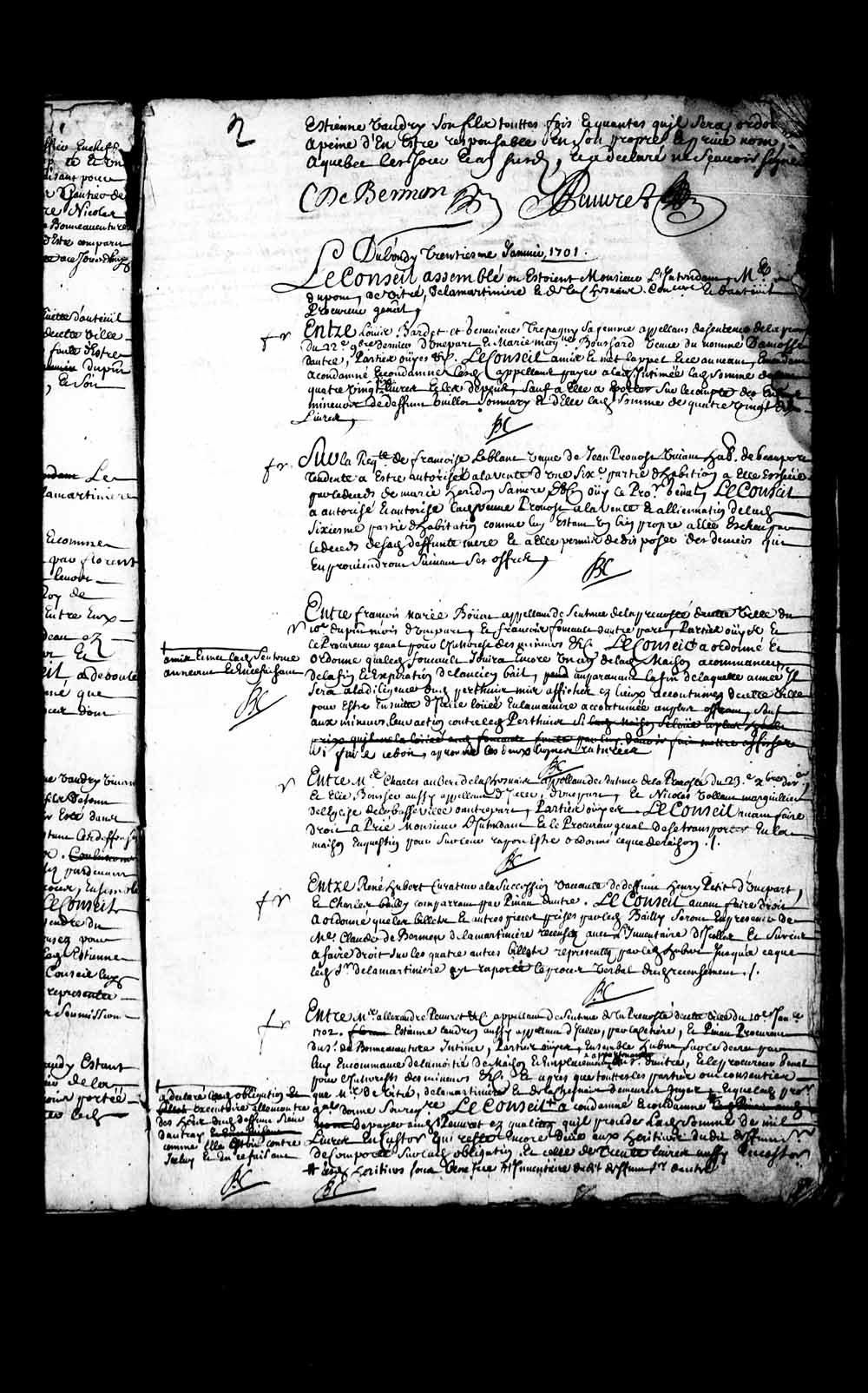
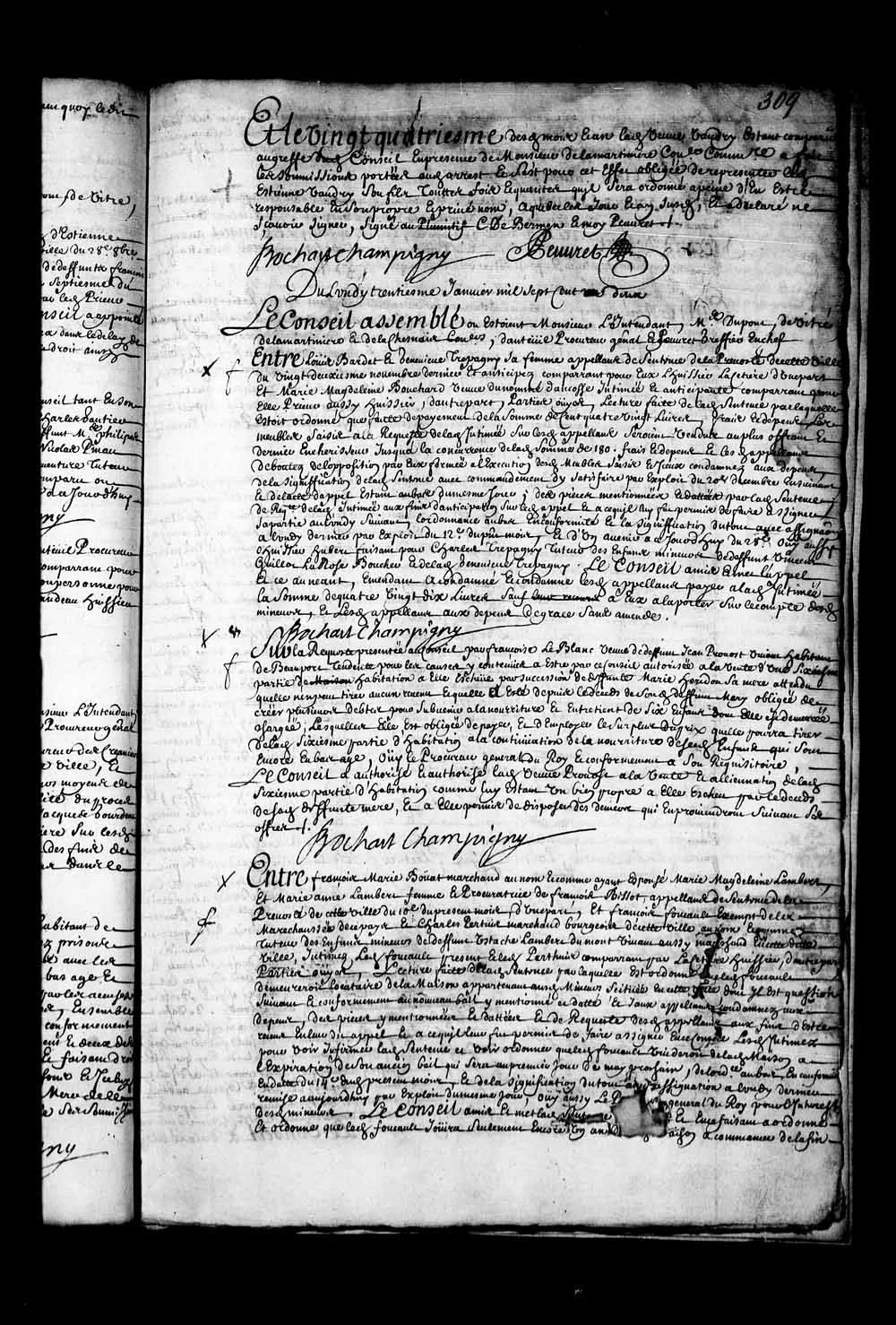
They are the same session, the same petitioner, the same relief granted. One is a summary minute, the other the fuller engrossed entry. Cite both if you want the record complete; count one. Two copies of a decision corroborate nothing, any more than two printings of a book corroborate its contents.
And one of them is misdated
Having established that the volumes are not independent, we get something better than corroboration out of the pair: a correction.
The shorter volume is headed, in plain arabic numerals, 1701. The fuller volume was headed mil sept cent un and then struck through and corrected to deux—a clerk catching himself in the ordinary January slip of writing the outgoing year.
Which is right? The documents themselves supply the answer, in a detail neither clerk thought he was recording. Both headings begin Du Lundy—Monday.
| Date | Day of the week | Verdict |
|---|---|---|
| 30 January 1701 | Sunday | The Conseil did not sit; the heading is impossible |
| 30 January 1702 | Monday | Consistent with both headings |
The session is 30 January 1702. The correction in the second volume was right, and the first volume's heading is an uncorrected error that a researcher using only that volume would have carried away.
The test
Count witnesses by source string, not by citation. Two records of one event, however differently they are catalogued, are one witness to it.
And test internal dates against something outside the document. Weekdays, regnal years, liturgical calendars and feast days are all cheap to check and they will not defer to a clerk's mistake the way a second copy of the same clerk's mistake will.
A coda: the name that is wrong
Both volumes name the mother from whom Françoise inherited. Both write her as Marie Heridon.
There was no Marie Heridon. The register is simply wrong, in both copies, and the modern catalogue transcription reproduces the error faithfully because a transcription's job is to reproduce what is there.
What makes the identification secure is everything except the name: Françoise Leblanc, widow of Jean Prévost, habitants of Beauport, inheriting a fractional share of an habitation from her deceased mother. Four elements, all matching, none of them the surname.
"Sur la Requeste presentée au Conseil par Françoise Le Blanc veufve de deffunct Jean Prevost vivant habitant de Beauport, tendante… à estre par ce Conseil autorisée à la vente d'une sixiesme partie d'habitation à elle escheue par succession de deffuncte Marie Heridon sa mere, attendu qu'elle n'en peut tirer aucun revenu et qu'elle est depuis le decedz de son deffunct mary obligée de créer plusieurs debtes pour subvenir à la nourriture et entretient de six enfans dont elle est demeurée chargée…"
— Conseil souverain, arrêt of 30 January 1702The test
An identification is sound when the elements that carry it are sound—not when every element in the record is. Ask which facts are doing the work. If a surname is the only thing linking a record to your subject, you have one thread. If everything but the surname matches, you have a corrupt name and a secure identification, and the honest write-up says both.
The other directionWhat a record settles that no search can
It would be a poor lesson to leave researchers treating every document as a trap. Sometimes a record does the opposite—it closes a question that no amount of searching could have closed.
There is no marriage contract for Léonard Leblanc and Marie Riton. A researcher could work through Paul Vachon's greffe act by act, and through every other notary practising near Québec in 1650, and record a negative search of impeccable extent, and still be left with the usual weak conclusion: none found.
The 1674 inventory says it outright. Explaining why the dower had to be handled as it was, the notary wrote that it was
"…à cause qu'il n'y avoit aucun contract de mariage entre le dit Leblanc [et la dite défuncte]."
— Inventaire après décès of Marie Riton, Paul Vachon, 4 November 1674Not not found. Never made—stated in a contemporary act, by the officer who would have drawn it, in the course of doing something else. That is stronger than any negative search can ever be, and it costs nothing but reading the act you already have all the way through.
The test
Before logging a negative search, ask whether some record in hand already answers the question affirmatively. Notarial acts in particular are full of recitals—explanations of why a thing is being done a certain way—and those recitals routinely settle questions that the act is not ostensibly about.
The working rule
Four failures, four tests. Written out as a procedure, they are what this practice applies to every claim before it reaches a published page.
- Cite the register, not the index. Names may come from a database card, because that is what makes a record findable. Ages, origins, occupations and relationships come from the original, or they do not appear.
- Test every datum against the whole file. Reaching the original is the start of the work. A figure that cannot be reconciled with the rest of the evidence is recorded as a conflict, not quietly dropped or quietly preferred.
- Count witnesses by source string. Two catalogue entries, two piece numbers, two volumes and two citations may all be one witness. Ask what the independent acts of observation were, and count those.
- Read the whole act, including the boring parts. The recitals explaining why a thing is being done contain the facts nobody set out to record—and those are frequently the ones that settle a question outright.
None of this makes a file safe. Marie Riton's age in February 1660 is still unexplained, and this study does not pretend otherwise. What the procedure does is make the remaining uncertainty visible, which is the difference between a conclusion a reader can evaluate and a conclusion a reader has to trust.
Sources
- Confirmation, 24 February 1660 — Registre des confirmés et des abjurations, Québec, 1649-1663, p. 23, entry 13. Compare PRDH-IGD no. 403669.
- Abjuration, 29 June 1645 — Archives départementales de la Charente-Maritime, cote I 171-173, La Rochelle, collection du greffe, pastoral, abjurations 1643-1648, p. 2 of 5; digital images, Archinoë.
- Baptism of Marie, daughter of Marie Riton, November 1644 — Archives départementales de la Charente-Maritime, non coté, Ars-en-Ré, collection communale, paroissial, baptêmes 1638-1648, p. 111 of 176; digital images, Archinoë.
- Marriage, 23 August 1650 — Notre-Dame-de-Québec, registre 1621-1671.
- Census of Canada, 1666 — Archives des Colonies, Série G1, vol. 460, 1re partie, Beauport.
- Inventaire après décès of Marie Riton, 4 November 1674 — Paul Vachon, greffe 1655-1693, Bibliothèque et Archives nationales du Québec, 03Q,CN301,S266; BAnQ numérique document 4215636, viewer images 229-237.
- Arrêt of the Conseil souverain, 30 January 1702 — Fonds Conseil souverain, Archives nationales à Québec: TP1,S28,P7216 and TP1,S28,P6755. Two volumes of one decision.
- PRDH-IGD (Université de Montréal), consulted in the French interface. Card images are not reproduced on this site; records are cited by number and transcribed.
Research note: The claims in this study are held to a stated evidence tier and every withdrawn claim remains on the record in the project's research log, with a number and a date, rather than being silently removed. One conclusion in Marie Riton's file was withdrawn in the course of preparing this page: an earlier reading that accepted the database's "La Rochelle" against the register. It is logged as MR-W-01.