
Two Families the Trees Merged

The Challenge
On January 21, 1839, Father François Norbert Blanchet performed a long sequence of marriages at the Willamette mission — regularizing, in a single ceremony, the country unions of the French-Canadian and Métis families of French Prairie. Two of those marriages have been mistaken for one ever since.
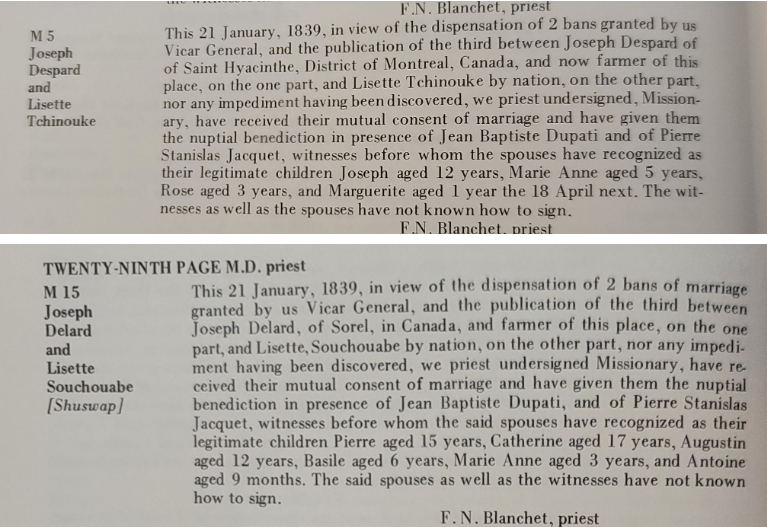
In marriage entry M15, Joseph Delard, “of Sorel, in Canada,” married Lisette Souchouabe — a Shuswap woman. In a separate entry, M5, Joseph Despard, of Saint-Hyacinthe, married Lisette Tchinouke — a Chinook woman. Two grooms, two brides, two nations, two sets of children, two origin parishes — recorded on the same day by the same priest.
Unsourced public trees collapse Delard and Despard into a single family — treating “Despard” as a mere spelling variant of “Delard,” and merging the two Josephs and the two Lisettes into one couple.
They are not variants. They are two distinct families, kept separate throughout the original register and indexed separately in the published Munnick volumes.
As a consequence of the merge, Joseph Delard’s wife Lisette is commonly assigned a Chinook identity — and, in some trees, made a daughter of the Chinook head chief Comcomly.
That Chinook identity belongs to the other Lisette — Lisette Tchinouke, Joseph Despard’s wife. Joseph Delard’s wife was Shuswap, and her baptism names no parents at all.
The consequence is not cosmetic. It erases the documented Shuswap identity of a real woman and replaces it with a borrowed Chinook one — and it grafts a prestige bloodline, Comcomly’s, onto a family it never touched. Every descendant who relies on these trees inherits the wrong nation, the wrong mother-in-law, and the wrong children.
Nothing in the original 1839 register supports the conflation. The merge exists because two families who married on the same day, sharing a groom’s given name and a bride’s given name, were copied together from tree to tree without anyone returning to the record that had kept them apart all along.
The Breakthrough
M15: Joseph Delard, of Sorel, married Lisette Souchouabe. The legitimation clause names their children by age: Pierre (15), Augustin (13), Basile (6), Marie Anne (3), Antoine (9 months).
M5: Joseph Despard, of Saint-Hyacinthe, married Lisette Tchinouke. Their children: Joseph (12), Marie Anne (5), Rose (3), Marguerite (1) — a wholly different set, several baptized in their own entries (B22, B57).
Different origin parishes. Different children. Different bride’s nation. The published Munnick index keeps “Delard” and “Despard” as separate surname blocks — the archive’s own editor never merged them.
Lisette Souchouabe (Shuswap), Joseph Delard’s wife, baptized aged 32 in 1839, died February 1841 and was buried at St. Paul. Munnick lists her surviving children: Catherine, Pierre, Augustin, Basile, Marie Anne, Antoine.
Lisette Tchinouke (Chinook), Joseph Despard’s wife, recorded as Marie Anne “Stients,” died March 26, 1865 at St. Paul — twenty-four years later, a different nation, a different husband.
Two women, two nations, two deaths a generation apart. The Chinook identity — and any connection to Comcomly — belongs to the woman who died in 1865, not to the Shuswap woman who died in 1841. Her baptism (B38) records her simply as born of “infidel parents, Indians of Souchoabe,” naming no father and no mother.
With the couple correctly identified, Joseph Delard’s own ancestry runs, generation by generation, from the Willamette Valley back to a single parish in France — each step resting on a record in hand.
The Québec record falls silent on Joseph after his 1792 baptism — no marriage, no burial there — exactly what one expects of a man who married and died in Oregon. The two records meet with no overlap and no contradiction: a clean handoff from Sorel to the Columbia.
On the immigrant’s wife’s side, the line carries seventeenth-century Québec depth through the Therrien, Jahan Laviolette, and Trépanier families (PRDH-IGD #12544, #5760), reaching the founding-era marriages of the Île d’Orléans parishes.
The Result
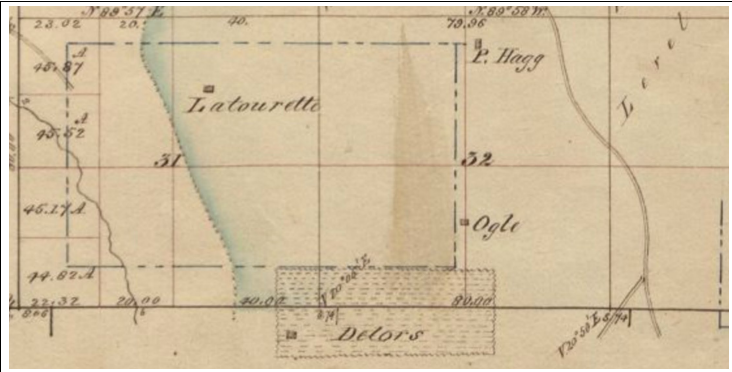
Joseph Delard was baptized at Sorel in 1792, arrived in the Oregon Country by 1815, and died at St. Louis, Marion County, in 1869. His first wife, Lisette Souchouabe, was a Shuswap woman — her nation named in her own baptism, her death recorded at St. Paul in 1841, her six children enumerated in the mission record. After her death he married a second time, to Marie Toussaint Poirier, in 1843. The two marriages and their two sets of children are kept distinct in the record; only the trees confuse them.
Joseph and Lisette’s son Augustin Delard — known in Oregon by the nickname “Quine,” the source of the variant “Augustin Quine Delore” — married Zoé Quintal at St. Louis Church in Marion County on August 25, 1857. The marriage record names both parent-couples in a single entry: Augustin as the legal son of Joseph Delard and Lisette, and Zoé as the daughter of Laurent Quintal and Marie Anne Nipissing. In one document, two documented fur-trade families are joined — and this couple links directly to the Quintal–Nipissing line traced elsewhere in these pages.
What the record gives for Lisette is considerable: her nation (Shuswap), her approximate birth (about 1806–07, from her stated age at baptism), her 1839 baptism and marriage, her 1841 death, and the six children who survived her. What it does not give is the names of her own parents — her baptism records her as born of non-Christian parents of the Shuswap nation, without naming them, as was typical for an Indigenous woman entering the sacramental record as an adult. Her ancestry reaches an honest limit there. It does not reach Comcomly; that was always a different woman’s family.
The conflation corrected here is a textbook example of how Métis and fur-trade genealogies go wrong: a shared given name, a shared community, a single ceremony, and a record read in fragments rather than in full. The uncorrected version does more than misfile two couples. It strips a Shuswap woman of her documented nation and hands her a Chinook chief’s lineage that belonged to her namesake at the same wedding. The original register kept them apart. The correction only required reading it.
The surname appears across Oregon records as Delard, Delore, Delor, Delart, and Dellart, and the family is sometimes indexed under the trade name “Peter.” None of these should be confused with Despard — a genuinely separate family from Saint-Hyacinthe, whose wife Lisette Tchinouke was Chinook. The distinction between a spelling variant of one surname and the surname of a different family is precisely what the conflation missed.
The document-by-document analysis behind this case study — including the M5 and M15 register entries, both Lisettes’ death records, the PRDH citations tracing the Delard line to France, and the complete evidence base for separating the two families — is available in the full methodology.
Full Methodology The Free Man of the Prairies The Guilbault Line